There is a mystery in the Moon that has resisted explanation for decades, written not in craters or plains but in the faint magnetization of ancient rocks. The Moon today has no global magnetic field, yet samples returned by Apollo astronauts carry a magnetic memory that should not exist—or at least, should not exist in the pattern scientists have observed. Two new studies, using samples from opposite sides of the Moon, are deepening the puzzle rather than resolving it.
The first clue comes from Apollo samples analyzed by researchers at the University of Oxford. Their findings, published in Nature Geoscience, suggest that the Moon's magnetic field was weak for most of its history but experienced brief, intense bursts of strength lasting no more than a few thousand years—possibly as short as a few decades . The Apollo missions, it turns out, happened to land in a region rich in titanium-bearing basalts that recorded these rare events, creating a sampling bias that misled scientists for decades.
Lead author Claire Nichols explained the implication: "Our new study suggests that the Apollo samples are biased to extremely rare events that lasted a few thousand years—but up to now, these have been interpreted as representing 0.5 billion years of lunar history" . The mechanism, the team proposes, involved melting of titanium-rich material at the Moon's core-mantle boundary, which could have temporarily generated a strong dynamo effect.
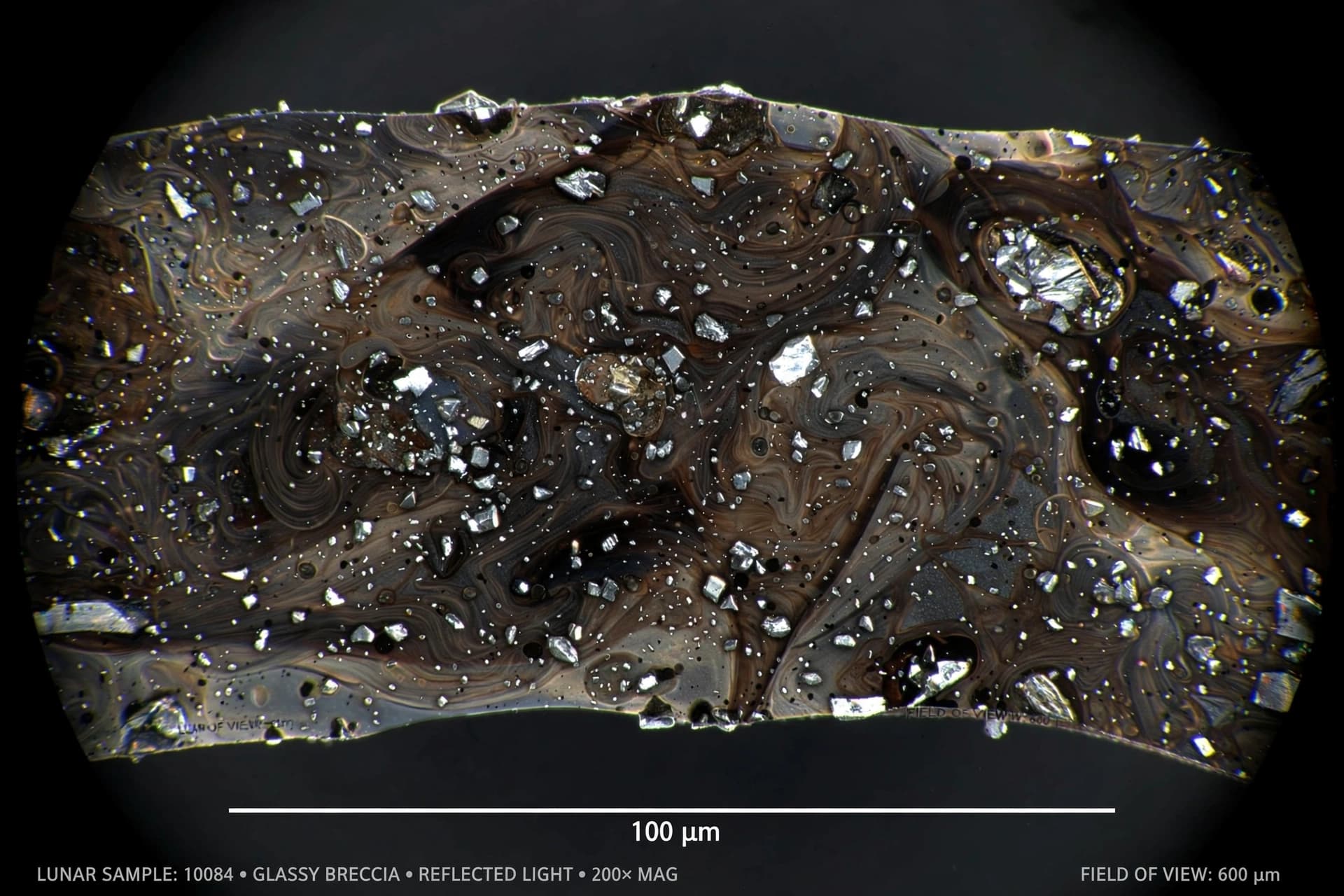
A second line of evidence comes from a different source entirely: lunar soil returned by China's Chang'e-6 mission from the far side of the Moon. Researchers at the Chinese Academy of Sciences identified a form of iron—face-centered cubic γ-Fe—that has never before been found in natural lunar samples . This iron phase is stable only at high temperatures and should transform into a different structure as it cools, yet it was preserved in impact glass, shielded by rapid cooling and a glassy matrix .
What makes γ-Fe significant is its magnetic behavior. Using off-axis electron holography, the team found that larger γ-Fe nanoparticles formed a stable single-vortex magnetic state, maintaining a stable response under external magnetic fields . This suggests that γ-Fe may be a previously unrecognized recorder of magnetic information in lunar materials, one that preserves signals differently from the iron phase scientists have traditionally studied .
Together, the two studies complicate a picture that was already uncertain. The Moon's magnetic field, according to current understanding, was active from about 4.2 to 3.5 billion years ago, then declined significantly by 3.1 billion years ago, possibly ceasing entirely around 1 billion years ago . But Chang'e-6 samples dated to 2.8 billion years ago showed a surprising rebound in field strength, measuring between 5 and 21 microteslas—stronger than models predicted for that era .
The Oxford team's titanium correlation offers one explanation for the Apollo anomalies: brief dynamo bursts triggered by deep melting events. The γ-Fe discovery offers another avenue entirely: a magnetic recorder that may preserve signals from impact events, which could be transient and localized rather than global. Both possibilities point to a Moon whose magnetic history was more episodic and more complex than a simple story of gradual decline.
The upcoming Artemis missions, which will return samples from different lunar regions, may help resolve the question. "If we were aliens exploring the Earth, and had landed here just six times, we would probably have a similar sampling bias," said Jon Wade, a co-author of the Oxford study . The Moon, it seems, has been hiding its magnetic history in places we did not think to look—and in minerals we did not know could remember.
AI Image Disclaimer: The visuals accompanying this report were created using artificial intelligence and are not photographs of actual lunar samples.
Sources: University of Oxford, Chinese Academy of Sciences (CAS), PNAS, Nature Geoscience, EurekAlert!, Hefei Institutes of Physical Science
Published by Banx Network. This article is part of the Banx decentralized media programme, powered by the BXE token on the XRP Ledger.