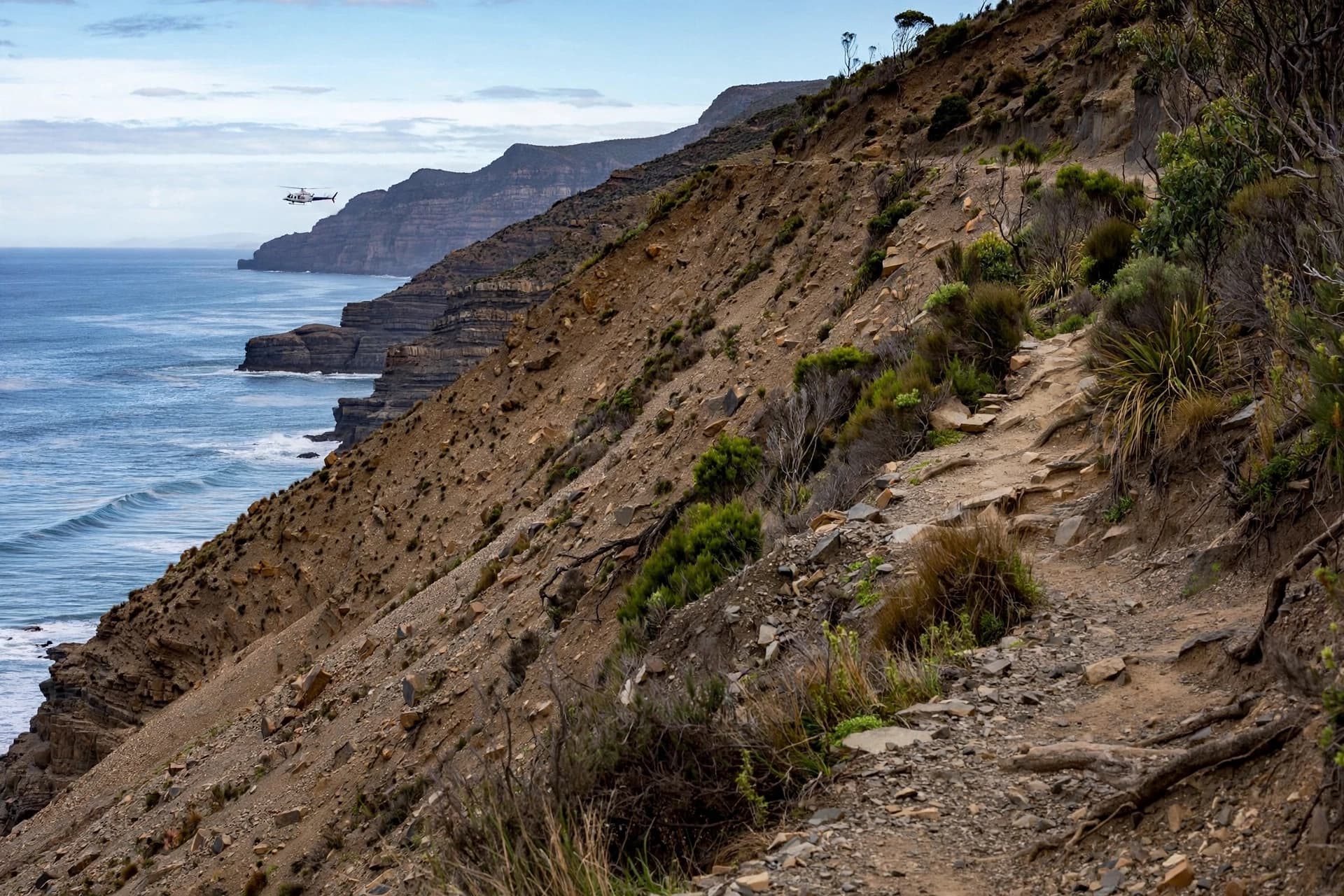
There is a particular kind of luck that attends a fall on a coastal cliff—a luck measured not in the distance fallen but in the place where the falling stops. On Saturday morning, a 62-year-old man from New South Wales was walking alone on a track at Dennes Point on North Bruny Island when he slipped and tumbled about ten meters down a steep, unstable slope toward the water. He was not injured. He came to rest at the top of a further 40-meter cliff. And then he did the thing that search-and-rescue teams wish every walker would do: he stopped, took out his phone, and called for help .
The call came in around 10:30 a.m. Police attended the scene shortly afterward, but the terrain required more than a ground response. A specialist police roping team was dispatched in the Westpac Rescue Helicopter. By about 1 p.m., the man had been secured and lifted to safety. He walked away without injuries. Senior Constable Callum Herbert of Search and Rescue described the outcome as "lucky," noting that an attempt at self-rescue "may have resulted in him falling further and could have had a catastrophic outcome" .
That same afternoon, a second rescue unfolded on the opposite side of the state. In the remote Tyndall Range on Tasmania's west coast, a 44-year-old man on a day walk with two companions became too ill to continue. The group was equipped for overnight camping and carried a personal locator beacon. Around 3 p.m., they activated it and contacted emergency services via satellite. The Westpac Rescue Helicopter located the group and transported the man to Royal Hobart Hospital for assessment .
The two incidents, occurring within hours of each other and requiring the same helicopter, prompted Tasmania Police to issue a renewed safety warning. The advice was tiered according to the environment. For short, accessible walks like the one on Bruny Island, a fully charged mobile phone may be sufficient—provided there is reception. For remote areas like the Tyndall Range, where mobile coverage cannot be relied upon, a personal locator beacon is essential. Inspector Steve Jones said the incidents were a reminder for bushwalkers in remote areas to carry "sufficient food, water, communication equipment and emergency shelter for unexpected delays" .
What makes these two rescues notable is not the danger itself—Tasmania's wilderness is well known for it—but the decisions that turned potential tragedies into successful operations. The Bruny Island walker recognized that the ground beneath him was unstable and that climbing back up was a risk he should not take alone. The Tyndall Range group had the right equipment, knew how to use it, and used it early. Neither group waited until the situation became critical. Neither group tried to push through .
Tasmania's landscapes attract visitors from around the world because of their dramatic beauty. The same terrain that makes them beautiful also makes them dangerous: steep slopes, loose gravel, rapid weather changes, and long distances between help and the people who need it. The message from police is not that people should stay home. It is that they should carry the tools that turn an emergency into a rescue. A charged phone. A personal locator beacon. Enough supplies to wait. And the willingness to call for help before the situation becomes one that no device can fix.
AI Image Disclaimer: The images accompanying this article were generated by artificial intelligence and are for illustrative purposes only.
Sources: Australian Broadcasting Corporation, Tasmania Police, Pulse Tasmania, OZ Arab Media, BrightWire
Published by Banx Network. This article is part of the Banx decentralized media programme, powered by the BXE token on the XRP Ledger.