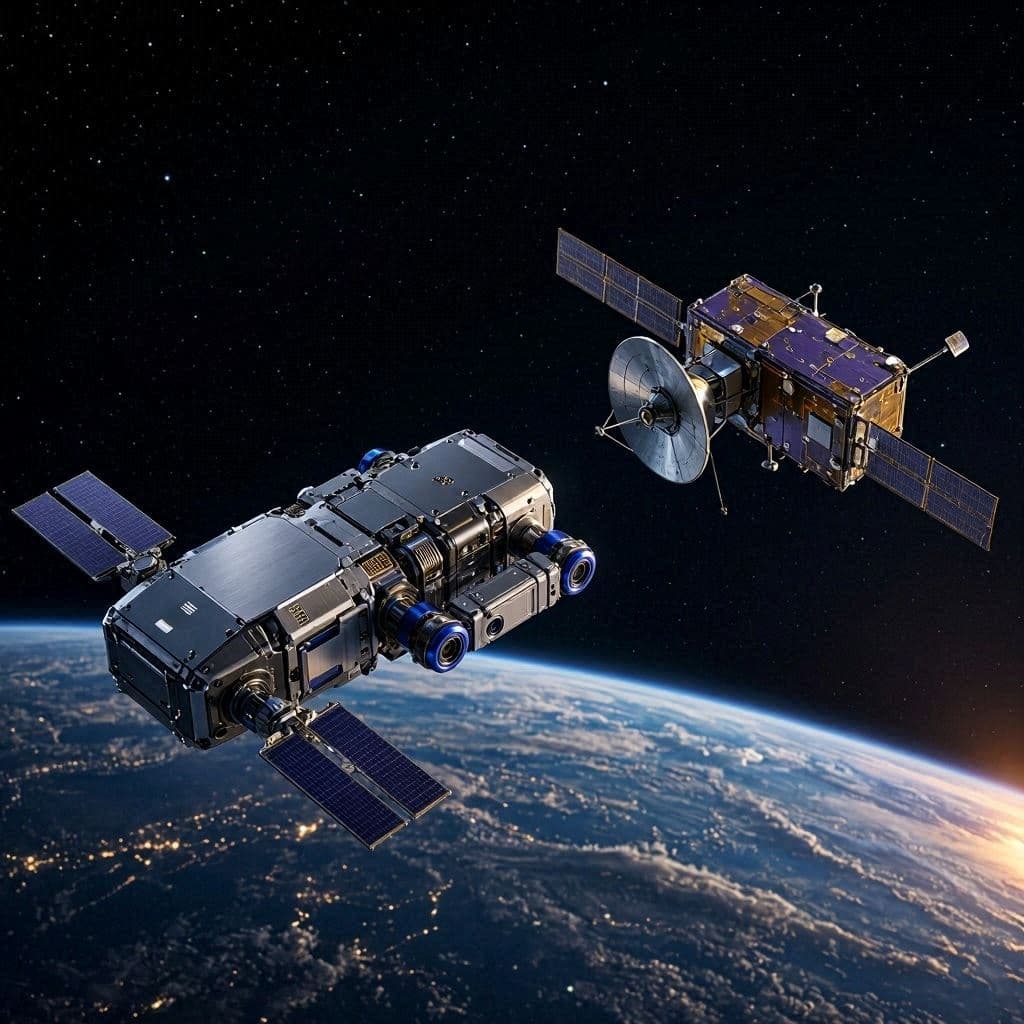
In the silent, star-dusted expanse above our heads, a new era of stewardship is quietly unfolding. For decades, satellites have been launched into orbit with a sense of finality, destined to drift as space junk once their fuel ran dry or their systems failed. But now, a sophisticated mechanical envoy has arrived to challenge that narrative of obsolescence, offering a gentle promise that our technological companions in the sky can be cared for, repaired, and extended in their service.
This mission represents more than just engineering prowess; it is a shift in philosophy, moving from a culture of disposal to one of sustainability. As we look up at the night sky, we are no longer just observers of distant lights but participants in a delicate dance of maintenance and preservation, ensuring that the infrastructure of modern life remains intact among the stars.
Body: The satellite in question, often identified in recent reports as part of Northrop Grumman’s Mission Extension Vehicle (MEV) program or similar advanced servicing initiatives like ClearSpace’s upcoming missions, represents the pinnacle of orbital robotics. These vehicles are designed to dock with aging satellites, taking over their propulsion and attitude control to keep them operational long past their original design life. It is a feat of precision that requires navigating the vacuum of space with millimeter accuracy.
Unlike traditional spacecraft, these servicers are built with modular flexibility and advanced autonomous systems. They can approach a client satellite, grapple it securely, and then act as its new engine and guidance system. This capability transforms a potential piece of debris into a valuable asset, extending the economic and functional life of critical communications and weather monitoring tools that society relies upon daily.
The technology behind these missions involves complex sensors, robotic arms, and artificial intelligence algorithms that allow the servicer to match the rotation and trajectory of its target. This "cosmic handshake" is one of the most difficult maneuvers in spaceflight, requiring split-second calculations and flawless execution. The success of such operations paves the way for a future where satellites are not just launched but maintained, much like aircraft or ships.
Beyond life extension, the next generation of servicing satellites aims to perform more intricate tasks, such as refueling, repairing broken components, or even upgrading software and hardware in orbit. This evolution suggests a future where space infrastructure is dynamic and adaptable, reducing the need for costly and environmentally taxing new launches. It is a step toward a circular economy in space, where resources are preserved and waste is minimized.
The implications for space sustainability are profound. With thousands of satellites currently in orbit and many more planned, the risk of collision and debris generation grows. Servicing missions offer a proactive solution, removing defunct objects or keeping them functional so they do not become hazards. This responsible approach aligns with international efforts to preserve the orbital environment for future generations.
As private companies and government agencies collaborate on these technologies, the barrier to entry for space services is lowering. This democratization of access could lead to a vibrant industry of orbital mechanics, where specialized firms offer repair and maintenance services to satellite operators worldwide. The sky, once a frontier of exploration, is becoming a neighborhood of managed assets.
Closing: The arrival of advanced robotic servicers marks a mature chapter in humanity’s relationship with space. It is a testament to our ability to innovate not just in reaching for the stars, but in caring for what we have already placed there. As these mechanical guardians go about their work, they remind us that sustainability is not just an earthly concern but a celestial imperative.
AI Image Disclaimer: Please note that any visual illustrations accompanying this text are AI-generated interpretations designed to evoke the thematic context of space technology and do not depict actual photographs of specific proprietary satellites or real-time docking procedures.
Sources: Northrop Grumman SpaceNews BBC Science Focus ClearSpace
Published by Banx Network. This article is part of the Banx decentralized media programme, powered by the BXE token on the XRP Ledger.