
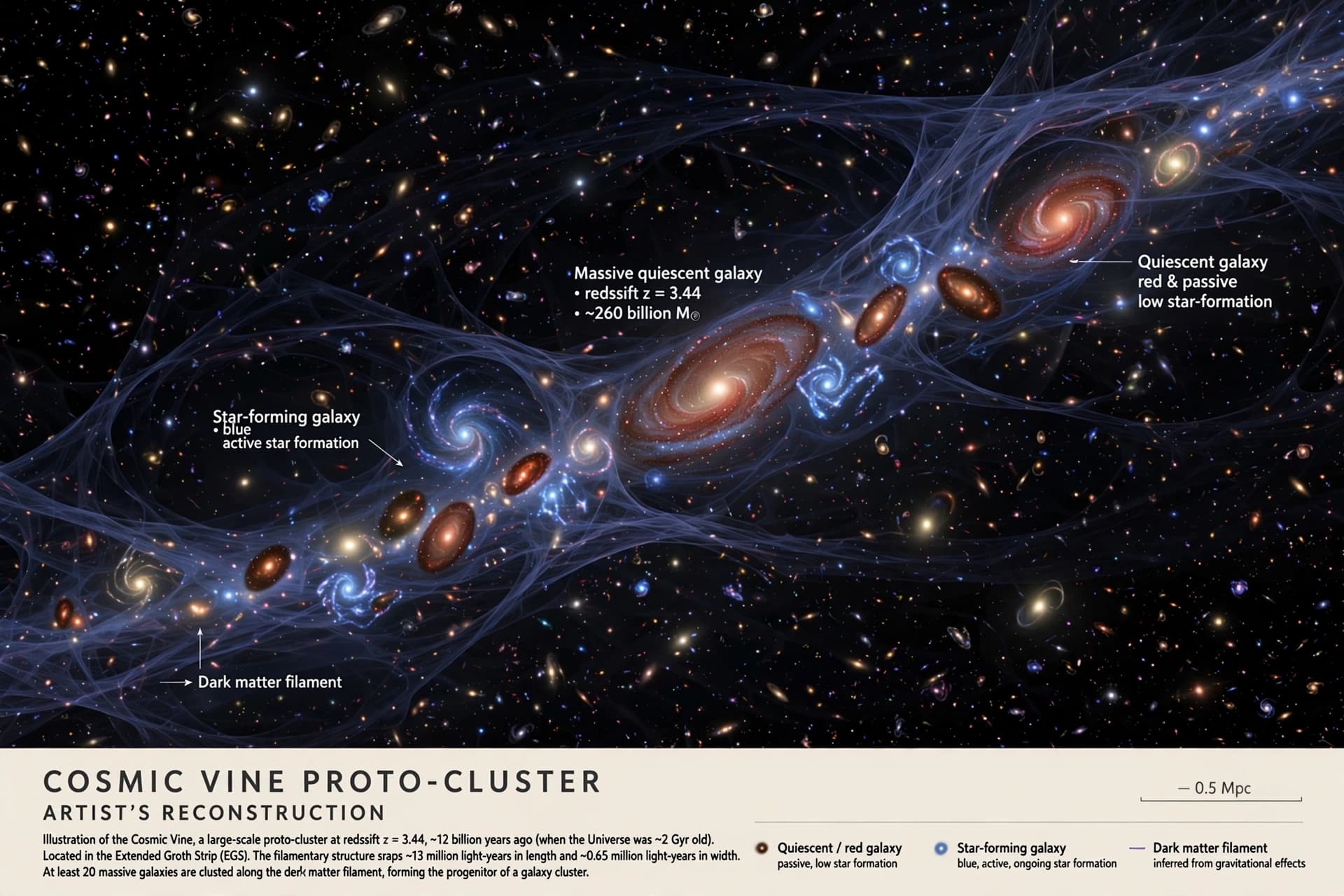
There is a particular kind of mystery that deepens the more we look at it—a discovery that does not simply add a new object to our catalog of the cosmos but instead questions the assumptions we brought to the search. The James Webb Space Telescope has delivered such a finding: a massive cosmic structure, observed when the Universe was less than a billion years old, that appears far more mature than current models of cosmic evolution would predict.
The structure, known as the “Cosmic Vine,” is a proto-galaxy cluster discovered in 2023. It resembles its namesake—galaxies clustered along a central filament like grapes on a vine, stretched across an expanse 4.7 by 3.0 million light-years wide . Astronomers expected to find young, actively star-forming galaxies in such an early structure. Instead, an international team led by researchers at the Cosmic Dawn Center in Copenhagen found something surprising: eleven “dead” galaxies—quiescent systems that have already stopped forming new stars .
This is the largest known sample of quiescent galaxies ever discovered in such a young structure. Even more remarkable, when researchers plotted the galaxies by color and brightness, they found a clear “red sequence”—a tight band of red, non-star-forming galaxies normally seen only in mature clusters in the nearby, modern Universe . “The large population of quiescent galaxies tells us the Cosmic Vine is maturing faster than expected for a structure this young,” said Shuowen Jin, a Marie Skłodowska-Curie fellow at DAWN .
The Cosmic Vine is seen as it was just 1.8 billion years after the Big Bang—about 13 percent of the Universe’s current age. The team confirmed 136 galaxies as members, identifying four distinct substructures plus two foreground groups nicknamed the Cosmic Leaf . The proto-cluster core contains ten times more dark matter than any of the smaller subgroups, suggesting it is on track to become one of the most massive clusters in the early Universe .
The discovery adds to a growing pattern of early-maturity anomalies. In January, NASA’s Chandra X-ray Observatory and Webb jointly identified JADES-ID1, a protocluster with a mass of 20 trillion Suns seen just one billion years after the Big Bang—one to two billion years earlier than models predicted possible . “The universe was in a huge hurry to grow up,” said Akos Bogdan of the Harvard-Smithsonian Center for Astrophysics, who led that study .
These findings do not overturn the standard model of cosmology, but they challenge its timelines. The mechanisms by which galaxies cease star formation—feedback from supermassive black holes, environmental effects, or internal processes—apparently operated far more efficiently in the early Universe than simulations suggest. The James Webb Space Telescope, with its infrared sensitivity and resolution, has opened a window into an era that was previously inaccessible, and what it reveals is a cosmos that assembled its largest structures with startling speed.
AI Image Disclaimer: All images associated with this report were generated using artificial intelligence and serve illustrative purposes only, not as astronomical data or documentary records.
Sources: Niels Bohr Institute, NASA, Chandra X-ray Observatory, Agerpres, Universe Today, Universe Space Tech
Published by Banx Network. This article is part of the Banx decentralized media programme, powered by the BXE token on the XRP Ledger.



