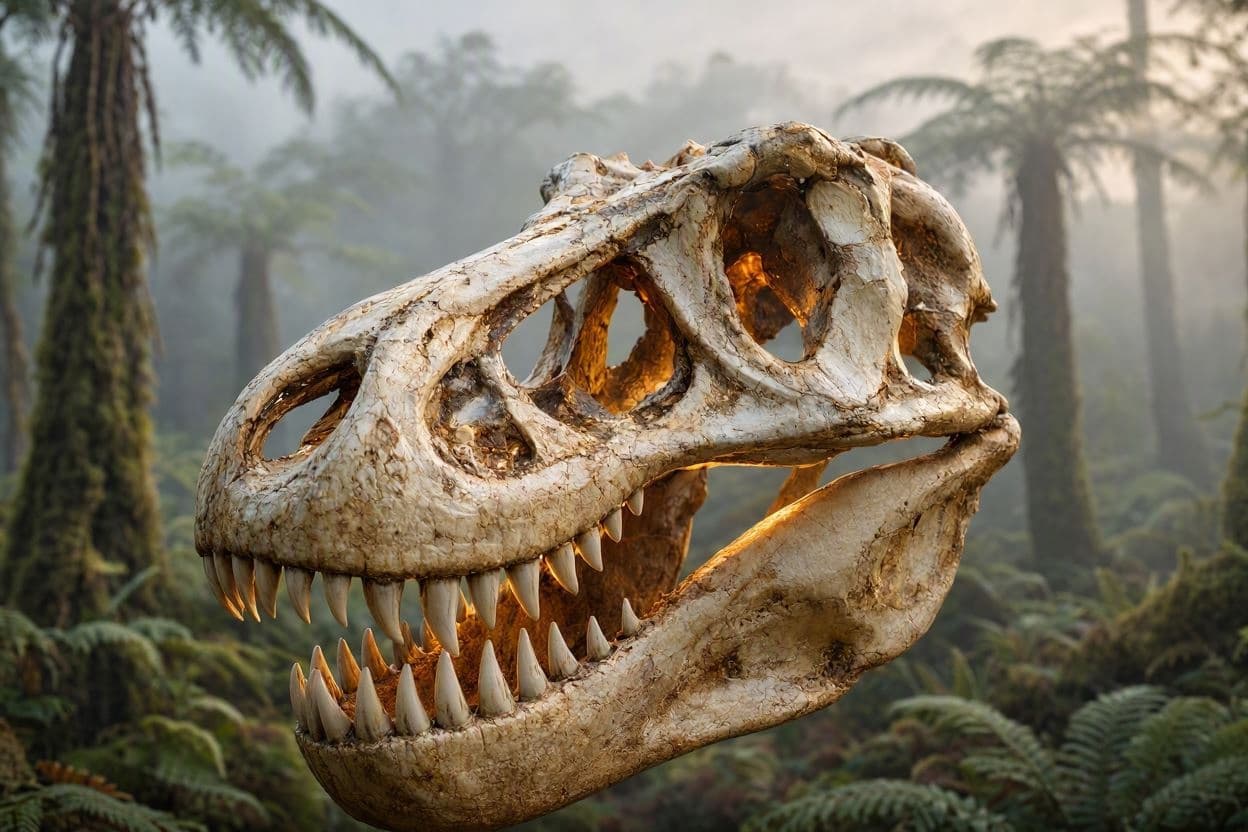
For decades, the image of the Tyrannosaurus rex has been dominated by the cold, reptilian gaze of a creature driven purely by instinct and ambient heat. We imagined it as a sluggish giant, waiting for the sun to warm its massive frame before launching into a hunt. Yet, recent scientific inquiries have begun to peel back the layers of this prehistoric narrative, suggesting that the king of the dinosaurs may have possessed a warmth not unlike our own. This shift in understanding does not merely change how we view a fossil; it alters the very atmosphere of the Mesozoic era, painting it as a world pulsing with internal energy rather than one governed solely by the external climate.
The study in question utilizes advanced geochemical techniques to analyze the isotopic composition of fossilized teeth and bones. By examining the ratios of oxygen and carbon isotopes, researchers can estimate the body temperature at which these tissues formed. The results indicate that T. rex maintained a stable, high body temperature, remarkably similar to that of modern mammals. This finding challenges the long-held dichotomy between cold-blooded reptiles and warm-blooded mammals, suggesting a more complex evolutionary spectrum where gigantothermy or even endothermy played a crucial role.
This physiological insight reshapes our understanding of the dinosaur’s daily life. A warm-blooded predator requires significantly more energy than a cold-blooded one, implying that the T. rex was not merely an ambush hunter but an active, metabolically demanding creature. It likely needed to consume vast amounts of food to sustain its internal furnace, driving it to be a more persistent and perhaps more social animal than previously thought. The sheer caloric requirement would have dictated its movement patterns, territorial range, and interaction with other species.
Furthermore, this discovery bridges a gap in evolutionary biology. It suggests that the traits we associate with mammals—such as high metabolic rates and temperature regulation—may have deeper roots in the archosaur lineage than once believed. The T. rex, therefore, becomes a cousin in spirit if not in direct ancestry, sharing a biological kinship with the warm creatures that now dominate the planet. This connection invites a more empathetic view of these ancient beasts, seeing them not as alien monsters but as vibrant, living entities with complex biological needs.
The methodology used in this study represents a significant leap forward in paleontology. Traditional bone analysis often provided limited insights into soft tissue functions or metabolic rates. However, isotopic thermometry offers a window into the physiological processes of extinct animals, allowing scientists to reconstruct their internal environments with unprecedented accuracy. This technique is not without its challenges, as diagenesis—the chemical changes fossils undergo over millions of years—can skew results. Yet, rigorous controls and cross-referencing with other data points have strengthened the validity of these findings.
Critics of the endothermic dinosaur hypothesis have long argued that large body size alone could retain heat, a phenomenon known as gigantothermy. While this is a valid consideration, the specific temperature ranges identified in the T. rex samples exceed what would be expected from passive heat retention alone. The data suggests an active regulatory mechanism, pointing toward a level of physiological sophistication that rivals modern birds and mammals. This nuance is crucial, as it moves the debate from a binary choice to a spectrum of thermal strategies.
As we continue to uncover these details, the T. rex transforms from a static museum exhibit into a dynamic organism. We begin to imagine it breathing heavily after a chase, its heart pounding with the same rhythmic urgency as a lion or a wolf. This humanization of the dinosaur, grounded in hard science, allows us to connect with the deep past on a more intimate level. It reminds us that life, in all its forms, strives for stability and vitality, regardless of the epoch.
The revelation that Tyrannosaurus rex likely possessed a mammal-like body temperature enriches our understanding of evolutionary history. It underscores the adaptability of life and the diverse strategies organisms employ to thrive. As research continues, we may find that the line between reptile and mammal is far more blurred than we once imagined, inviting us to view the ancient world with renewed wonder and scientific curiosity.
AI Image Disclaimer: Please note that any accompanying visuals are AI-generated interpretations designed to illustrate the scientific concepts discussed.
Sources: Nature Science Daily Yale University News Smithsonian Magazine
Published by Banx Network. This article is part of the Banx decentralized media programme, powered by the BXE token on the XRP Ledger.