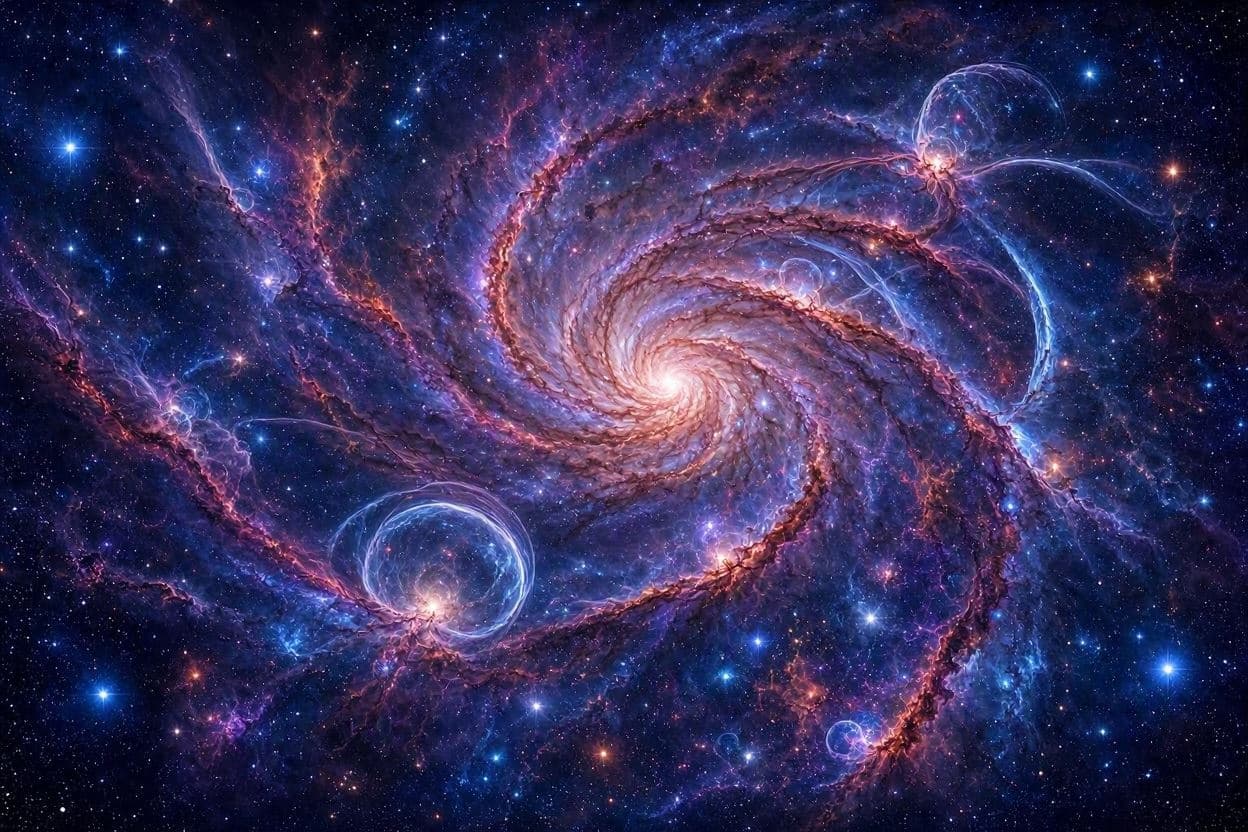
In the vast, swirling arms of the Andromeda galaxy, a silent chaos has long puzzled astronomers. It is a turbulence that shapes the very structure of stars and gas, yet its source remained hidden in the cosmic dust. Now, through a remarkable collaboration between Chinese and American observatories, the veil is lifting, revealing that the violent deaths of stars may be the architects of this galactic disorder.
A recent study published in Nature Astronomy has provided compelling evidence that supernovae are the primary drivers of turbulence in the disk of the Andromeda galaxy (M31). Led by researchers from Tsinghua University in collaboration with partners in the United States, the team utilized high-resolution data to map the movement of gas and stellar populations. Their findings suggest that "superbubbles"—vast cavities created by multiple supernova explosions—inject enough energy to stir the galactic medium on a massive scale.
For decades, scientists debated whether this turbulence was caused by gravitational interactions, magnetic fields, or stellar winds. The new observations point decisively toward supernovae. By analyzing the kinematics of neutral hydrogen and ionized gas, the team identified patterns consistent with the shockwaves from these stellar cataclysms. These shockwaves do not just disperse material; they compress it, triggering new waves of star formation in a cyclical dance of creation and destruction.
The collaboration leveraged the unique strengths of both nations’ astronomical infrastructure. Chinese telescopes provided detailed spectral data, while American facilities contributed advanced imaging capabilities. This synergy allowed for a more comprehensive view of Andromeda’s internal dynamics than either could have achieved alone. It stands as a testament to the power of international scientific cooperation in unraveling the universe’s deepest mysteries.
Andromeda, our nearest large galactic neighbor, serves as a crucial laboratory for understanding spiral galaxies. Since we reside within the Milky Way, our perspective is limited by our position inside the disk. Studying Andromeda from the outside offers a clearer picture of how similar processes might be at work in our own home galaxy. The insights gained here could reshape our understanding of the Milky Way’s evolution and future.
The concept of "superbubbles" is central to this discovery. When massive stars end their lives in supernovae, they release immense amounts of energy. If several such events occur in close proximity, their shockwaves merge to form these gigantic structures. The study shows that these superbubbles are not rare anomalies but common features that play a fundamental role in regulating the galaxy’s ecosystem.
This finding also has implications for models of galaxy formation. Current simulations often struggle to account for the observed levels of turbulence without adjusting parameters artificially. By confirming the supernova origin, astronomers can now refine these models, leading to more accurate predictions about how galaxies grow, merge, and evolve over billions of years.
As the data continues to be analyzed, the scientific community looks forward to further revelations about the dynamic life of galaxies. The collaboration between China and the US highlights a shared human curiosity, proving that even in the vastness of space, we are connected by the pursuit of knowledge.
AI Image Disclaimer: The visual elements accompanying this article are AI-generated interpretations designed to reflect the themes of astronomical observation and galactic structure.
Sources: Nature Astronomy, Tsinghua University, Science Daily, ESO
Published by Banx Network. This article is part of the Banx decentralized media programme, powered by the BXE token on the XRP Ledger.