There is a word we use for nothing, and it is "vacuum." The word suggests stillness, emptiness, a space swept clean. But quantum theory has long insisted that this is a misunderstanding—that the vacuum is not a stage waiting for actors but a restless sea, churning with particles that flicker into existence and vanish again before any instrument could catch them. This is not a metaphor. It is the mathematics of the uncertainty principle applied to the void itself, and the consequences, as a recent essay in The Conversation reminds us, reach from the color of the aurora to the fate of black holes and the architecture of galaxies.
The essay, by physicist Robert Egan, traces the history of how physicists came to take the quantum vacuum seriously . In the mid-twentieth century, quantum mechanics was proving remarkably accurate at describing atoms and molecules, but theory and experiment would not agree unless scientists accounted for the vacuum's influence. Electrons in excited states, for instance, do not remain there forever; the vacuum shakes and perturbs them until they fall back to lower energy levels, emitting light at specific colors. The spectra of oxygen and nitrogen in the upper atmosphere, energized by solar particles, produce the aurora borealis—a light show that is, in a sense, a visible signature of the vacuum at work .
A more precise measurement came in 1947, when Willis Lamb found that the lowest energy levels of hydrogen were shifted slightly from what theory predicted without the vacuum. This "Lamb shift," which earned a Nobel Prize, was direct evidence that the emptiness between and within atoms is not passive. It perturbs . Modern atomic physics, including the laser control of quantum computers and simulators, relies on accurate calculations of these vacuum effects. The "nothing" has become something physicists must account for in nearly every precision experiment.
The most dramatic consequence, perhaps, lies near black holes. The strong gravitational curvature of spacetime around a black hole modifies the distribution of particles in the vacuum, causing the black hole to slowly evaporate into surrounding space. This is Hawking radiation, and it is the only known mechanism by which black holes shrink—their contents escaping, in some complex manner, from behind the event horizon. The quantum vacuum, in this picture, is not merely a curiosity of the microscopic world but an agent of cosmic change .
And at the largest scales, cosmologists believe the same fluctuations played a foundational role. In the earliest moments of the universe, tiny differences in the density of matter—seeded by quantum vacuum fluctuations—were stretched to cosmic scales by inflation. Under gravity's patient influence, those differences grew into the filaments and clusters of galaxies that now span the observable universe . The cobweb of cosmic structure, in other words, may be a fossil of the vacuum's restlessness at the beginning of time.
Physicists at the University of Cambridge have recently presented preliminary research showing direct imaging of these fluctuations in a lab-made quantum vacuum, and experiments using high-intensity lasers are underway to test whether the vacuum behaves as birefringent—treating light of different polarizations differently, like polarized sunglasses . These are difficult experiments, but they aim at a fundamental question: whether the "nothing" that underlies everything can be observed on its own terms.
The essay's closing thought is worth carrying: from the structure of atoms to the fate of black holes and the shape of galaxies, the quantum vacuum takes center stage. It is a reminder that the universe is not built on a foundation of stillness. It is built on a foundation of restless, flickering potential—and we are only beginning to learn how to see it.
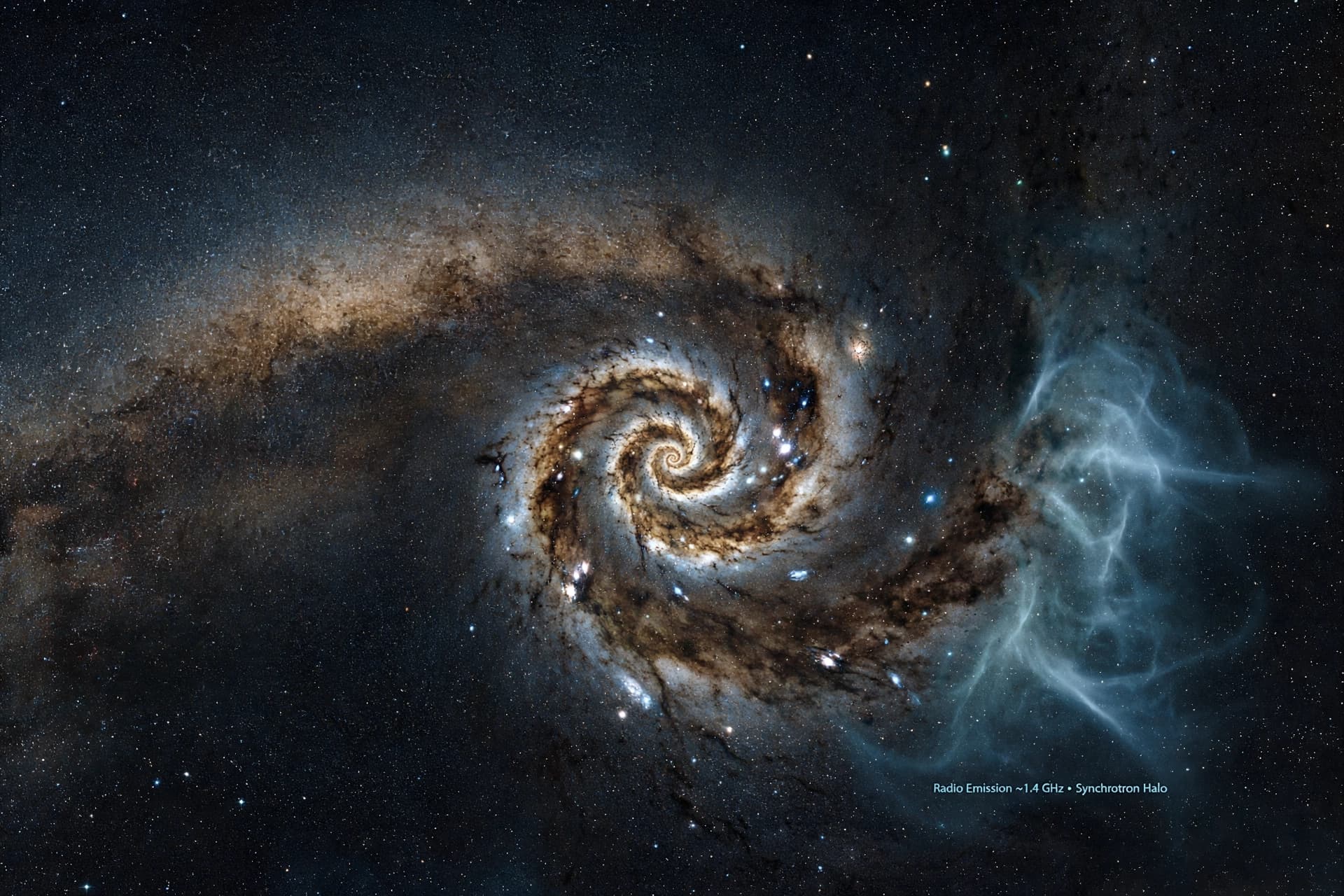
Image Disclaimer: The visual accompanying this article was generated by artificial intelligence and is not an actual scientific photograph or data visualization.
Sources: The Conversation, Phys.org
Published by Banx Network. This article is part of the Banx decentralized media programme, powered by the BXE token on the XRP Ledger.