There is a particular kind of quiet that settles over a place like the Ewhurst brick and roof tile works in Surrey, England—the dust of clay, the hum of machinery, the ordinary rhythm of industry. It was here, in 2001, that workers uncovered something extraordinary: the fossilized remains of a dinosaur that had lain buried for roughly 125 million years. And now, more than two decades later, that dinosaur has a name, and the name belongs to a man who never knew it would be found.
The man was Will Proudlove, the manager of the Ewhurst works, who had worked his way up through the ranks and who harbored a quiet fascination with the fossils that occasionally surfaced as layers of clay were stripped away. His wife, Rachael, recalled that he would check each new layer for anything that looked like bone, caught by the simple wonder of what might be hidden beneath his feet. He died at thirty-five, shortly before the fossil was unearthed, leaving behind Rachael and their two young children.
The fossil was donated to the Natural History Museum, where it rested in the collections for years. Recently, researchers took a closer look and realized that the bones belonged not merely to a known species but to an entirely new genus and species. They named it Paludohadros proudlovii—the genus name drawing from the Latin palus, meaning swamp, a nod to the wetland environment where the animal once lived, and the species name honoring Will Proudlove.
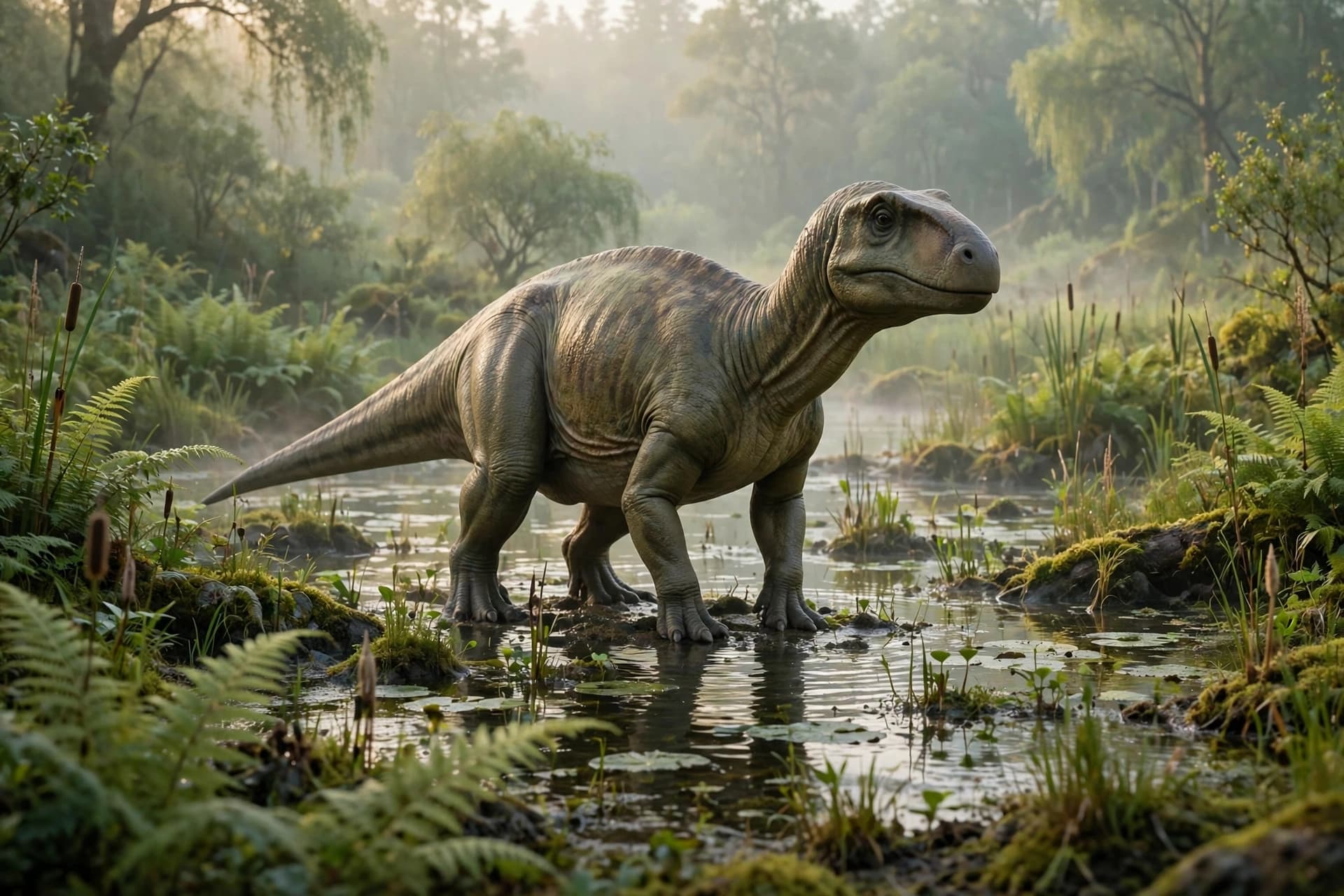
Paludohadros was a member of the iguanodontians, a group of plant-eating dinosaurs known for their distinctive thumb spikes. It lived during the Early Cretaceous Period, when southern England was a muddy, humid landscape of wetlands and waterways. The individual whose bones were found was roughly five meters long and weighed between 1.5 and two tons, about the size of a rhinoceros. But its bones were not fully developed, suggesting it was a juvenile—meaning a fully grown adult might have been twice as large.
The discovery adds to a growing list of newly named iguanodontians from southern England, a wave of taxonomic revision made possible by a detailed redescription of the Mantellisaurus published in 2023. Fossils that had long been assumed to belong to known species are now being recognized as distinct, and Paludohadros is the latest in that line. The Natural History Museum’s collections, it turns out, hold more than they were once thought to.
There is also a darker thread to the story. The fossil was found just one hundred meters from where Baryonyx walkeri, a large fish-eating carnivore, was discovered in 1983. Baryonyx is known to have eaten young iguanodontians, and it is possible that the two dinosaurs crossed paths in life as well as in death. The wetland that gave Paludohadros its name was a place of both abundance and danger, where a juvenile herbivore might have been vulnerable to a predator with a taste for small game.
For the Proudlove family, the naming is a legacy of a different kind. Rachael described it as a “huge honor,” a sentiment that carries the weight of grief transformed, however slightly, into something enduring. The dinosaur is not named for a famous scientist or a wealthy patron; it is named for a man who managed a brickworks and liked to look at the clay. There is something fitting in that, a reminder that curiosity is not the exclusive province of professionals.
Ricardo Sacamoto, the researcher who led the study, spoke of the moment he realized he was looking at a new species, the kind of discovery that every paleontologist hopes for. But the story belongs equally to a family in Surrey, for whom a pile of ancient bones has become a connection to a husband and father who is gone but not entirely absent. Names have a way of carrying the past forward, and Paludohadros proudlovii now carries two histories at once: one written in stone, and one in memory.
Image note: This article’s visuals are AI-generated and do not represent the actual fossil or the individuals mentioned.
Sources: BBC News, Natural History Museum (London), Yahoo News
Published by Banx Network. This article is part of the Banx decentralized media programme, powered by the BXE token on the XRP Ledger.