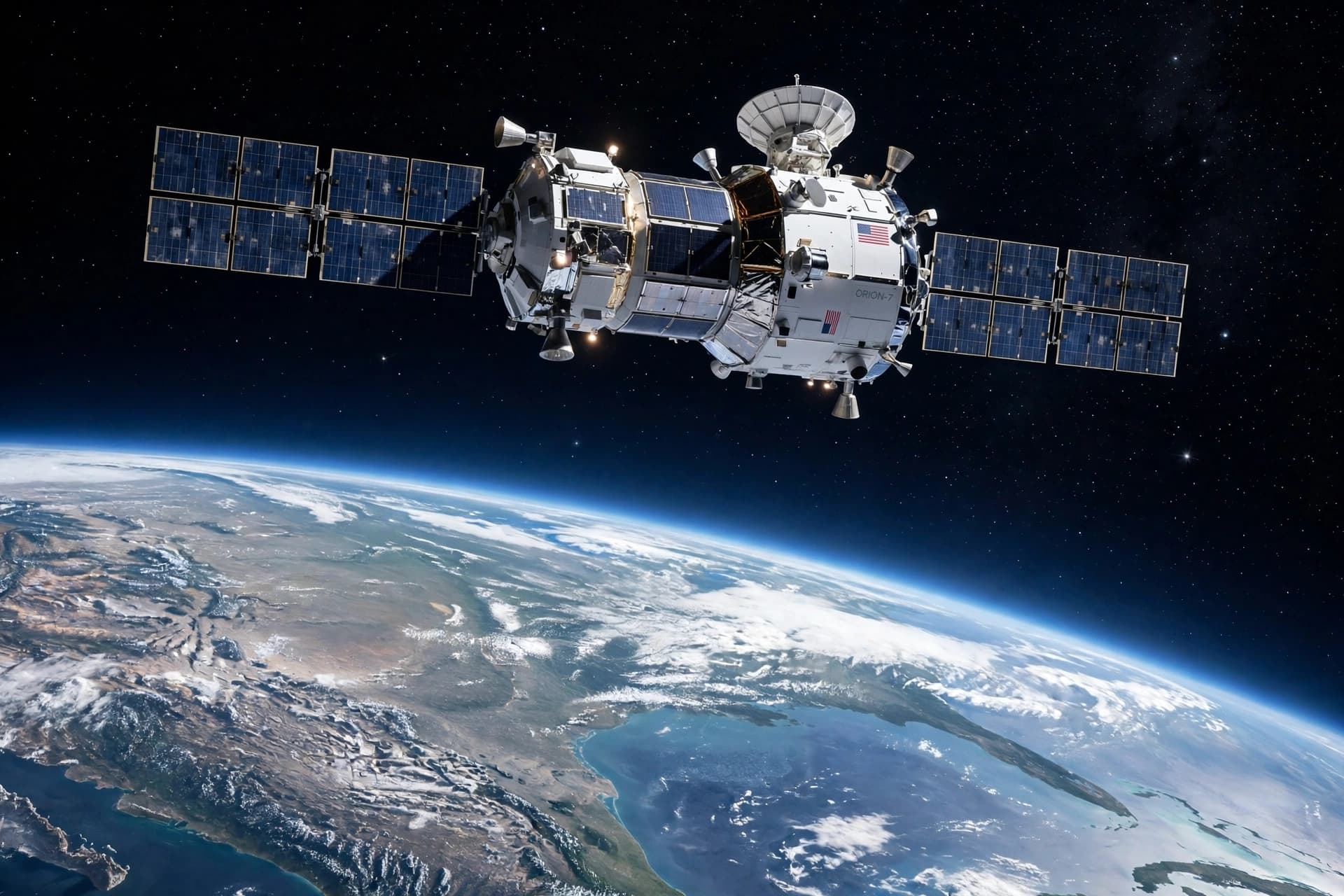
There is a particular elegance to the way a spacecraft travels through the solar system—not in straight lines, but in curves and arcs that borrow from the gravity of worlds along the way. On September 28, the European Space Agency's Jupiter Icy Moons Explorer, known as Juice, passed within 8,640 kilometers of Earth, using our planet's gravity to bend its path and accelerate toward its ultimate destination. It was the third of four Earth flybys planned for the mission, a maneuver that deflects the spacecraft's trajectory by about 20 degrees and increases its velocity by approximately 3.5 kilometers per second—all without consuming a drop of onboard fuel .
The logic behind this celestial choreography is straightforward. Jupiter is, on average, 800 million kilometers from Earth. Sending a spacecraft there directly would require an enormous rocket and an unthinkable amount of propellant—not just to reach the giant planet, but to slow down enough to enter orbit rather than fly straight past . Instead, flight controllers devised a strategy that makes the most of the planets and their gravity. Juice launched in April 2023 and has since performed a lunar-Earth flyby, a Venus flyby, and now this third Earth flyby. By borrowing speed from these encounters, the spacecraft will have plenty of fuel left in its tanks to enter orbit around Jupiter in 2031, and then around Ganymede in 2034 .
The September 28 flyby came with its own set of challenges. For about nine hours, spanning the closest approach, Juice was in Earth's shadow, unable to rely on solar power. The spacecraft operated on battery power alone, prioritizing the most important instrument observations to avoid depleting its batteries completely . Unlike the 2024 lunar-Earth flyby—a more complex maneuver that involved passing the Moon first and then Earth a day later—this flyby was simpler from an operational perspective. But all flybys carry risk. As Juice's mission team prepared, they held open the possibility of a final emergency maneuver at 08:00 CEST on the day of the flyby to correct critical navigation errors or avoid a collision with other satellites .
What makes this flyby particularly valuable is the bonus science it provided. Juice's ten science instruments were switched on between September 23 and October 3 to collect data on Earth and the Moon. This gave instrument teams a rare opportunity to calibrate their tools on a known planetary surface before using them at Jupiter—a chance to test and refine data analysis in preparation for the mission's primary scientific goals . It is a quiet, methodical step in a journey that has years yet to unfold. After this flyby, Juice will perform a final Earth flyby in January 2029, putting it onto the optimum path to intercept Jupiter in July 2031 . From there, it will conduct a tour of the gas giant and its icy moons, including 35 flybys, before settling into orbit around Ganymede for a year. The mission is designed to answer a fundamental question: could these icy worlds harbor conditions suitable for life? For now, the spacecraft continues its long, patient voyage, borrowing speed from the planets it passes, in no hurry to arrive.
AI Image Disclaimer: The visual elements in this article were created using AI generation tools and are intended for illustrative purposes only.
Sources: European Space Agency, BBC Newsround, ExtremeTech, Simple English Wikipedia
Published by Banx Network. This article is part of the Banx decentralized media programme, powered by the BXE token on the XRP Ledger.