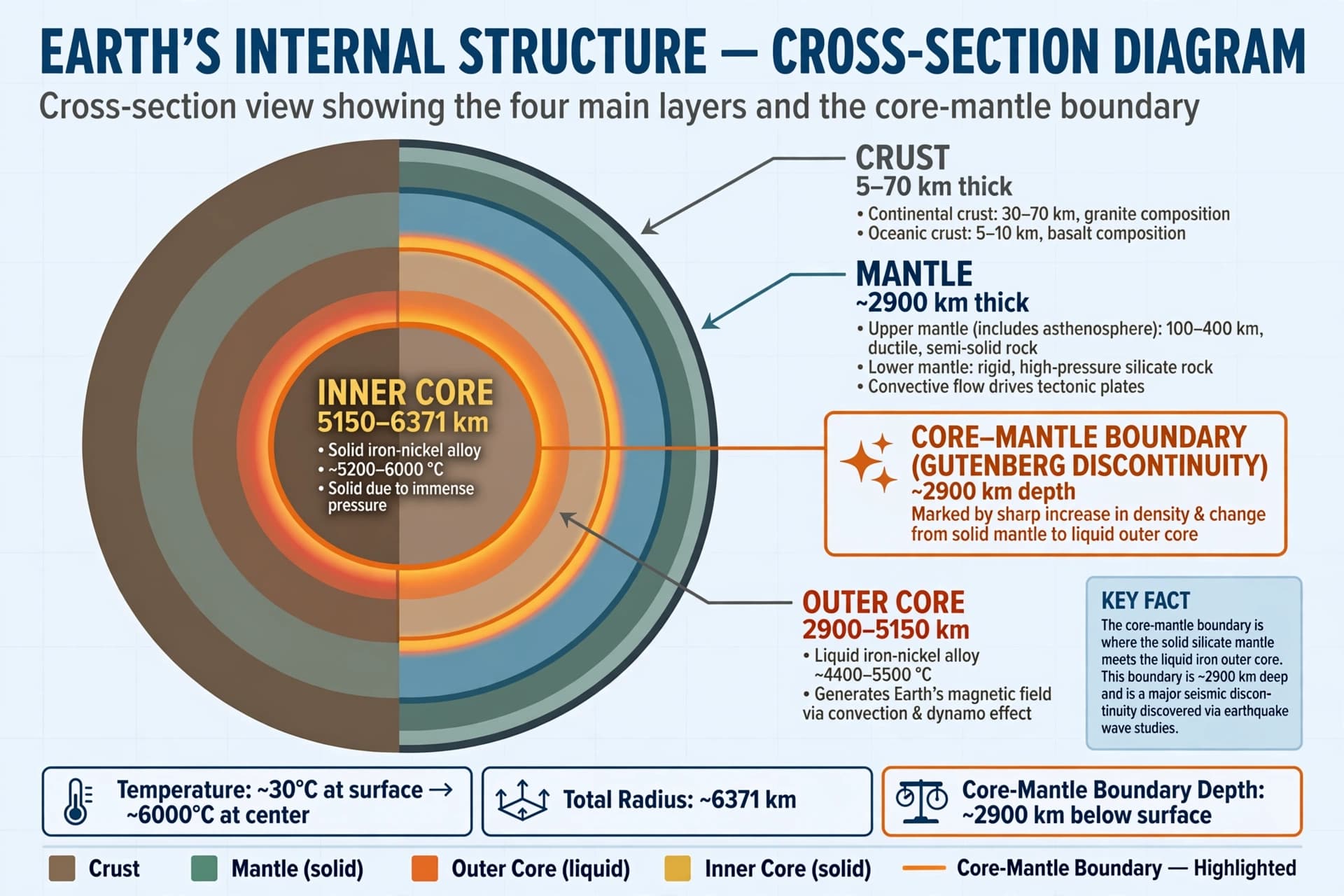
There is a place beneath our feet that no human will ever visit—a boundary nearly 2,900 kilometers down where the slow, solid mantle meets the liquid iron of the outer core. We cannot drill to it, cannot send a camera or a probe. And yet, in recent years, scientists have learned to listen. Earthquakes, those sudden ruptures of the surface, send waves rippling through the planet's interior. When those waves encounter something different—a change in density, composition, or temperature—their path bends and shifts. The faintest of those shifts can tell us what lies in the darkness.
A new study led by Chinese researchers used artificial intelligence to examine seismic records collected over more than three decades . The goal was to detect an elusive class of signals called PKP precursors, weak waves that scatter off irregularities near the core-mantle boundary. For decades, finding these precursors in the noise required painstaking manual review, and even then, only a fraction were identified. The researchers trained a deep-learning model on signals previously classified by experts, then let the algorithm search through nearly two million records .
The result was the detection of more than 170,000 high-quality precursor signals—more than ten times the number catalogued in prior studies . That expanded dataset revealed something unexpected: six distinct regions of heterogeneity near the core-mantle boundary that had not been documented before. They lie beneath areas including high-latitude Eurasia, Central Asia, and the South Atlantic .
What these structures actually contain remains uncertain. One hypothesis is that they are accumulations of subducted tectonic plates—remnants of ancient ocean crust that sank into the deep mantle over hundreds of millions of years . Another possibility is that they preserve materials from Earth's earliest history, perhaps even fragments related to the giant impact that formed the Moon . The researchers emphasize that their findings are based on seismic wave behavior, not direct observation, and the true composition of these anomalies will require further study.
The boundary where these structures reside is one of the most dynamic and least understood regions of the planet. Temperature gradients there can reach a thousand degrees over relatively short distances. Heat escaping from the core drives convection in the mantle above, and that slow churning is ultimately connected to volcanic activity at the surface . Understanding the deep structure is, in a sense, understanding the engine that has shaped Earth's surface for billions of years.
Science often advances not through dramatic discoveries but through better tools for seeing what was always there, hidden in plain data. The seismic waves that pass through the planet carry a record of everything they encounter. For decades, we simply lacked the means to read it fully. Now, with machine learning, the quiet signals that once slipped past unnoticed are beginning to speak.
AI-generated images are used for visual context in this article.
Sources: Note: No mainstream English-language scientific source (NASA, Nature, Science, AGU journals directly)
Published by Banx Network. This article is part of the Banx decentralized media programme, powered by the BXE token on the XRP Ledger.