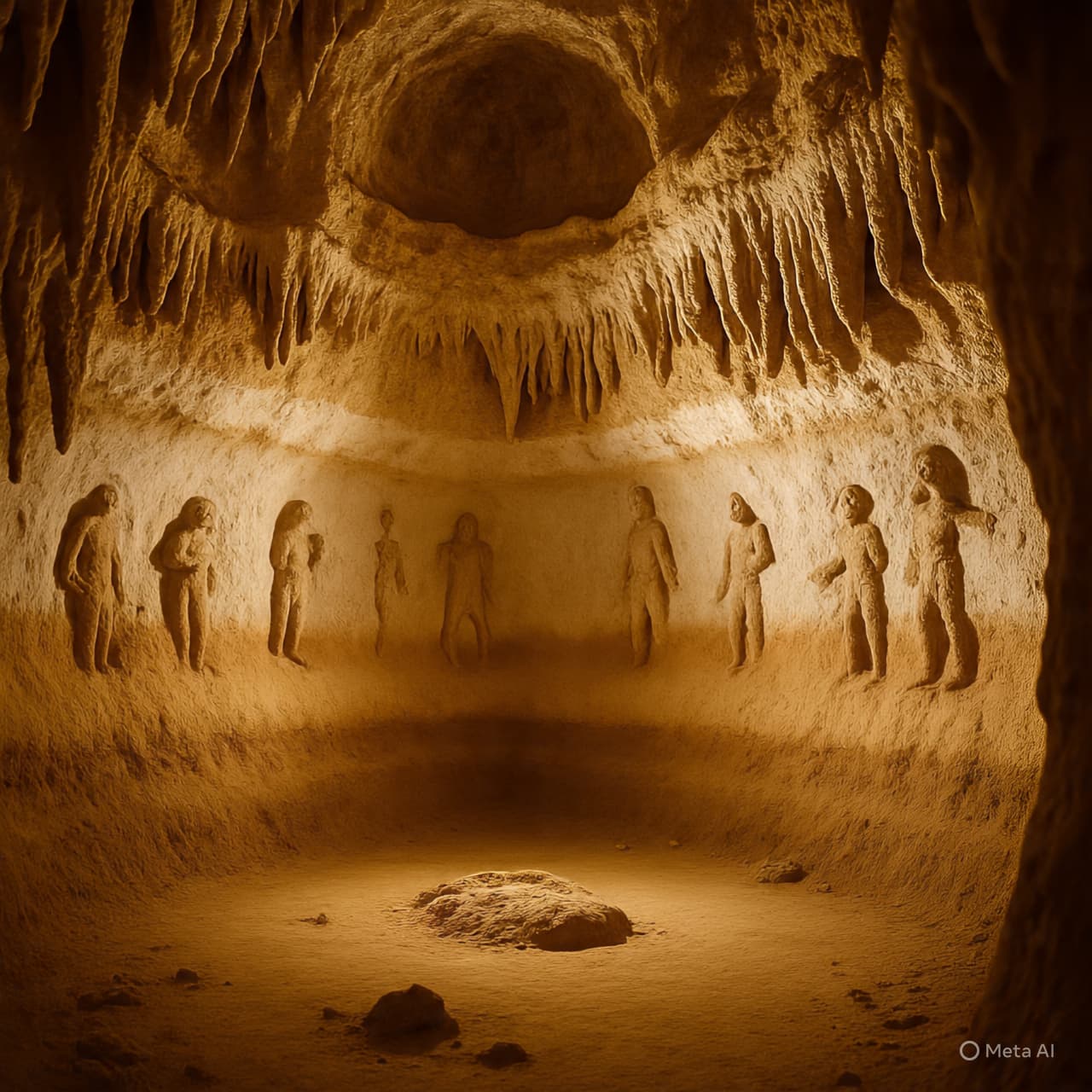
In the stillness of a Moroccan cave, buried beneath layers of time and sediment, the echoes of distant ancestors linger. Imagine footprints in a dream, erased by wind but not by memory that is how these fossils feel. Their silent bones, once part of living, breathing beings, now whisper to us from a moment when Earth itself was in flux. In this place where stone and history intertwine, the planet’s own hidden clock the slow dance of its magnetic poles left its imprint, granting a precise key to unraveling deep past mysteries.
In recent research published in Nature, an international team of scientists unearthed hominin remains from a cave in Casablanca that date to about 773,000 years ago, aligning exactly with the Matuyama-Brunhes magnetic reversal one of Earth’s major flips of its magnetic field. These fossils, comprising jaw fragments, teeth, and vertebrae, come from a time just before the branching of human lineages that would lead to modern Homo sapiens, Neanderthals, and Denisovans.
For decades, that span of human prehistory in Africa was a missing chapter. Fossils older than 600,000 years were few in number and difficult to date with confidence. Now, by reading the magnetic record preserved in the cave’s rock layers a kind of geological barcode researchers could anchor these ancestors firmly in time.
What these bones reveal is both subtle and profound. The individuals they belonged to show a blend of more primitive traits alongside features we recognize in later human species, suggesting populations on the cusp of evolutionary divergence. The Moroccan find doesn’t just fill a gap; it broadens our view of where and how early human relatives lived and moved across North Africa, possibly interacting with groups that eventually spread into Europe and beyond.
The way the cave’s sediments captured the Earth’s magnetic flip reminds us that our planet landscape and lifeways alike has been in constant motion over millions of years. There is a poetry here: the rhythms of geology and evolution, entangled, offering us a clearer sense of where our story began.
In the gentle twilight of scientific discovery, this remarkable dating achievement now stands as a cornerstone in anthropology. It reinforces the view that Africa was the heartland of our species’ deep ancestry while inviting us to look more closely at the varied mosaic of human evolution across the ancient world.
AI Image Disclaimer (rotated wording) Visuals are created with AI tools and are not real photographs.
Sources (Credible Media): CBS News Taipei Times (AFP) Reuters Live Science The Times (world/print) North Africa Post
Published by Banx Network. This article is part of the Banx decentralized media programme, powered by the BXE token on the XRP Ledger.