
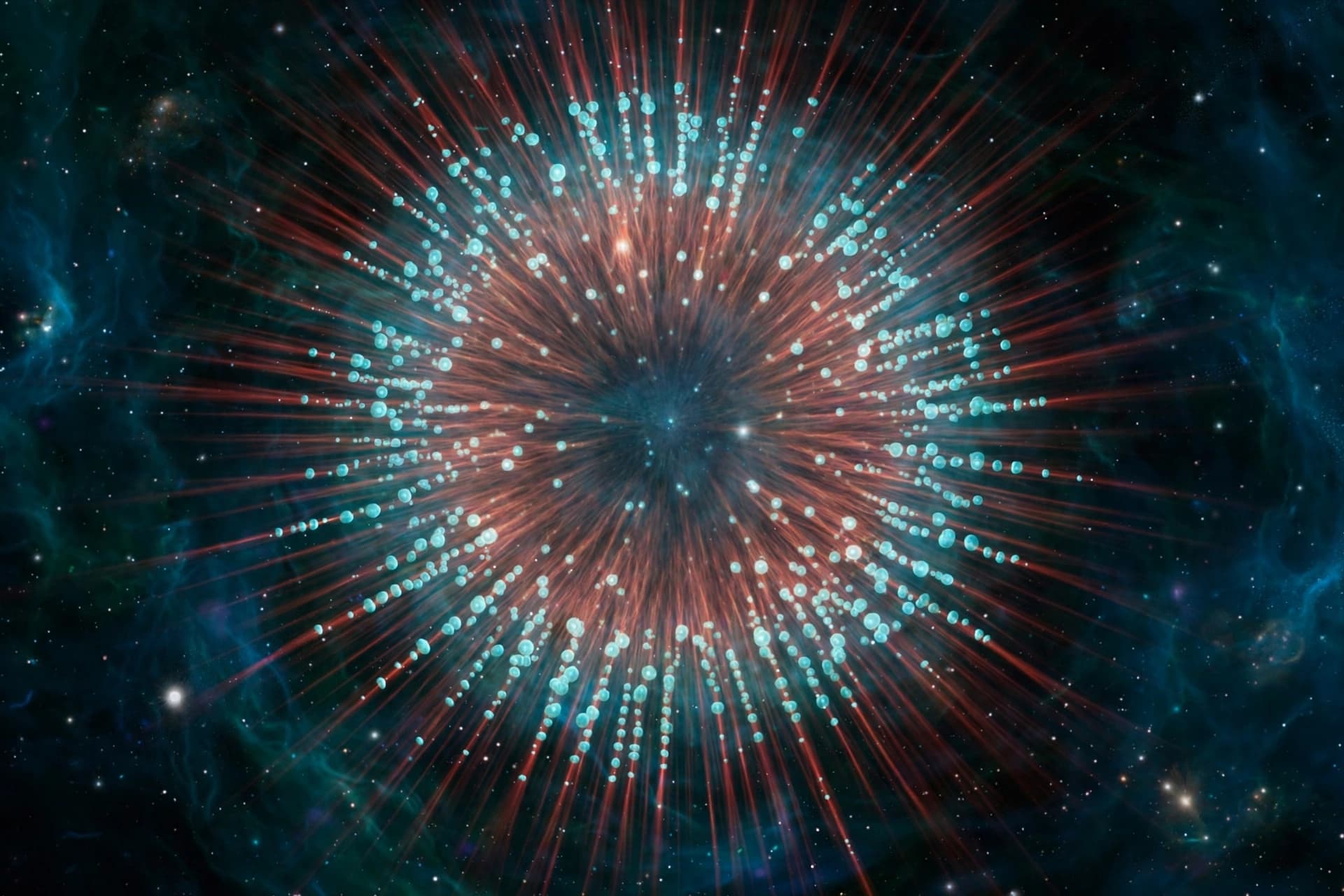
There is a particular kind of beauty that arrives not from design but from violence—the aftermath of an explosion so immense that its echoes can still be read nearly a thousand years later, in the light of a telescope pointed at the same patch of sky where medieval astronomers once saw a new star appear. That is the story of Pa 30, the remnant of a supernova witnessed from Earth in the year 1181, and now the subject of the most detailed image ever captured of its strange and elegant structure.
Using the Gemini North telescope in Hawai‘i, an international team led by Tim Cunningham of the Center for Astrophysics and Ilaria Caiazzo of the Institute of Science and Technology Austria has revealed that the remnant’s famous “firework” filaments are not smooth streaks at all. They are chains of tiny knots—pearls of gas strung along radial lines, each one about four light-days in diameter, large enough to contain our solar system’s planetary region ten times over . The new observations show roughly ten times more filamentary structure than any previous image .
Pa 30 is unique in the Milky Way. It is the only known remnant of a Type Iax supernova—a rare, incomplete explosion that does not destroy its star entirely . Where a typical thermonuclear supernova obliterates its white dwarf progenitor, a Type Iax event leaves behind a “zombie star”: the surviving core of the exploded object, still hot, still emitting winds that stream outward at thousands of kilometers per second . The central star of Pa 30, with a surface temperature around 200,000 degrees Celsius, sits almost exactly at the center of the expanding nebula—a detail that tells astronomers the explosion was remarkably symmetric .
The historical record adds a layer of poignancy to the modern observations. In 1181, astronomers in China and Japan recorded the appearance of a “guest star” in the constellation Cassiopeia, visible for 185 days before fading from view . They could not have known what they were witnessing: the death throes of a star 7,500 light-years away, an event whose light had traveled across the galaxy for millennia before reaching human eyes. The connection between that medieval observation and the modern nebula Pa 30 was not made until 2013, when amateur astronomer Dana Patchick identified the object in archival infrared data, and subsequent studies confirmed its age and origin .
The pearl-like knots themselves are a puzzle. Their uniformity is striking—scientists expected more irregular clumps in the chaos of a supernova remnant . “The knots are quite strikingly uniform,” Caiazzo said. “We are excited to try to model them” . What created this regularity remains unclear. One possibility is that thermal or density variations in the material surrounding the star before the explosion shaped the ejecta as it expanded .
For now, Pa 30 offers something rare: a direct link between a human observation made nearly 850 years ago and the detailed physics of stellar death that modern instruments can now reveal. The light that medieval astronomers saw has long since faded, but the debris it left behind continues to tell its story—one pearl at a time.
AI Image Disclaimer: All images associated with this report are AI-generated and serve illustrative purposes only, not as astronomical data or documentary records.
Sources: NOIRLab, Gemini Observatory, Institute of Science and Technology Austria, WIRED, Yahoo Tech
Published by Banx Network. This article is part of the Banx decentralized media programme, powered by the BXE token on the XRP Ledger.



.jpg&w=3840&q=75 "September 2026 Was the Second-Warmest on Record, With Global Temperatures Above 1.5°C for a Second Month")