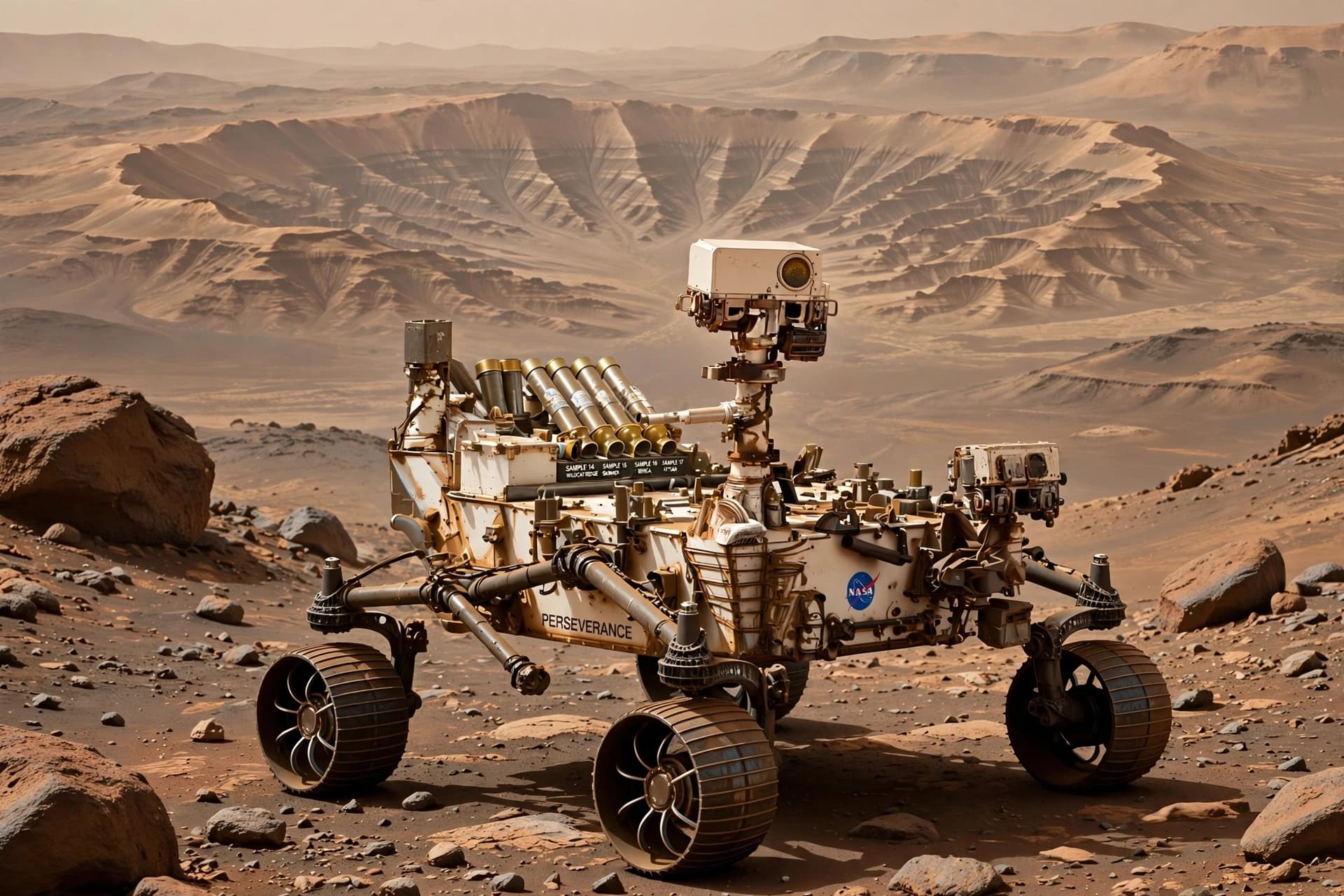
There is a particular suspense in a scientific mission that has already succeeded in its most difficult task—collecting the samples—but that has not yet figured out how to bring them home. NASA's Perseverance rover has been drilling into the Martian surface since 2021, filling tubes with rock and soil that may contain evidence of ancient microbial life. The samples are sealed, catalogued, and waiting. But the spacecraft that was supposed to retrieve them has been delayed, redesigned, and criticized for its cost. And the question of who will bring them home—and when—remains unresolved.
The original plan, developed jointly by NASA and the European Space Agency, involved a complex choreography: a lander would touch down near Perseverance, a small rocket would launch the samples into orbit around Mars, and a European spacecraft would capture them and return them to Earth. But an independent review in 2023 found that the plan was too expensive, with costs rising to $11 billion, and too slow, with a return date slipping to 2040. NASA asked for alternatives. The agency is now evaluating proposals from industry and from its own centers, with a decision expected later this year.
The stakes are high. The Mars Sample Return mission is widely considered the highest priority in planetary science. The samples collected by Perseverance come from Jezero Crater, a site that was once a river delta and a lake—a place where life could have existed. The rover has already found evidence of organic molecules and signs of ancient water. But to determine whether life ever existed on Mars, scientists need to study the samples in laboratories on Earth, using instruments far more sophisticated than anything that can be sent to Mars. The samples could answer one of the most profound questions in science: are we alone?
The delay has consequences beyond the science. The samples are sitting on the Martian surface, exposed to radiation and the harsh Martian environment. Their integrity depends on the tubes remaining sealed and the rover remaining operational. Perseverance is in good health, but it will not last forever. The clock is ticking, and the question of who will bring the samples home—and how—has become a test of the international community's ability to execute a complex mission at a time when budgets are tight and priorities are shifting.
The answer may come from the private sector. Companies like SpaceX and Blue Origin have expressed interest in the mission, and their capabilities could reduce costs and accelerate timelines. The European Space Agency remains committed to its role, but the architecture may change. For now, the samples wait. The scientists wait. And the question of who will bring them home remains unanswered. The rocks are ready. The rover is ready. The only missing piece is the ride.
AI Image Disclaimer: All images in this article are AI-generated and are intended for illustrative purposes only.
Sources: NASA, European Space Agency, SpaceNews, Nature
Published by Banx Network. This article is part of the Banx decentralized media programme, powered by the BXE token on the XRP Ledger.