There is a particular irony in a protest slogan that means almost nothing at all, a phrase that sounds like nonsense until you understand the joke beneath it. In France this month, as high school and university students blocked schools and marched against deteriorating conditions in education, a handwritten sign began to appear in the crowds: "Bismillah, c'est les ténèbres." In Arabic, "Bismillah" means "in the name of God." In French, "c'est les ténèbres" translates to "it's the darkness." Together, the phrase is absurd—"In the name of God, it's the darkness"—and that absurdity is precisely the point.
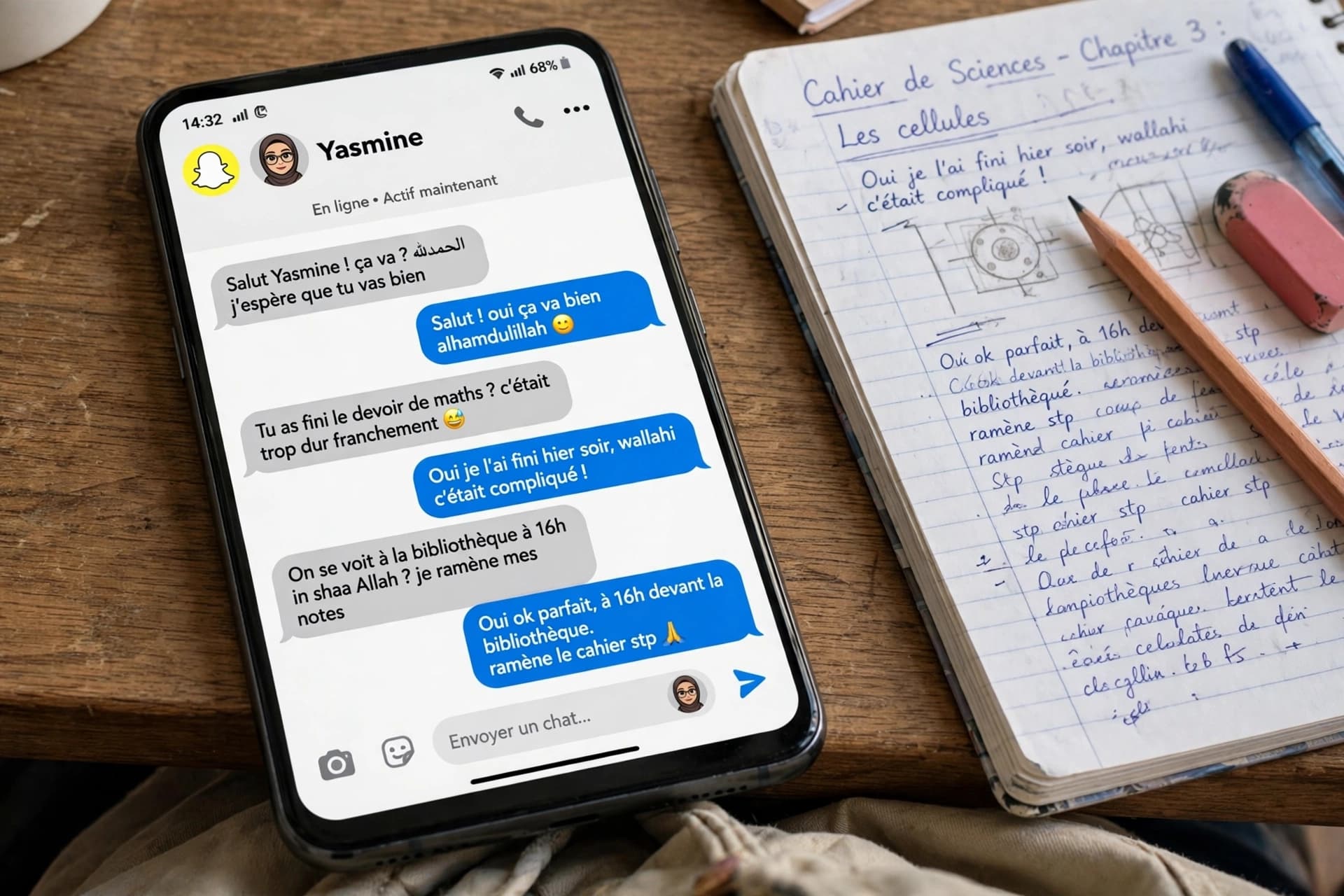
The slogan originated on Snapchat, where students had been organizing school blockades and coordinating their movement. A user named "Mamadou," whose profile picture carried an Algerian flag emoji, sent a message asking to be added to a group: "Hello, in the name of God, it's the darkness. When is the blockade, wallah, brother?". Other similar accounts asked where protests would take place and who was selling fireworks and smoke bombs. To the students, the awkward mix of Arabic, street slang, and national flags was a tell. They concluded that the messages were written by police officers pretending to be teenagers in order to infiltrate private protest groups.
Whether the police actually attempted to infiltrate student groups has not been independently verified. Neither the police nor the Interior Ministry has commented on the screenshots, and no one has confirmed who was behind the accounts. Some users claimed they had traced the accounts to locations near police stations, but these claims remain unverified. Some of the screenshots circulating may themselves be fakes or parodies. But the students did not wait for confirmation. They took the perceived insult—the clumsy, stereotype-laden attempt to speak their language—and turned it into a weapon of ridicule.
The phrase spread with remarkable speed. It appeared on cardboard signs outside blocked schools. It was shared in satirical videos tens of thousands of times. Greta Thunberg repeated it in a video supporting the French students. Within weeks, it had become the unofficial slogan of the student movement, a rallying cry that mocked the authorities' inability to understand the generation they were trying to monitor. The message was clear: we know you are watching, and we know you do not understand us.
The context of the student protests is grounded in real grievances. The movement began in Créteil, in the southeastern suburbs of Paris, on September 18, and spread rapidly nationwide. Students complained of overcrowded classrooms, deteriorating school buildings, prolonged schedules, and teacher shortages. These problems, they argued, disproportionately affect low-income suburbs and minority communities. The student movement later joined the broader national protests against the cost of living that descended into violence on October 17, when hundreds of thousands marched across France and riots erupted in multiple cities.
There is a sociological dimension to the slogan that observers have noted. The phrase functions as a kind of digital shibboleth, a password that identifies who belongs and who does not. Those who understand the joke are part of the movement; those who take it seriously, or who try to mimic it without understanding, reveal themselves as outsiders. The students did not need to prove that police were behind the messages. The clumsiness of the attempt was proof enough, and the mockery was the response.
For now, the slogan continues to appear on signs and screens, a strange and nonsensical phrase that carries a generation's contempt for those who underestimate them. The student protests have not achieved their demands. The government has promised three thousand substitute teachers for high schools with severe shortages, a measure students dismissed as a temporary fix. The movement has merged with a broader wave of anger over the cost of living, and the outcome remains uncertain. But the slogan has already done something that protests often struggle to do: it has made people laugh, and it has made the authorities look foolish. In the long arithmetic of a movement, that is not nothing.
Published by Banx Network. This article is part of the Banx decentralized media programme, powered by the BXE token on the XRP Ledger.