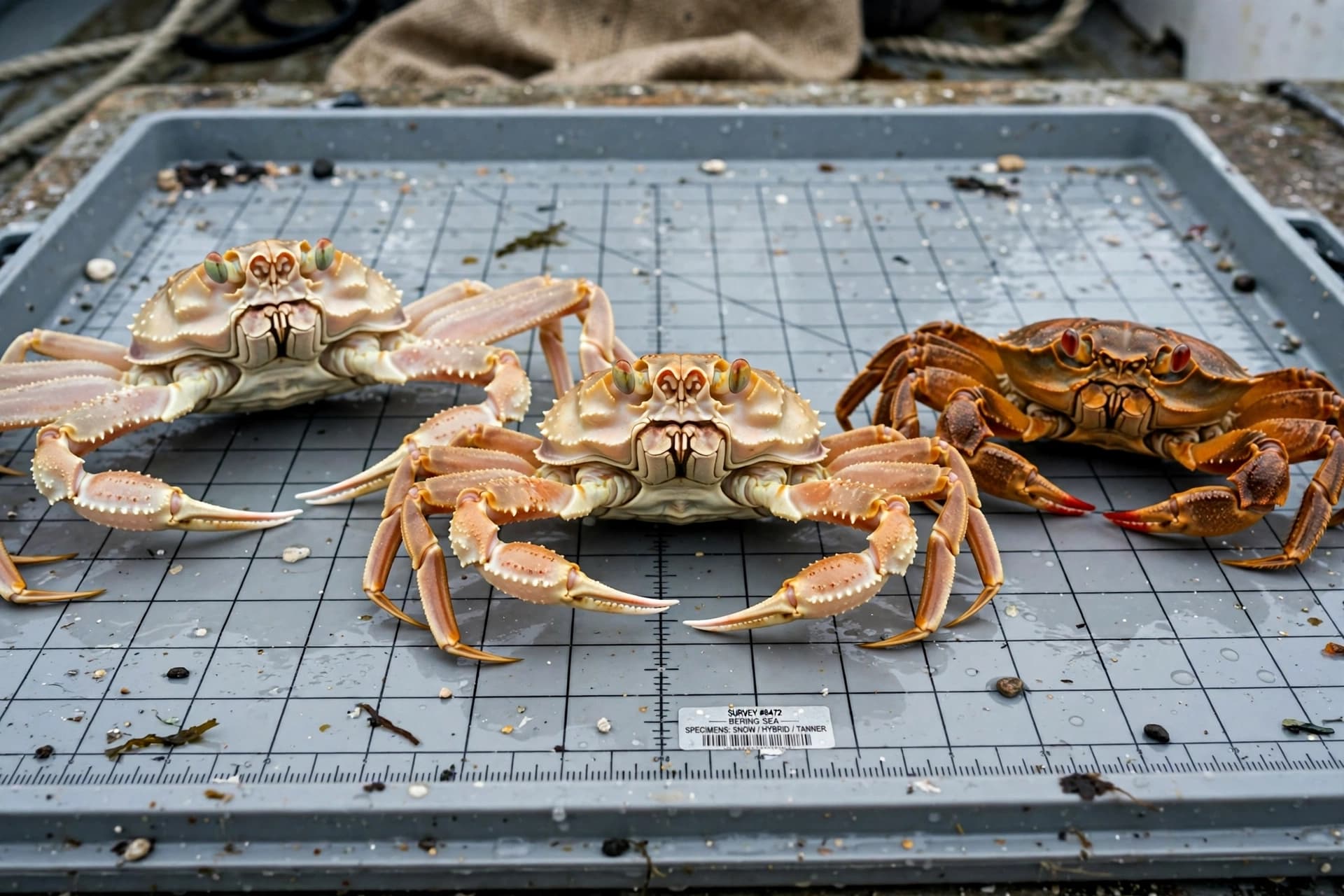
There is a particular kind of surprise that arrives not from a new discovery but from a new abundance, a creature that was always there, in small numbers, suddenly appearing in nets by the thousands. In the eastern Bering Sea, fishermen and scientists have long known that snow crabs and Tanner crabs occasionally interbreed, producing hybrids that are neither one nor the other. They were rare, a curiosity, never more than ten percent of the commercial-sized male population. Then came the heat wave, and the snow crabs died, and the hybrids did something no one expected.
A marine heat wave in 2018 and 2019 raised temperatures in the Bering Sea and reduced winter sea ice, setting off a chain reaction that starved billions of snow crabs. The population fell from an estimated eight billion to roughly one billion, and Alaska closed the commercial fishery for two years . In the years that followed, researchers at NOAA's Alaska Fisheries Science Center noticed an unusual number of hybrids in their survey trawls. In 2025, the abundance of snow-Tanner hybrids was 13.4 times greater than the historical average. Nearly half of the commercial-sized male crabs in the survey were hybrids, a proportion that had never exceeded ten percent before .
The question was why. A new study in the Proceedings of the National Academy of Sciences tested three possible explanations. Perhaps the warmer water directly benefited the hybrids, allowing more of them to survive. Perhaps the collapse of snow crabs brought the two parent species into closer contact, increasing interbreeding. Or perhaps the mechanism was indirect: with billions of snow crabs gone, the hybrids faced less competition and predation, and more of their young survived .
The modeling pointed clearly to the third explanation. The heat wave did not directly improve hybrid survival, nor did it significantly increase spatial overlap between mature snow and Tanner crabs. Instead, the loss of snow crabs created a vacuum. The hybrids, released from the pressures that had kept their numbers low, filled it .
The consequences are not yet clear. Very little is known about whether hybrids can reproduce, or whether they can form a stable population independent of their parent species. Their sudden abundance complicates fisheries management, because legal-sized male hybrids are harvested as snow crabs but have historically been excluded from quota calculations. If the hybrids persist, the existing rules may not reflect the reality of the population .
For now, the Bering Sea is offering a lesson in unintended consequences. A heat wave killed one species and, indirectly, allowed another to flourish. The hybrids are not a new species, not a restoration, not a solution to the snow crab collapse. They are an ecological surprise, a response to a disturbance that no one predicted, and a reminder that the ocean's systems are connected in ways that are not always visible until they change.
---
AI Image Disclaimer: The images in this article are generated by artificial intelligence and are intended for illustrative purposes only.
Sources: ScienceAlert, PNAS, ECOticias, JoVE
Published by Banx Network. This article is part of the Banx decentralized media programme, powered by the BXE token on the XRP Ledger.