There is a particular genius in biology that engineering has never fully replicated, a sensitivity born of millions of years of evolution rather than design. A locust's antenna carries roughly fifty thousand olfactory receptor neurons, a system so refined that it can detect faint odors guiding behavior in ways no synthetic sensor can match. But even that system has limits. It can smell, but it cannot always identify. And that, according to researchers at Washington University in St. Louis, is where a little engineering can help.
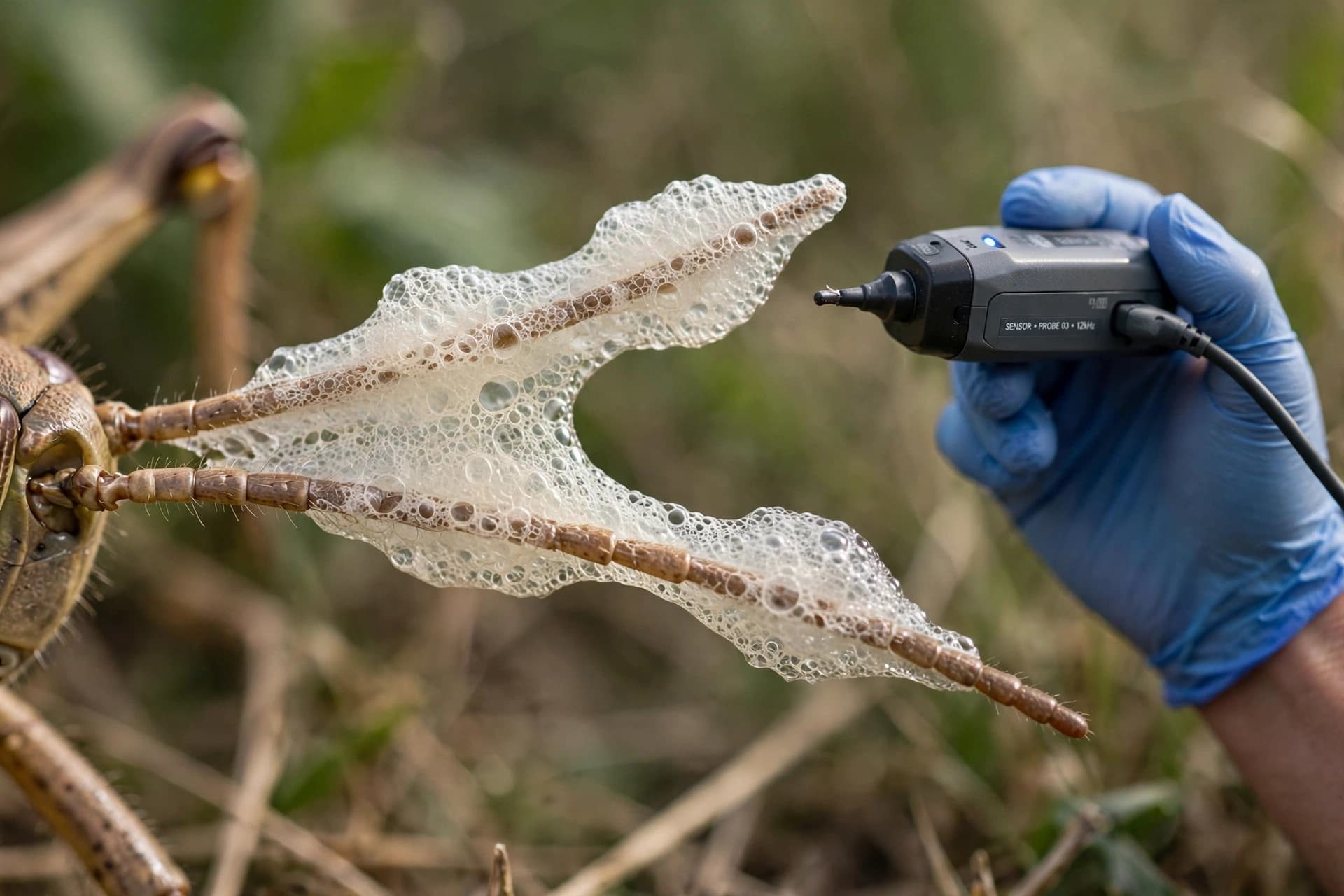
The work, published in Advanced Materials, describes a hybrid chemical sensing system that combines a locust's natural olfactory abilities with a nanomaterial coating designed to collect and identify trace chemicals. The coating is an ultralight, highly porous foam that uses a technique called surface-enhanced Raman scattering, or SERS, which boosts signals from molecules on or near nanostructured metal surfaces. Applied to the locust's antennae or wings, the foam augments the insect's odor-detecting skills without interfering with its other functions .
The logic behind the hybrid is one of complementarity. A locust's olfactory system is extremely sensitive and can detect faint odors that guide its behavior, but it cannot identify a wide enough range of chemical compounds. Synthetic sensors, meanwhile, are accurate at detecting specific compounds but lack the mobility and versatility of a living creature. "Both biological and artificial chemical sensing approaches have their strengths and drawbacks," said Srikanth Singamaneni, a professor of mechanical engineering and materials science. By combining them, "you can cast a broader net" .
In tests, locusts equipped with the foam outperformed both non-SERS locusts and synthetic chemical sensors alone, improving odor-detection performance across all chemicals tested, including the chemical signature for TNT . The foam provided molecular vibrational-fingerprint information, while the insect's antenna provided the active sampling—the movement through the air that brings molecules into contact with the sensors. The confidence-weighted fusion of neural and SERS responses outperformed either modality alone .
The implications extend beyond the laboratory. Insects are already being explored as agents in places where humans cannot easily go: rubble after an earthquake, minefields, disaster zones where chemical hazards may be present. A locust that can fly, sample the air, and identify a broader range of compounds than its biology alone allows would be a useful tool. "We marry the best biology has to offer with engineering principles to create a superior sensing system," said Barani Raman, the study's other senior author .
The research is not yet a deployable technology. The locusts were tested under controlled conditions, and the foam, while ultralight, adds a layer that must be tolerated by the insect over time. The question of how to read the data from a free-flying locust in a chaotic environment—how to distinguish a signal from noise, how to communicate the identification back to human handlers—remains unresolved. But the proof of concept is clear. The best of both worlds can be merged.
For now, the locusts in Raman's lab carry their nanomaterial coatings and perform tasks that neither biology nor engineering could accomplish alone. It is a small thing, a foam on an antenna. But it suggests a future in which the boundary between organism and instrument is less a wall than a membrane, and in which the most sensitive chemical detector in the room might have wings.
---
AI Image Disclaimer: The imagery in this article is generated by artificial intelligence and is intended for illustrative purposes only.
Sources: Washington University in St. Louis, Advanced Materials, Nanowerk
Published by Banx Network. This article is part of the Banx decentralized media programme, powered by the BXE token on the XRP Ledger.