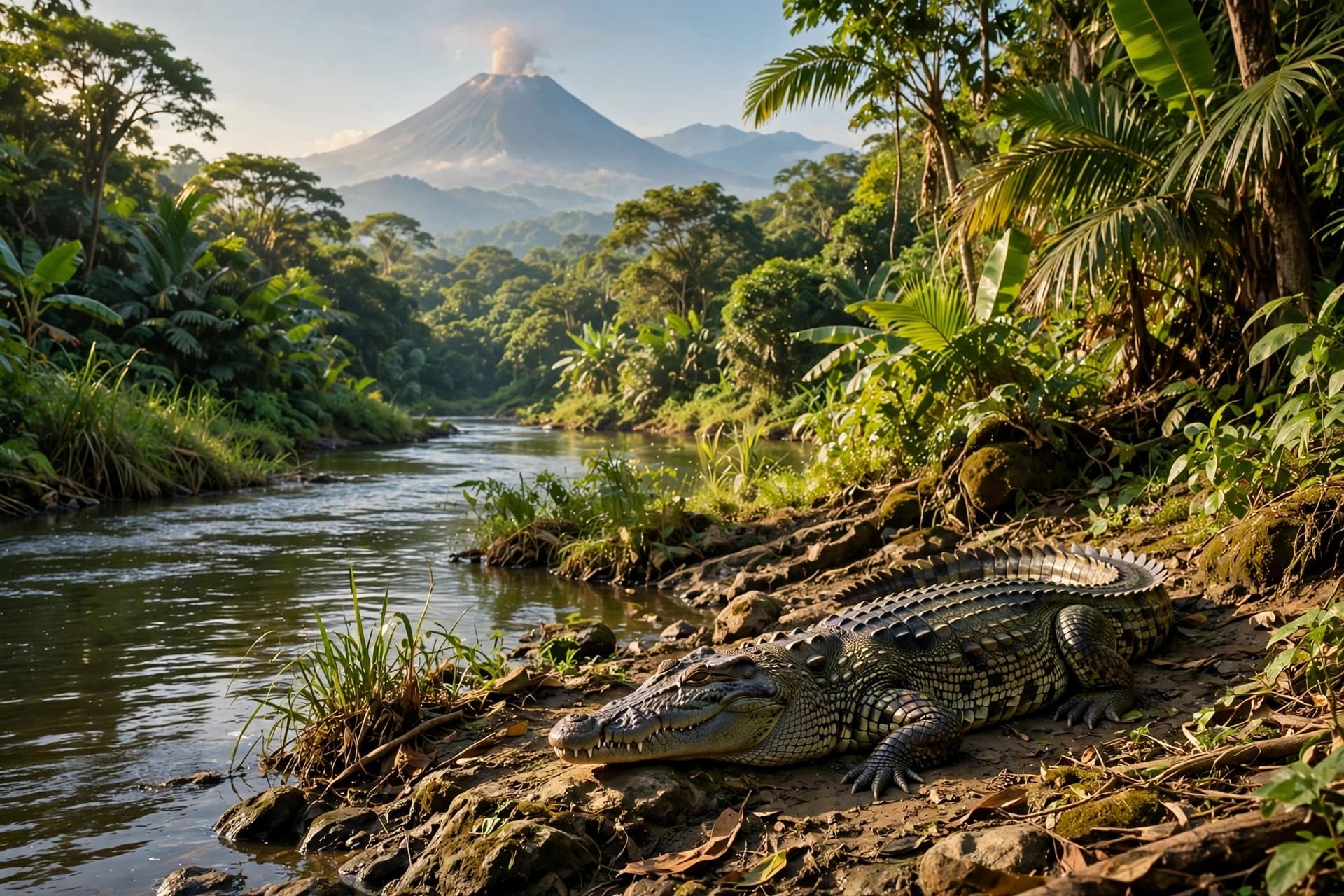
There is a particular survival strategy that does not rely on strength or speed or cunning, but on staying where the conditions are right. Crocodiles and their relatives have been following that strategy for 250 million years, moving with the warmth as the planet's climate shifted, retreating to the tropics when the world cooled and spreading toward the poles when it warmed. A new study suggests that this long-standing preference for warm climates may be the reason the lineage survived the asteroid impact that killed the dinosaurs.
The research, led by University College London and published in Science Advances, examined more than 7,000 fossils and records of over 400 species—both living and extinct—from the pseudosuchian group, which includes modern crocodiles and their ancient relatives. The team compared these records with computer reconstructions of Earth's climate and geography over the past 245 million years . What they found was a pattern of climate tracking: rather than adapting to new conditions, crocodile relatives moved to follow the climates they preferred. During hothouse periods, when global temperatures were about 10 degrees Celsius higher than today, they lived at high latitudes in North America, Europe, and even Antarctica. When the planet cooled, their range shrank back toward the equator .
The asteroid impact 66 million years ago created conditions that were hostile to most life. Sunlight was dimmed by dust and ash, temperatures dropped, and ecosystems collapsed. But the researchers simulated several scenarios for the aftermath and found that warm regions near the equator and subtropics remained suitable for crocodile relatives in all but the most extreme cases. At 5 to 10 percent reduced sunlight, equatorial refuges held. At 15 percent less, they did not—but that scenario is now considered unlikely . The dinosaurs, by contrast, had suitable climates that shrank far more drastically, according to earlier modeling by the same team.
Lead author Alfio Alessandro Chiarenza put it plainly: "The asteroid did not make the whole planet equally hostile to every group. Crocodiles' long-standing preference for warm environments may have placed survivors exactly where suitable climates held up best, like around the equator. These refuges could have sheltered populations that later recovered and radiated out" .
Climate alone did not explain the survival. Smaller body size, semi-aquatic lifestyles, flexible diets, and the low energy needs of ectothermic animals probably also helped . The ancestors of modern crocodiles were far more diverse than the animals we know today—armored plant eaters, land-dwelling predators, giants weighing more than a tonne. But what remained consistent across that diversity was the relationship with warmth.
There is a contemporary implication that the researchers are careful to draw. If crocodiles coped with past climate change by moving toward suitable habitats, then today's species will need room to move as the planet warms. The loss of suitable areas to roads, farms, and cities is making that harder . The strategy that saved the lineage once may not be available to it again, not because the climate is changing but because the corridors are closing.
For now, the crocodiles that survive are the descendants of those that found the warm refuges and waited out the darkness. They are not living fossils, unchanged since the age of dinosaurs. They are the product of a long and flexible relationship with the planet's temperature, a relationship that has proven more durable than the asteroid that ended the reign of their neighbors.
AI Image Disclaimer: The visuals in this article are generated by artificial intelligence and are intended for illustrative purposes only.
Sources: Science Advances, University College London, EurekAlert!, Nautilus
Published by Banx Network. This article is part of the Banx decentralized media programme, powered by the BXE token on the XRP Ledger.