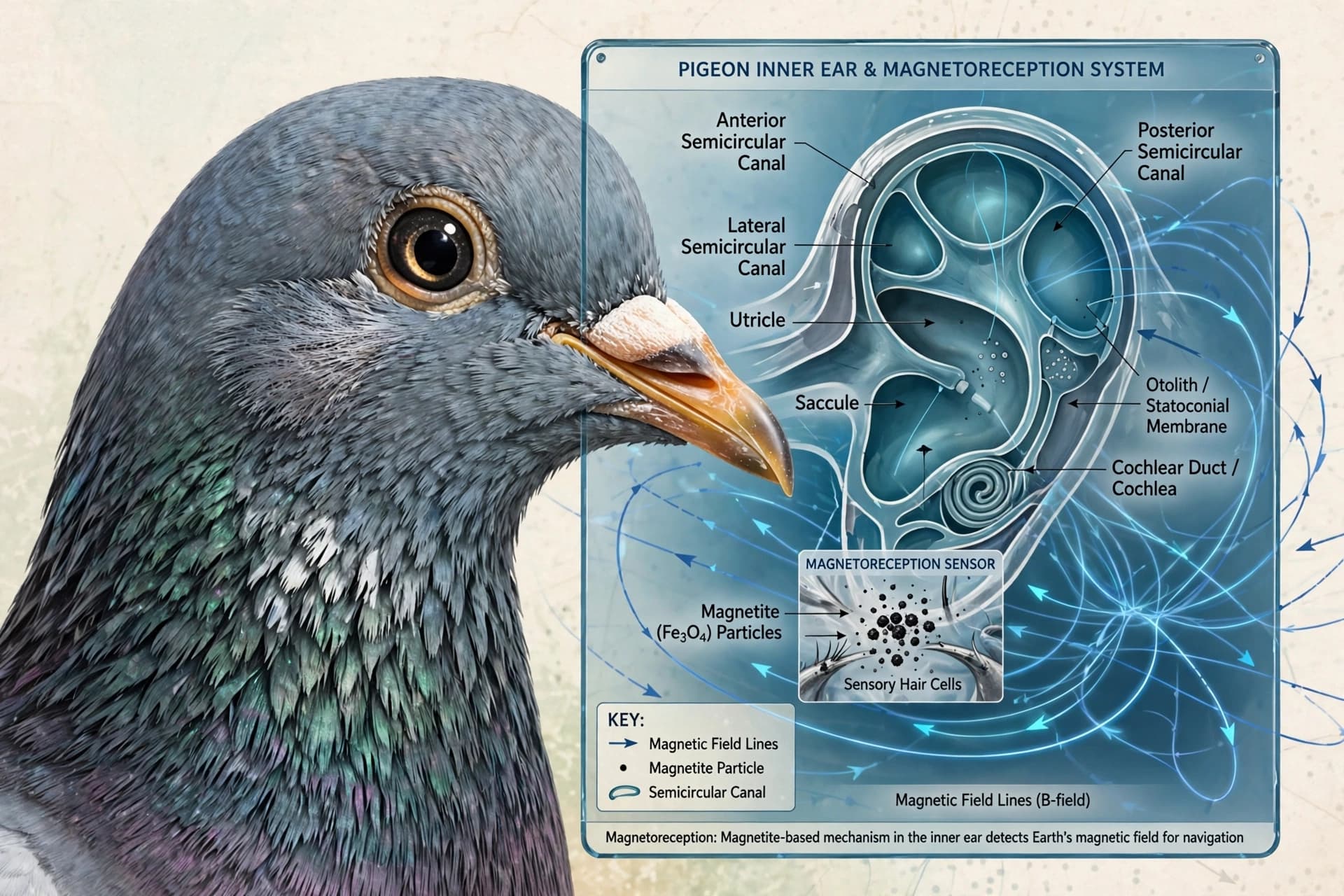
For centuries, the homing pigeon has been a symbol of reliable navigation, capable of finding its way home across hundreds of miles of unfamiliar terrain. Scientists have long suspected that these birds possess an internal magnetic compass, but the exact mechanism has remained elusive. A recent theoretical study suggests that a leading hypothesis—that pigeons detect magnetic fields through their inner ear—may face a significant hurdle: electrical noise. This finding adds a layer of complexity to our understanding of animal magnetoreception, inviting deeper inquiry into how nature solves the puzzle of direction.
The hypothesis in question proposes that pigeons use electromagnetic induction within the semicircular canals of their inner ear to sense the Earth’s magnetic field. As the bird moves its head, the motion through the magnetic field would generate tiny electric currents, which specialized cells could then detect. This idea, first put forward in 2019, offered a plausible mechanical explanation for magnetoreception, linking it to the vestibular system responsible for balance and spatial orientation. However, new modeling suggests that the signal generated by this process might be too weak to be useful.
Researchers found that the electrical noise inherent in biological systems could overwhelm the faint magnetic signal. In essence, the "static" of the body’s own electrical activity might drown out the subtle cues from the Earth’s magnetic field. This noise problem implies that if the inner ear is indeed involved, it must operate with a level of sensitivity and filtering that current models do not fully account for. The study does not disprove the inner-ear theory but highlights the need for more robust mechanisms to explain how pigeons extract directional information.
Despite this challenge, behavioral and neurological evidence continues to support the idea that pigeons have a magnetic sense. Experiments have shown that disrupting the inner ear can impair their navigational abilities, and brain imaging reveals activity in regions linked to balance when pigeons are exposed to magnetic fields. These findings suggest that the inner ear plays a role, even if the exact method of detection remains unclear. The search for the primary sensory cells and molecular mechanisms continues to be a vibrant area of research.
Alternative theories, such as the radical-pair mechanism involving light-sensitive proteins in the eye, also remain in contention. Some scientists propose that pigeons may use a combination of senses, integrating magnetic information with visual cues and olfactory signals. This multi-sensory approach could provide redundancy, allowing birds to navigate effectively even if one system is compromised by noise or environmental factors. The complexity of navigation likely reflects the evolutionary pressure to survive in diverse and changing environments.
The debate over pigeon magnetoreception is not just about birds; it has implications for understanding how other animals, including sea turtles and bats, navigate. Unraveling the mystery could inspire new technologies for sensing magnetic fields without the need for complex electronics. Nature’s solutions, often elegant and efficient, offer valuable lessons for engineers and scientists seeking to develop bio-inspired sensors. The pigeon, in this sense, is both a subject of study and a source of inspiration.
As research progresses, the focus will likely shift toward identifying how biological systems manage to filter out noise and amplify weak signals. Understanding these processes could reveal new principles of sensory biology and neural processing. For now, the pigeon’s inner-ear compass remains a fascinating puzzle, one that challenges our assumptions about the limits of biological detection.
The discovery of a noise problem in the proposed inner-ear compass of pigeons underscores the intricacy of natural navigation systems. While the exact mechanism remains to be fully understood, the ongoing research highlights the sophistication of animal senses. The homing pigeon continues to guide scientists toward new insights into the intersection of physics, biology, and behavior.
AI Image Disclaimer: The images in this article are AI-generated artistic interpretations intended to illustrate the concept of magnetic sensing and inner-ear anatomy, not actual microscopic images or experimental setups.
Sources: Phys.org, ScienceDirect, Current Biology, IMP.ac.at
Published by Banx Network. This article is part of the Banx decentralized media programme, powered by the BXE token on the XRP Ledger.