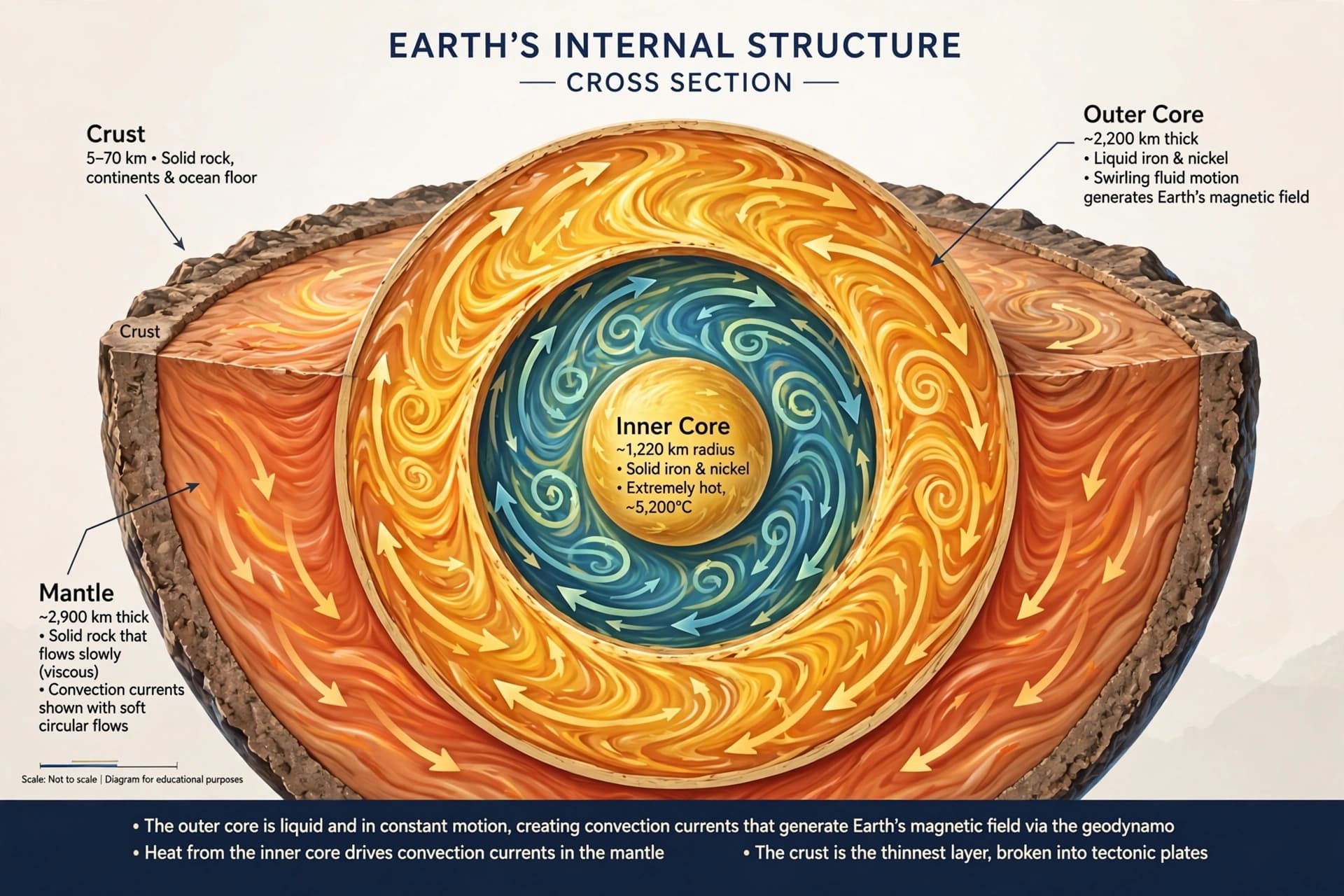
Time, as we measure it, is assumed to be constant, a steady tick of the clock that governs our daily lives. Yet, beneath our feet, deep within the Earth’s interior, forces are at work that subtly alter the length of our days. Recent research has revealed that movements in the planet’s core and mantle cause minute fluctuations in the Earth’s rotation speed, making some days slightly longer and others slightly shorter. This discovery reminds us that our planet is a dynamic, living system, constantly in motion and change.
The Earth’s rotation is not perfectly uniform. Over the course of a year, the length of a day can vary by milliseconds due to various factors, including atmospheric pressure, ocean currents, and the gravitational pull of the Moon. However, new studies indicate that processes deep within the Earth, particularly in the liquid outer core and the solid inner core, play a significant role in these variations. The interaction between these layers creates a complex dance of angular momentum that affects the planet’s spin.
Scientists have identified a specific oscillation in the Earth’s core, known as the Chandler wobble, which contributes to these changes. Additionally, the transfer of heat and material between the core and the mantle can alter the distribution of mass within the planet, much like a figure skater extending or pulling in their arms to change their spin rate. These internal shifts, though imperceptible to human senses, are detectable by precise atomic clocks and satellite measurements.
The implications of these findings extend beyond mere curiosity. Accurate timekeeping is essential for modern technology, including GPS navigation, telecommunications, and financial transactions. Even a millisecond discrepancy can cause errors in these systems, requiring regular adjustments through the insertion of leap seconds. Understanding the internal drivers of rotational change helps scientists predict these adjustments more accurately and maintain the synchronization of global time standards.
Furthermore, studying the Earth’s interior dynamics provides insights into the planet’s geological history and future. The core’s behavior influences the magnetic field, which protects us from solar radiation. Changes in rotation may be linked to shifts in the magnetic field, offering clues about the stability of this protective shield. By monitoring day length, scientists can indirectly observe processes happening thousands of kilometers below the surface.
The research also highlights the interconnectedness of Earth’s systems. The atmosphere, oceans, and solid earth are all coupled, influencing each other in complex ways. A change in one component can ripple through the others, creating a feedback loop that maintains the planet’s equilibrium. This holistic view is crucial for understanding climate change and other global phenomena.
As measurement techniques improve, scientists expect to uncover more details about these internal processes. Future missions and advanced seismological tools will allow for a deeper probe into the core’s structure and dynamics. Each new discovery adds to our understanding of the planet we call home, revealing the hidden rhythms that govern our existence.
The fluctuation in the length of our days is a subtle but significant reminder of Earth’s dynamic nature. Driven by forces deep within its interior, these changes connect the microscopic precision of atomic clocks to the macroscopic movements of the planet’s core. As we continue to study these phenomena, we gain a deeper appreciation for the complex machinery that keeps our world turning.
AI Image Disclaimer: The images accompanying this report are AI-generated illustrations intended to represent the concept of Earth’s internal structure and rotation, not actual seismic data or cross-sections.
Sources: Live Science, NASA Earth Observatory, The Conversation, Geophysical Research Letters
Published by Banx Network. This article is part of the Banx decentralized media programme, powered by the BXE token on the XRP Ledger.