Memory Is More Than a Record of the Past
Every human life is built from memories.
Your first day at school.
A conversation you never forgot.
The face of someone you love.
The sound of music from your childhood.
The place where you grew up.
The most embarrassing moment of your life.
A memory can feel like a recording.
But biologically, it is nothing like one.
The brain does not appear to store experiences as simple video files waiting to be played back.
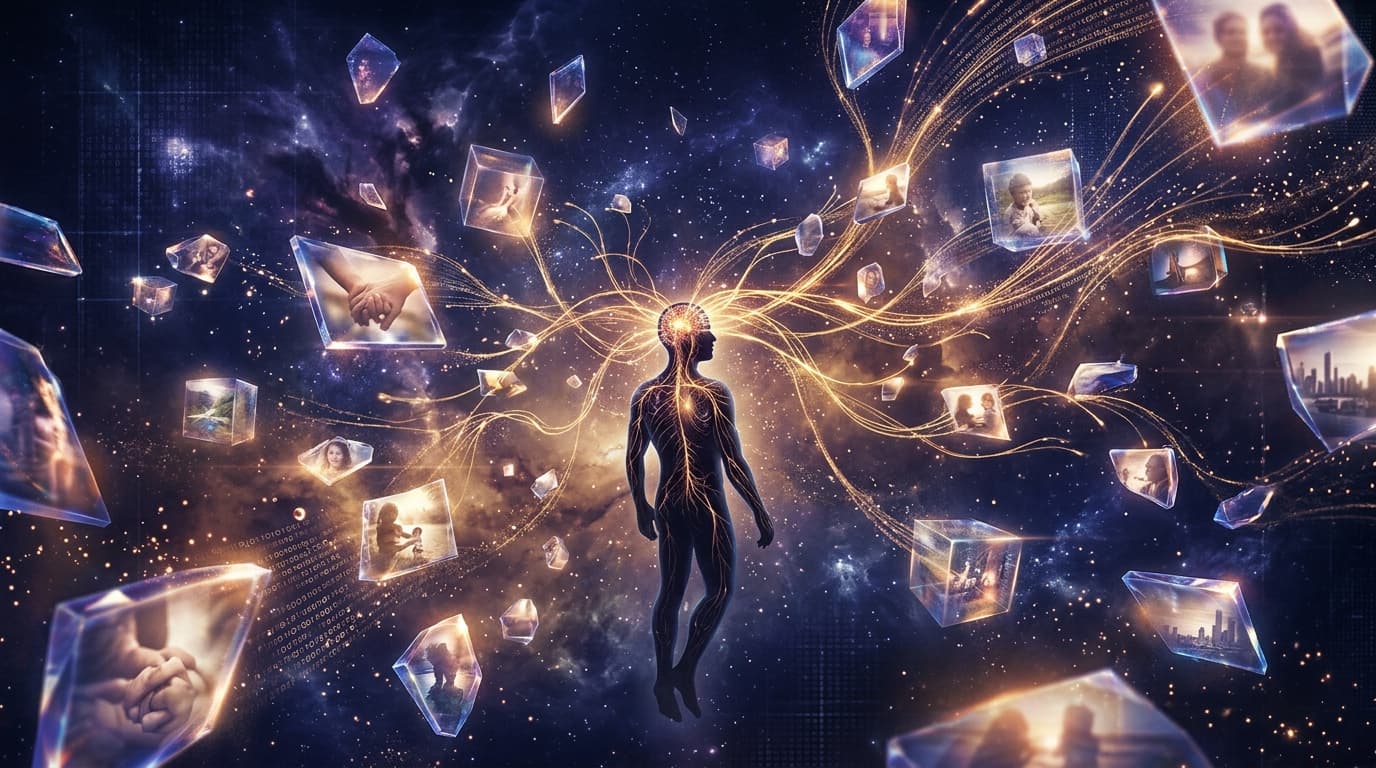
Instead, memories emerge from changes across populations of neurons, connections between brain regions and patterns of neural activity.
Modern neuroscience refers to the physical and biological substrate associated with a memory as an engram.
Researchers increasingly understand that these memory representations can involve distributed neural ensembles rather than a single location in the brain.
That distinction could determine whether humanity ever develops a true memory technology.
Because before we can record a memory, we first need to understand what exactly we are recording.
Where Does a Memory Actually Live?
For decades, scientists have searched for the physical basis of memory.
The answer is becoming clearer—but also more complicated.
The hippocampus plays a central role in forming and retrieving many types of episodic memories.
Other areas of the brain contribute sensory, emotional, spatial and conceptual information.
A single experience can therefore involve multiple neural systems.
Researchers have found evidence that memory-related neural ensembles can be distributed across interconnected brain regions and can change over time.
This creates a fascinating problem.
If your memory of a holiday involves:
visual information sounds locations emotions people smells language expectations
then a machine would potentially need to capture much more than one simple neural signal.
It would need to understand the relationships between them.
That is where artificial intelligence could become important.
The Brain Doesn't Store Memories Like a Hard Drive
The computer metaphor is tempting.
We write data.
We store data.
We retrieve data.
We delete data.
The brain is fundamentally different.
Memory is dynamic.
The act of remembering can itself change a memory.
Research into memory engrams increasingly suggests that memories are not perfectly fixed representations. They can be updated, linked to other memories and modified during reconsolidation.
That means remembering your childhood may not be like opening an old file.
It may be closer to reconstructing the past each time you access it.
The implication is profound.
A future memory-recording device might not produce an objectively perfect copy of an experience.
It could produce a technological reconstruction of something that was already reconstructed by the brain.
The Memory Engram
The concept of the engram has become central to modern memory research.
An engram can be thought of as the physical changes associated with a memory.
Researchers have used sophisticated techniques to identify and manipulate memory-related cell populations, particularly in animal models.
These experiments have shown that specific groups of neurons can become associated with particular memories and that manipulating these populations can influence memory-related behaviour.
But there is no single "memory neuron."
A memory is far more complicated.
It can involve ensembles of neurons, synaptic changes and communication between different brain regions.
And those representations can change.
The brain is constantly rewriting itself.
The First Memory Revolution: Reading Brain Activity
Before technology can record memories, it needs to interpret brain activity.
This is already happening at a basic level.
Brain-computer interfaces can record neural signals and use algorithms to infer information from them.
Researchers have used machine learning to decode aspects of perception, attention and memory from neural activity.
A 2025 Nature Communications study demonstrated that machine learning could improve prediction of episodic memory performance by combining multiple cognitive components of brain activity rather than treating memory as a single process.
That may sound modest.
But it represents an important transition.
The machine is not simply recording brain activity.
It is beginning to infer something about what the brain is doing.
From Brain Signals to Meaning
The next step is much harder.
Instead of determining whether someone is likely to remember something, could a machine determine what they remember?
This is where modern neural decoding becomes fascinating.
Researchers have increasingly used AI models to connect patterns of brain activity with information about images, language and mental representations.
In 2025, researchers reported a method for decoding features of autobiographical mental imagery from fMRI activity using a general semantic model. The study demonstrated that aspects of internally generated personal imagery could be related to neural representations in ways that could be decoded computationally.
This is not a machine downloading someone's memories.
It is not a perfect mind reader.
But it demonstrates something important:
information associated with personal mental experiences can leave measurable patterns in brain activity.
AI Could Become the Translator
The brain does not communicate in English.
It communicates through electrical and chemical activity.
A future memory technology would therefore require a translator.
AI could potentially learn the relationship between:
neural activity → brain state → perception → memory representation → language
The more data a system receives, the better its model could potentially become.
Imagine a future neural interface learning your personal brain patterns over years.
It could learn:
how you recognise faces.
how you remember places.
how you imagine objects.
how you retrieve names.
how you experience emotions.
how you recall specific events.
Eventually, it might build a highly personalised model of your cognitive representations.
That would be far more powerful than a generic brain decoder.
The Personal Brain Model
Imagine wearing a neural interface for twenty years.
It continuously learns your brain.
Not necessarily recording every thought, but building a model of how your brain represents information.
Over time, the system becomes increasingly familiar with you.
It knows how your brain represents:
your childhood home.
your family.
your favourite songs.
your memories of school.
your travels.
your relationships.
your fears.
your ambitions.
Your brain becomes, in effect, a continuously evolving dataset.
This raises an extraordinary possibility.
Could your memories eventually become searchable?
Imagine Searching Your Own Memory
Picture opening an interface and asking:
"Show me the last time I visited this place."
The system searches your neural history.
It identifies a matching pattern.
Then reconstructs the associated visual and semantic information.
You see an approximation of the experience.
Not necessarily an exact recording.
But a technologically reconstructed memory.
The interface might show:
where you were.
who was with you.
what you saw.
what you were discussing.
what objects were present.
Perhaps even aspects of how you felt.
That would be unlike anything humans have ever possessed.
Memory Reconstruction Is Already Becoming More Sophisticated
Researchers are already studying how neural activity corresponds to remembered experiences.
A 2025 Nature Communications study used fMRI during naturalistic movie viewing and later narrative recall to investigate neural representations associated with memory formation and retrieval. The researchers found relationships between hippocampal neural states during encoding and later memorability.
Other research has examined how neurons in the human hippocampus and amygdala represent visual objects during perception and memory.
In one 2025 study, researchers recorded activity from 3,173 individual neurons in these regions while participants performed visual recognition tasks, providing unusually detailed information about how human neural populations represent objects and memory.
The technology is not yet capable of downloading a lifetime of memories.
But scientists are progressively mapping the relationship between neural activity and remembered information.
Could We Record a Memory?
This is where science fiction begins to approach neuroscience.
A true memory recording system would need to capture enough information to reconstruct an experience.
But what exactly would it record?
Possibilities could include:
Visual representations.
Auditory information.
Spatial information.
Emotional states.
Semantic information.
Context.
Associations with other memories.
Internal thoughts.
The complexity is enormous.
The brain contains roughly 86 billion neurons and vastly more synaptic connections.
A complete recording of human memory would therefore be dramatically more complicated than recording a video.
You would not simply be recording what happened.
You would be recording how your brain represented what happened.
Could Memories Become Digital Files?
Possibly—but the term "file" may be misleading.
A digital memory representation could eventually consist of enormous amounts of information describing neural patterns and their relationships.
AI could translate some of that information into a reconstructed experience.
But whether that reconstruction would be identical to the original memory is another question entirely.
The system might produce:
a reconstruction of your memory.
Not necessarily:
your original memory.
That distinction becomes critical when we begin discussing identity.
The Memory Prosthesis
One of the most remarkable developments is that researchers are not only trying to read memory.
They are also investigating whether memory can be influenced through neural stimulation.
A 2024 study investigated a hippocampal neural prosthetic system designed to model aspects of memory encoding and deliver stimulation patterns to hippocampal regions.
The study involved patients who already had implanted electrodes for clinical epilepsy monitoring. Researchers reported changes in memory performance on some experimental tasks following stimulation, with stronger effects observed among participants with impaired memory receiving bilateral stimulation.
This is still experimental.
It is not a consumer memory implant.
It does not mean scientists can simply upload knowledge into someone's brain.
But it demonstrates an important principle:
neural activity associated with memory may be modifiable with carefully designed stimulation.
The Future Memory Implant
Imagine a much more advanced version of such a system.
A tiny implant communicates with the hippocampus.
AI interprets neural activity.
The system detects when a memory is being formed.
It recognises the neural signature.
Then it provides carefully timed stimulation designed to reinforce or support encoding.
The result could be a memory prosthesis.
Its first purpose would probably be medical.
Helping people with:
memory impairment.
brain injuries.
neurological disorders.
age-related cognitive decline.
dementia.
The technology could eventually become more ambitious.
From Repairing Memory to Enhancing Memory
The boundary between medicine and enhancement could become complicated.
Suppose a neural implant can help someone with severe memory impairment.
That is a medical treatment.
Now suppose the same technology can make a healthy person's memory significantly stronger.
That is enhancement.
And enhancement creates a new set of questions.
Would students use memory implants?
Would soldiers?
Pilots?
Surgeons?
Executives?
Athletes?
Would employers expect workers to use them?
Would governments regulate them?
Could enhanced memory become another form of inequality?
The End of Forgetting?
Forgetting is often treated as a defect.
But forgetting is also part of healthy cognition.
The brain cannot preserve every detail of every experience with equal strength.
Forgetting allows information to be prioritised.
It helps us generalise.
It helps us focus.
It may protect us from being overwhelmed by irrelevant information.
A technology that attempted to preserve everything could therefore create unexpected problems.
Imagine remembering every conversation.
Every face.
Every mistake.
Every embarrassing moment.
Every argument.
Every traumatic experience.
Perfect memory might not feel like a superpower.
It could feel like a burden.
Could Technology Record Dreams?
Dreams provide another fascinating challenge.
During sleep, the brain generates complex internal experiences without direct external stimulation.
If neural decoding becomes sufficiently advanced, could technology reconstruct aspects of dreams?
Researchers already study neural activity associated with imagery and internal mental states.
Future systems might potentially identify broad categories of dream content.
Perhaps:
a person.
a place.
movement.
speech.
emotion.
Visual imagery.
But reconstructing a complete dream would be vastly more difficult.
Dreams are unstable.
They are often fragmented.
And the person may forget them almost immediately after waking.
Still, the possibility is intriguing.
One day you might wake up and ask:
"What was I dreaming about?"
And your device might have an answer.
The Personal Memory Archive
Now imagine combining memory technology with ordinary digital life.
Your phone already records photographs.
Your smartwatch records activity.
Your devices store messages.
Your car may record journeys.
Your social media accounts store years of interactions.
Future neural systems could add another layer:
your internal perspective.
Instead of simply remembering where you went, you could preserve how you experienced it.
Instead of a photograph of a holiday, you could preserve aspects of what the holiday felt like to you.
Instead of a video of a conversation, you could preserve your own subjective interpretation of it.
That could create the most detailed personal archive humanity has ever produced.
The Problem With Subjective Memory
But there is an important catch.
Two people can experience the same event differently.
They can remember different details.
They can assign different emotional meanings.
They can construct completely different memories of the same conversation.
A technological memory archive would therefore not necessarily preserve objective reality.
It would preserve the individual's representation of reality.
That could make recorded memories both incredibly valuable and potentially misleading.
Could Memory Become Evidence?
Now imagine a courtroom.
A person's neural interface contains a reconstructed representation of an event.
Could lawyers use it as evidence?
Could police request access?
Could governments subpoena neural records?
Could a court determine whether a memory is genuine?
These questions sound futuristic.
But they become increasingly relevant as neural decoding improves.
Traditional digital privacy protects things like messages, photographs and files.
Future neural privacy may need to protect something much more intimate:
the contents of your mind.
The Rise of Cognitive Privacy
The concept of privacy could eventually expand.
Today, you can protect your:
passwords.
messages.
photographs.
financial information.
medical records.
In the future, you may also need to protect your:
thoughts.
memories.
emotions.
mental imagery.
attention.
intentions.
A brain-computer interface could potentially become one of the most sensitive devices a person owns.
Losing your phone would be inconvenient.
Losing control over a neural interface could be fundamentally different.
Who Owns Your Memories?
This may become one of the biggest legal questions of the century.
Suppose a company develops a neural interface.
You wear it for twenty years.
It collects information about your brain.
Who owns that information?
You?
The company?
Both?
What happens if you cancel your subscription?
Can the company retain your neural data?
Can it use your data to train AI?
Can it sell anonymised neural information?
Can law enforcement access it?
Can an employer request it?
Could an insurance company use it?
These questions have no simple technological answer.
They require law.
Could Someone Steal a Memory?
Cybersecurity could eventually move beyond passwords.
Imagine a hacker gaining access to a person's neural archive.
They could potentially obtain:
private memories.
personal experiences.
relationships.
fears.
traumatic experiences.
medical information.
mental imagery.
The consequences could be extraordinary.
A future cybersecurity industry may therefore have to protect not just computers and phones.
It may have to protect human cognition itself.
Could Memories Be Edited?
If technology can influence memory, another possibility emerges.
Could unwanted memories be modified?
Imagine a future therapy for trauma that helps reduce the emotional intensity associated with a traumatic memory.
That could be transformative.
But the same technology could potentially be abused.
What if someone altered a memory without your consent?
What if a government attempted to manipulate memories?
What if an abusive partner changed someone's perception of a relationship?
What if advertising could influence memories?
The ability to manipulate memory could become one of the most powerful technologies ever created.
Memory Editing Could Change Criminal Justice
Consider a different scenario.
A witness remembers a crime.
But human memory is imperfect.
Stress, suggestion and subsequent information can influence recollection.
Now imagine a future system capable of measuring neural activity associated with the memory.
Could it determine whether the witness is remembering an event accurately?
Probably not with perfect certainty.
A neural pattern is not automatically a truth detector.
But technology could potentially provide additional information about how a memory was encoded and retrieved.
This could eventually transform forensic neuroscience.
It could also create enormous opportunities for misuse.
A machine that claims to know whether someone is remembering the truth would have extraordinary social power.
The Digital Memory of a Dead Person
The most emotional application may come after death.
Imagine that someone spends their lifetime using a neural interface.
Their memories, preferences, speech patterns and personal experiences are partially preserved.
After they die, their family can interact with an AI trained on their recorded information.
It could remember:
family stories.
favourite places.
important events.
personal preferences.
The result could feel like communicating with the person.
But there would be an important question:
Is it actually them?
A Memory Is Not a Person
An AI trained on someone's memories might know an extraordinary amount about them.
It might speak like them.
Tell their stories.
Remember their childhood.
Recognise their family.
Predict what they might say.
But none of that necessarily means consciousness has survived.
The system could be a sophisticated reconstruction.
A model of a person.
Not the person themselves.
This distinction becomes even more important when considering digital immortality.
Could Your Memories Survive Your Body?
Imagine a future in which technology can preserve a detailed representation of your memories.
Your biological body eventually dies.
But the memory archive remains.
Your family could access it.
An AI could interpret it.
A virtual version of you could potentially use it.
From one perspective, part of your life would have survived.
From another perspective, nothing conscious survived at all.
The technology would have preserved information about you, not necessarily you.
That may become one of the central philosophical problems of the memory revolution.
The Copy Problem
Suppose technology creates a perfect digital representation of your memories.
Then it creates two copies.
Both remember your childhood.
Both know your family.
Both recognise your favourite music.
Both believe they are you.
Which one is the real you?
Biologically, neither would necessarily be your original consciousness.
Philosophically, the problem becomes even stranger.
If identity depends partly on continuity of experience, perhaps neither copy is you.
If identity depends on information, perhaps both are.
Technology could therefore turn an ancient philosophical thought experiment into an engineering problem.
What If Memories Could Be Transferred?
A more extreme possibility would be transferring memory-related information between biological brains.
Today, this is far beyond practical human medicine.
But if scientists eventually understood the neural code underlying specific memories well enough, they might investigate whether aspects of that information could be reproduced elsewhere.
Imagine learning a skill without years of practice.
Receiving a memory from someone else.
Sharing an experience directly between two brains.
It sounds impossible.
But it follows logically from one increasingly important idea:
if memories have physical representations, then in principle those representations contain information.
The technological challenge is understanding the code.
The Language of the Brain
Every technological memory system would eventually confront the same problem.
What is the brain's language?
We can measure electrical activity.
We can observe blood-flow changes.
We can record individual neurons.
We can examine synaptic changes.
We can map neural networks.
But measuring signals is not the same as understanding their meaning.
The brain does not have a universal dictionary where:
neuron 17 = grandmother
or:
pattern 42 = childhood holiday.
Meaning emerges from patterns, relationships and context.
That makes decoding extraordinarily difficult.
AI May Be the Missing Piece
This is where modern AI could change the equation.
The human brain is an enormous biological system.
Traditional analytical methods struggle with that complexity.
AI is designed to identify patterns across huge datasets.
Researchers are already applying machine learning to neural data to decode aspects of memory, perception and cognition.
As datasets improve, AI could potentially become a translator between neural activity and human-readable representations.
The machine would not necessarily understand consciousness.
It might simply become very good at predicting what certain patterns mean.
That alone could be revolutionary.
2030–2035: The Decoding Era
The next decade is likely to focus on increasingly accurate neural decoding.
Researchers may improve systems capable of interpreting:
speech intentions.
visual imagery.
attention.
memory formation.
emotional states.
movement.
Internal language.
Most applications will probably remain medical.
Helping people communicate.
Restoring movement.
Treating neurological disorders.
Improving memory after brain injury.
The technology will still be far from recording a complete human life.
But the foundations could become increasingly sophisticated.
2035–2040: The Personal Neural Model
If neural interfaces become more capable and less invasive, they could begin building personalised models of individual brains.
Your interface would learn your neural patterns.
AI would learn your cognitive signatures.
The system could become increasingly good at predicting what you are seeing, remembering or intending.
This could create a new category of personal technology:
the cognitive assistant.
Instead of waiting for you to type a command, it could understand aspects of your cognitive state directly.
2040–2050: The Memory Interface
The next stage could be direct interaction with memory.
A future system might help:
strengthen memories.
retrieve forgotten information.
support damaged memory systems.
organise personal experiences.
reconstruct aspects of past events.
Perhaps even generate immersive representations of remembered experiences.
At that point, the line between memory and technology would become extremely thin.
The Memory Economy
A new industry could emerge around human memory.
Memory storage.
Neural backups.
Cognitive healthcare.
Memory enhancement.
Neural cybersecurity.
Personal neural AI.
Digital legacy services.
Memory reconstruction.
Brain-data insurance.
The economic value could be enormous.
Human beings already spend billions preserving photographs, videos and personal records.
Imagine adding the brain itself to the equation.
The Most Valuable Data on Earth
Companies already compete for personal data.
But neural data could be more valuable than almost anything currently collected.
A shopping history tells a company what you purchased.
A neural record could potentially reveal what you perceive, remember, attend to or imagine.
That would be vastly more intimate.
The companies controlling neural interfaces could therefore possess unprecedented amounts of information about human beings.
The question becomes:
Who controls the infrastructure connecting humanity to its own minds?
The Great Ethical Boundary
There may eventually be a line that society refuses to cross.
Perhaps people will accept neural technology for treating disease.
Maybe memory assistance.
Maybe communication.
But direct access to private memories could remain protected.
Governments could establish strict cognitive privacy laws.
Neural data might become legally classified as an especially sensitive category.
Consent could become more important than ever.
The principle might eventually be simple:
Your brain belongs to you.
The Three Possible Futures Scenario One: Medical Memory Technology
The most realistic future.
Neural interfaces help people suffering from memory impairment.
AI assists diagnosis.
Implants support damaged neural circuits.
Memory enhancement remains primarily therapeutic.
Scenario Two: Personal Memory Systems
Technology becomes capable of recording and reconstructing increasingly detailed aspects of personal experiences.
People maintain private neural archives.
Memories become searchable.
AI becomes a personal cognitive assistant.
Scenario Three: The Memory Internet
The most radical possibility.
Humans can directly exchange information between brains and computers.
Experiences can be partially recorded.
Memories can be reconstructed.
Neural communication becomes a new form of digital communication.
The internet no longer connects computers.
It connects minds.
The Internet of Minds
Today's internet connects information.
The next generation of neural technology could potentially connect experiences.
Imagine sending someone a message that is not text.
Not an image.
Not a video.
But a reconstruction of an experience.
A memory.
A sensation.
A place.
An emotion.
The receiver does not simply read about what happened.
They experience an approximation of how you remember it.
That would be a fundamentally different form of communication.
Would That Make Humanity More Connected?
Perhaps.
But it could also create new forms of manipulation.
Today, misinformation spreads through text, images and video.
Tomorrow, it could potentially be delivered through neural interfaces.
Imagine propaganda designed not merely to convince you intellectually, but to influence how your brain represents an experience.
That would create an entirely new battlefield.
The battle for information could become a battle for memory itself.
The End of Private Experience?
This may be the darkest possibility.
For most of human history, there has been one place nobody else could directly access:
your mind.
People could hide their thoughts.
Hide their memories.
Hide their emotions.
Neural technology could weaken that boundary.
If machines become capable of interpreting increasingly detailed brain activity, society will have to decide how much access is acceptable.
The ability to read a mind does not automatically create the right to read it.
Technology may make cognitive privacy technically possible to invade long before society has decided whether it should be.
Memory Could Become Humanity's Next Digital Frontier
The first digital revolution moved information outside the human brain.
Books.
Computers.
The internet.
Cloud storage.
The next revolution could move in the opposite direction.
Technology would begin interacting directly with the information inside the brain.
That does not mean uploading consciousness.
It does not mean downloading memories tomorrow.
It means something more gradual.
Machines are becoming better at interpreting neural activity.
AI is becoming better at modelling complex information.
Brain-computer interfaces are becoming more sophisticated.
Neuroscience is becoming better at understanding the physical basis of memory.
These trends are converging.
We May Eventually Record What Was Once Impossible to Record
Humanity has already learned to record sound.
Then images.
Then video.
Then location.
Then biological activity.
The next frontier may be subjective experience.
Not perfectly.
Not completely.
But increasingly.
A future generation may look at today's photographs and videos the way we look at ancient paintings.
They will preserve what happened.
Future technology could potentially preserve something closer to:
how it felt to be there.
The Ultimate Question
Imagine that one day technology can reconstruct one of your childhood memories with extraordinary accuracy.
You put on a neural interface.
The system activates.
Suddenly you are back there.
You can see the room.
Hear the voices.
Feel the atmosphere.
Remember the people.
For a few moments, the past becomes technologically accessible.
Then the interface stops.
You open your eyes.
And you realise something extraordinary.
Humanity has developed a machine capable of reaching into the most private archive in existence:
the human mind.
At that point, the biggest question will not be whether the technology works.
It will be:
Who gets access?
The Memory Revolution
Humanity once recorded its history on stone.
Then paper.
Then photographs.
Then magnetic tape.
Then digital storage.
Now we are beginning to explore something far more ambitious.
The brain itself.
We do not yet know how to perfectly record a human memory.
We cannot download someone's childhood.
We cannot copy consciousness.
We cannot upload a person into a computer.
And we certainly cannot turn memories into flawless digital files.
But the scientific foundations are developing.
Researchers are identifying neural ensembles associated with memory.
AI systems are decoding increasingly sophisticated patterns of brain activity.
Neural interfaces are beginning to interact with memory-related circuits.
And researchers are demonstrating that aspects of internal mental imagery and autobiographical representations can be decoded from brain activity.
The technology is still primitive compared with science fiction.
But primitive technologies have a habit of becoming something much more powerful.
The first computers filled rooms.
The first mobile phones were enormous.
The early internet was painfully slow.
The first neural interfaces are similarly limited.
But they are beginning to establish a connection between two worlds that have historically been separate:
the human mind and the machine.
The next technological revolution may therefore not be about making computers faster.
It may be about making computers understand us more deeply.
And eventually, humanity may have to confront a possibility that once belonged entirely to science fiction:
What happens when our memories are no longer trapped inside our minds?
References
[1] Zhang, Y. & Roy, D. S. — Memory Storage in Distributed Engram Cell Ensembles, Advances in Neurobiology, 2024. Research examining the distributed cellular basis of memory engrams.
[2] Lopez, M. R. et al. — Mystery of the memory engram: History, current knowledge, and unanswered questions, Neuroscience & Biobehavioral Reviews, 2024.
[3] Guskjolen, A. & Cembrowski, M. S. — Engram neurons: Encoding, consolidation, retrieval, and forgetting of memory, 2023. Review of the cellular and circuit mechanisms underlying memory.
[4] Zaki, Y. & Cai, D. — Memory engram stability and flexibility, Molecular Psychiatry, 2024. Research examining memory stability, updating, reconsolidation and representational change.
[5] Choucry, A. et al. — Engram mechanisms of memory linking and identity, Nature Reviews Neuroscience, 2024.
[6] Mirjalili, S. & Duarte, A. — Using machine learning to simultaneously quantify multiple cognitive components of episodic memory, Nature Communications, 2025.
[7] Anderson, A. J. et al. — Neural decoding of autobiographical mental image features with a general semantic model, Nature Communications, 2025. Research demonstrating decoding of features associated with autobiographical mental imagery.
[8] Kwon, D. et al. — Coordinated representations for naturalistic memory encoding and retrieval in hippocampal neural subspaces, Nature Communications, 2025.
[9] Cao, R. et al. — A neuronal code for object representation and memory in the human amygdala and hippocampus, Nature Communications, 2025.
[10] Roeder, B. M. et al. — Developing a hippocampal neural prosthetic to facilitate human memory encoding and recall of stimulus features and categories, Frontiers in Computational Neuroscience, 2024.
[11] Song, D. et al. — Decoding Naturalistic Episodic Memory with Artificial Intelligence and Brain-Machine Interface, Advanced Science, 2026. Recent research exploring AI-assisted decoding of episodic memory through brain-machine interfaces.
[12] Mind-captioning AI decodes brain activity to turn thoughts into text, Nature, 2025. Reporting on advances in AI-based decoding of internally generated mental content.
Published by Banx Network. This article is part of the Banx decentralized media programme, powered by the BXE token on the XRP Ledger.