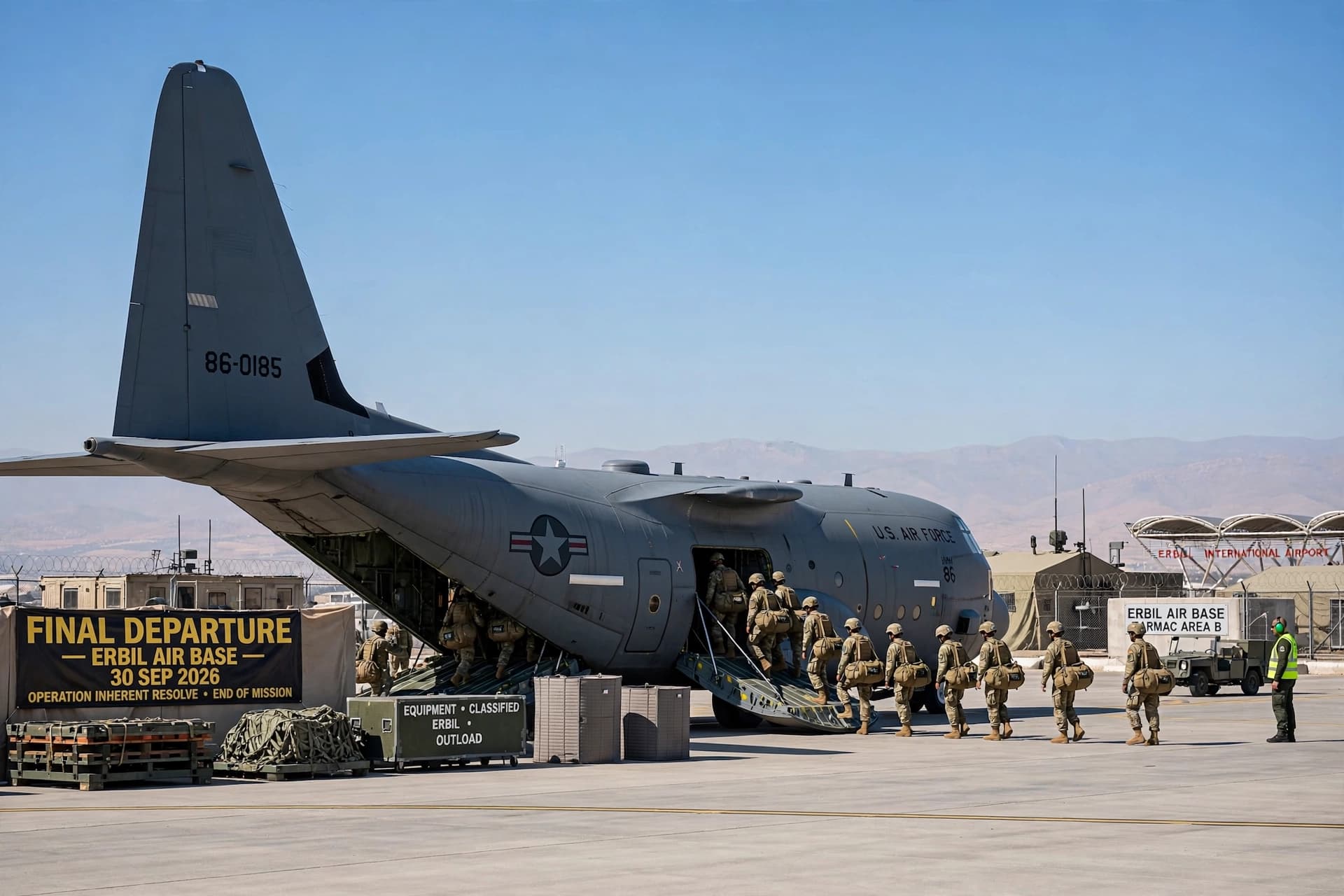
There is a quiet finality to the departure of troops, a folding of flags and loading of equipment that marks the end of something that once seemed permanent. On Wednesday, the last American and British forces left Erbil Air Base in northern Iraq, formally concluding Operation Inherent Resolve—a mission that began in 2014 to defeat the Islamic State and has now ended after twelve years, more than 2,000 American lives lost in the broader Iraq war, and a final chapter that leaves the country's security in Iraqi hands .
The Pentagon declared the mission's end with a statement from spokesman Sean Parnell, who said the "orderly departure" marked "the successful conclusion of the military mission that defeated ISIS in Iraq." The transition, he said, moves from "a wartime coalition mission to an Iraqi-led security effort supported by a more normal bilateral security relationship" . Iraqi Prime Minister Ali al-Zaidi hailed the withdrawal as the beginning of a new phase defined by "Iraq's sovereignty, the strength of its institutions, and the readiness of its forces" .
The departure fulfills an agreement signed in September 2024 between the Biden administration and the Iraqi government, which set a two-phase withdrawal: first from federal Iraq, then from the Kurdistan region by September 2026 . At its peak during the 2007 surge, the U.S. had more than 170,000 troops in Iraq. By this year, only about 2,000 remained, mostly at Erbil .
But the end of the coalition mission does not mean the end of the threat. A recent UN report assessed that ISIS retains several hundred fighters in Iraq, capable of "unsophisticated operations only" . The group still has up to 3,000 fighters in neighboring Syria, where U.S. forces continue to operate. The coalition's joint task force has relocated to Jordan, from where it will continue providing "targeted training and intelligence support" to Iraqi partners .
The greater concern may be the militias. Iranian-backed armed groups in Iraq have long used the presence of foreign troops as justification for retaining their weapons. With the Americans gone, Prime Minister al-Zaidi has vowed to disarm them and bring all weapons under state control—a promise that powerful factions have already resisted. He told The New York Times he now expects the groups to disband by June 2027, after initially setting a September 2026 deadline . Kata'ib Hezbollah, one of the strongest Iran-aligned militias, responded with a threat: if the government acts against "the interests of the people," it will be overthrown "by every means" .
In the Kurdistan region, where Erbil Air Base was located, the withdrawal has brought anxiety rather than relief. The Peshmerga, the Kurdish military force, noted that during the recent U.S.-Iran war, the region was targeted by more than 1,000 drone and ballistic missile attacks. "Under such complex regional circumstances, the departure of the U.S. from the Kurdistan region without providing defense systems is a concerning matter," the Peshmerga said in a statement . For now, Iraq assumes full responsibility for its own security—and the questions that come with it.
AI Image Disclaimer: The accompanying images in this report were created with artificial intelligence and are intended for conceptual representation only.
Sources: BBC, CBS News, Al Arabiya English, KBS, RaiNews, RSI
Published by Banx Network. This article is part of the Banx decentralized media programme, powered by the BXE token on the XRP Ledger.