The boundary between the microscopic world of quantum physics and the macroscopic realm of biology has long been a subject of fascination and debate. While some researchers argue that biological processes rely on quantum mechanics, a new perspective suggests a different connection: the mathematics used to describe quantum systems may also be the best tool for understanding complex biological networks. This insight does not imply that cells are quantum computers, but rather that the probabilistic nature of quantum math offers a powerful lens for viewing the uncertainty and complexity of life.
Traditional biology often relies on deterministic models, assuming that if we know the initial conditions, we can predict the outcome. However, living systems are inherently noisy and unpredictable, influenced by countless variables that interact in non-linear ways. Quantum mechanics, with its foundation in probability amplitudes and wave functions, provides a mathematical framework that is well-suited to handling such uncertainty. By applying these tools, scientists can model biological phenomena with greater accuracy and nuance.
Recent studies have shown that quantum-like mathematical structures can describe processes such as gene regulation, neural activity, and protein folding. For example, the way genes switch on and off can be modeled using concepts similar to quantum superposition, where a system exists in multiple states until measured. This does not mean the genes are literally in two states at once, but that the probability of their expression follows similar mathematical rules. This approach allows researchers to capture the fluidity and context-dependence of biological systems.
The application of quantum math to biology is part of a broader trend toward interdisciplinary science. It bridges the gap between physics and life sciences, fostering collaboration and innovation. By borrowing tools from one field to solve problems in another, scientists can uncover patterns and principles that might otherwise remain hidden. This cross-pollination of ideas is essential for tackling the complex challenges of modern biology, from understanding disease mechanisms to designing new therapies.
Critics of the "quantum biology" hypothesis often point out that biological systems are too warm and wet for delicate quantum effects like entanglement to survive. The new perspective sidesteps this debate by focusing on the mathematics rather than the physical mechanism. It acknowledges that while the hardware of life may be classical, the software—the logical structure of its processes—may share features with quantum algorithms. This distinction is crucial for avoiding misconceptions and focusing on practical applications.
For researchers, this approach opens up new avenues for modeling and simulation. It allows for the creation of more robust predictive models that can account for variability and noise. In fields like neuroscience, where the brain’s complexity defies simple explanation, quantum-like models offer a way to describe the emergence of consciousness and decision-making from neural activity. These models are not final answers but useful tools for exploring the unknown.
As the field evolves, it is likely that more biological processes will be described using quantum-inspired mathematics. This does not diminish the uniqueness of life but rather highlights the universality of certain mathematical principles. Whether in the spin of an electron or the firing of a neuron, the language of probability and uncertainty remains a constant companion.
The realization that biology’s math is quantum-like offers a fresh perspective on the complexity of life. It invites scientists to look beyond traditional boundaries and embrace new tools for understanding the living world. While the physical reality of cells may remain classical, the mathematical shadows they cast may well be quantum.
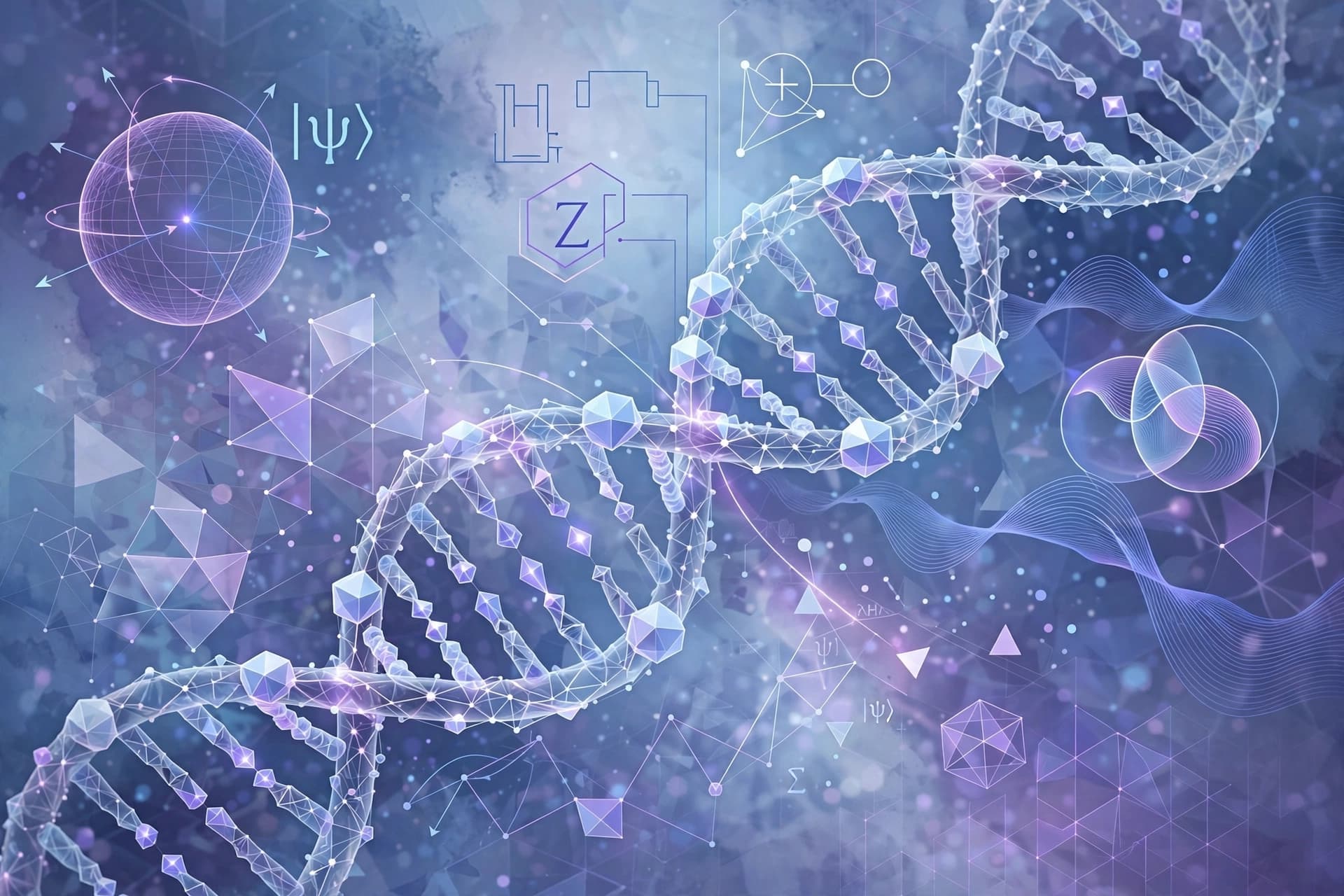
AI Image Disclaimer: The visuals in this article are AI-generated artistic interpretations intended to illustrate the concept of mathematical overlap between physics and biology, not actual microscopic images or data plots.
Sources: Quanta Magazine, Nature Physics, Scientific American, Phys.org
Published by Banx Network. This article is part of the Banx decentralized media programme, powered by the BXE token on the XRP Ledger.