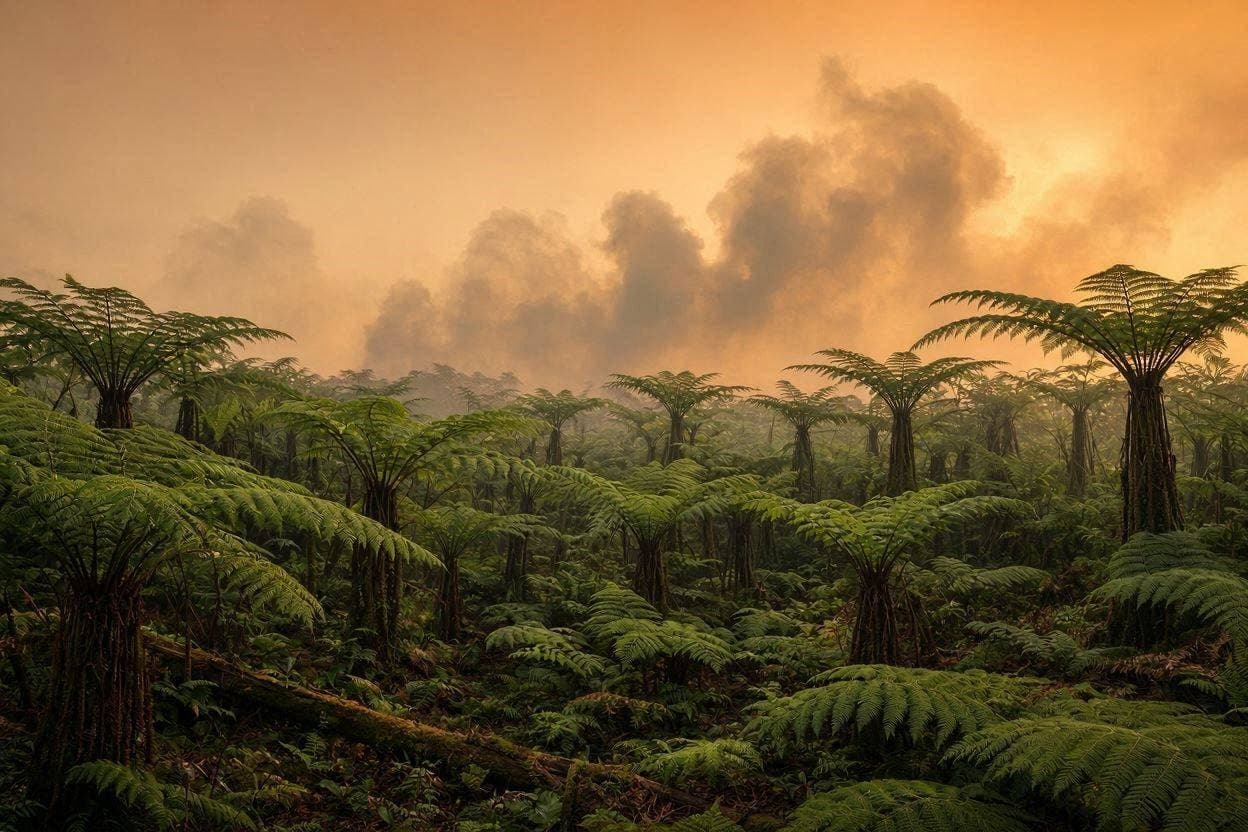
Fire is a primal force, both destroyer and renewer, shaping landscapes and ecosystems over millennia. In the Triassic period, roughly 240 million years ago, Europe was a landscape dominated by vast forests of ancient ferns. Recent research suggests that these plants, with their unique chemical composition, may have turned the continent into a tinderbox, prone to frequent and intense wildfires. This discovery invites us to reflect on the delicate balance between flora and fire, and how the very plants that cover the earth can dictate the rhythm of its destruction and rebirth.
Body: During the Triassic, the climate was hot and dry, creating ideal conditions for combustion. The dominant vegetation consisted of ferns and other early seed plants, which contained high levels of volatile organic compounds. These chemicals, while useful for defense against herbivores, also made the plants highly flammable. When lightning struck or temperatures soared, these forests did not just burn; they exploded into infernos that could spread rapidly across the landscape.
Geological evidence supports this theory. Sediment layers from the Triassic period contain high concentrations of charcoal, indicating widespread fire activity. By analyzing the chemical signatures of these charred remains, scientists have linked the frequency of fires to the abundance of ferns. The correlation suggests that the vegetation itself was a primary driver of the fire regime, creating a feedback loop where fire cleared the land for more fire-prone plants to grow.
This dynamic had profound implications for the evolution of life. Frequent fires would have shaped the behavior and physiology of early animals, forcing them to adapt to a volatile environment. Some may have developed burrowing habits to escape the heat, while others evolved to feed on post-fire regrowth. The ecosystem was not static but in a constant state of flux, driven by the cyclical nature of burning and regeneration.
Understanding this ancient fire cycle helps us contextualize modern wildfires. While today’s fires are often exacerbated by human activity and climate change, the fundamental relationship between plant chemistry and combustion remains unchanged. Studying the Triassic provides a baseline for understanding how natural systems operate without human interference, offering insights into the resilience of ecosystems under stress.
The research also challenges the notion that forests are always stable carbon sinks. In the Triassic, the frequent release of carbon through wildfires may have contributed to atmospheric changes, influencing global climate patterns. This perspective highlights the complex role of vegetation in the Earth’s carbon cycle, acting as both a storehouse and a source of greenhouse gases depending on environmental conditions.
For paleobotanists, the Triassic fern forests are a window into a world ruled by fire. It reveals a time when life was tough, resilient, and intimately connected to the destructive power of flames. The ferns, though simple in structure, played a pivotal role in shaping the geological and biological history of the planet.
Closing: The image of Triassic Europe as a wildfire inferno is a stark reminder of nature’s power. It shows that fire is not an anomaly but an integral part of many ecosystems. By studying these ancient burns, we gain a deeper appreciation for the forces that have shaped our world, long before humans walked the earth.
AI Image Disclaimer: Visuals in this article are AI-generated representations of prehistoric landscapes and botanical structures, intended to illustrate the concept of ancient wildfires without depicting specific real-time events.
Sources: Nature Communications University of Bristol Research ScienceDaily Geological Society of America
Published by Banx Network. This article is part of the Banx decentralized media programme, powered by the BXE token on the XRP Ledger.