In the vast, silent theater of the cosmos, black holes are often portrayed as cosmic vacuum cleaners, devouring everything in their path. Yet, some of these enigmatic entities are also the universe’s most powerful engines, launching jets of plasma that stretch across galaxies. For decades, astronomers have wondered if the mechanisms driving these jets differ between small, stellar-mass black holes and their colossal, supermassive counterparts. New research suggests a surprising unity: despite their vast differences in scale, both types may obey the same fundamental rules when it comes to launching these energetic beams.
The study focuses on the relationship between the power of the jet and the accretion rate, or how quickly matter falls into the black hole. By analyzing data from various sources, including X-ray binaries and active galactic nuclei, researchers found a consistent correlation. This implies that the physics governing jet formation is scale-invariant. Whether the black hole is the mass of a few suns or billions of suns, the efficiency with which it converts infalling matter into directed energy appears to remain constant. It is a elegant simplification in a complex field.
This finding challenges previous assumptions that different processes might be at play. Stellar-mass black holes, formed from the collapse of massive stars, were thought to operate differently than supermassive black holes, which reside at the centers of galaxies. The discovery of a universal rule suggests that the underlying magnetic fields and plasma dynamics are robust enough to function similarly across orders of magnitude. It hints at a deeper symmetry in the laws of physics, one that transcends size and location.
For astrophysicists, this unity offers a powerful tool for understanding black hole behavior. If the same rules apply, observations of smaller, more accessible black holes can help model the behavior of distant, supermassive ones. This cross-pollination of data allows for more accurate predictions about galaxy evolution and the feedback loops that regulate star formation. It bridges the gap between local phenomena and cosmic structures, creating a more cohesive picture of the universe.
The jets themselves are marvels of natural engineering. Powered by the rotation of the black hole and the twisting of magnetic fields, they accelerate particles to near-light speeds. These beams can influence their surroundings, heating gas and preventing it from cooling into new stars. Understanding the universal rule behind their launch helps explain how black holes shape the galaxies they inhabit, acting not just as destroyers but as architects of cosmic structure.
However, questions remain. While the correlation is strong, the exact mechanisms of magnetic field generation and stability are still subjects of intense debate. Future observations with next-generation telescopes will be crucial for testing the limits of this rule. Scientists are eager to see if it holds true for intermediate-mass black holes, a elusive category that has been difficult to study. Each new discovery adds a piece to the puzzle, refining our understanding of these cosmic giants.
The implications extend beyond astronomy into fundamental physics. Testing these rules in extreme gravity environments provides insights into general relativity and plasma physics that cannot be replicated on Earth. It is a reminder that the universe serves as a natural laboratory, offering experiments on scales and energies far beyond human capability. By observing black holes, we learn not just about them, but about the fabric of reality itself.
In the end, the discovery of a universal jet-launching rule brings a sense of order to the chaos of the cosmos. It suggests that despite the diversity of black holes, there is a common thread connecting them all. As we continue to probe the depths of space, this unity serves as a guide, helping us navigate the mysteries of the dark. It is a testament to the elegance of nature, where simplicity often underlies complexity.
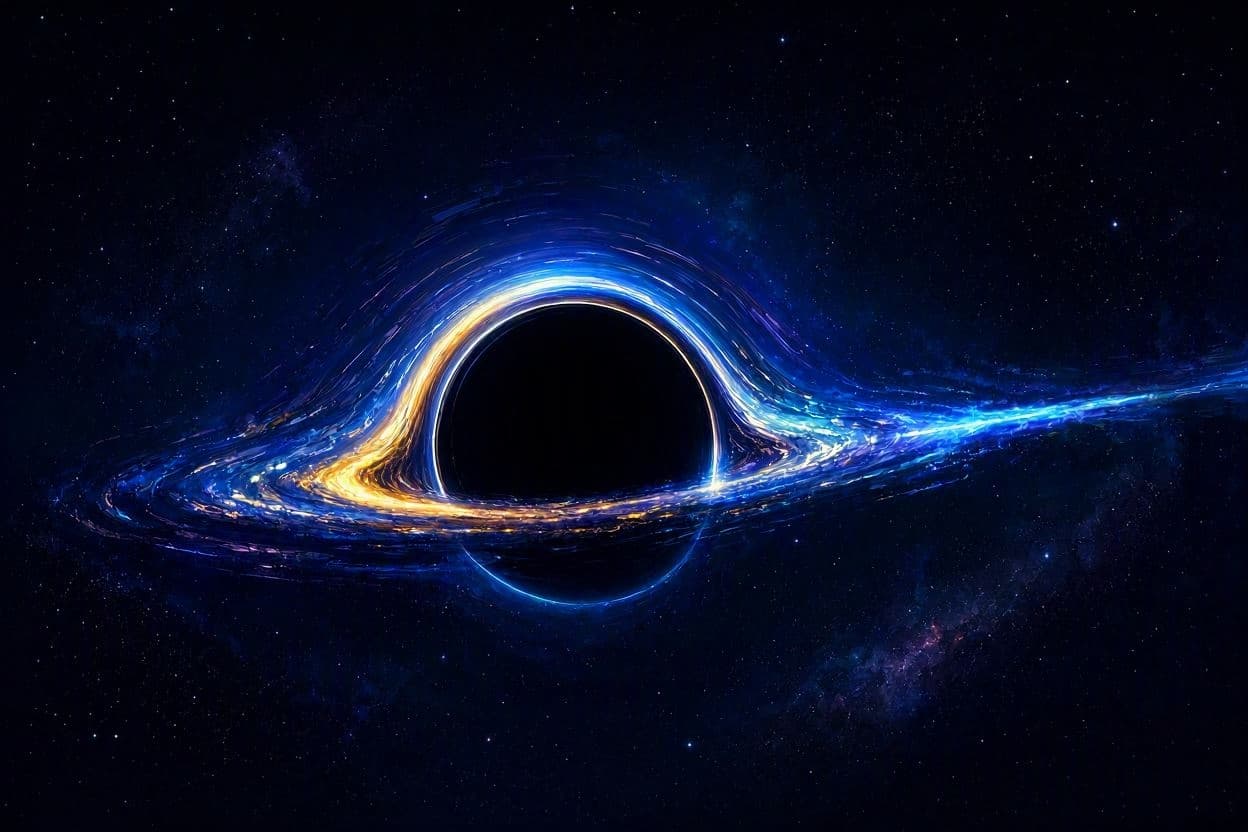
AI Image Disclaimer: The visual representations included here are AI-generated illustrations designed to depict black holes and cosmic jets, not actual photographs or telescope images of specific celestial objects.
Sources: Nature Astronomy ScienceDaily Phys.org
Published by Banx Network. This article is part of the Banx decentralized media programme, powered by the BXE token on the XRP Ledger.