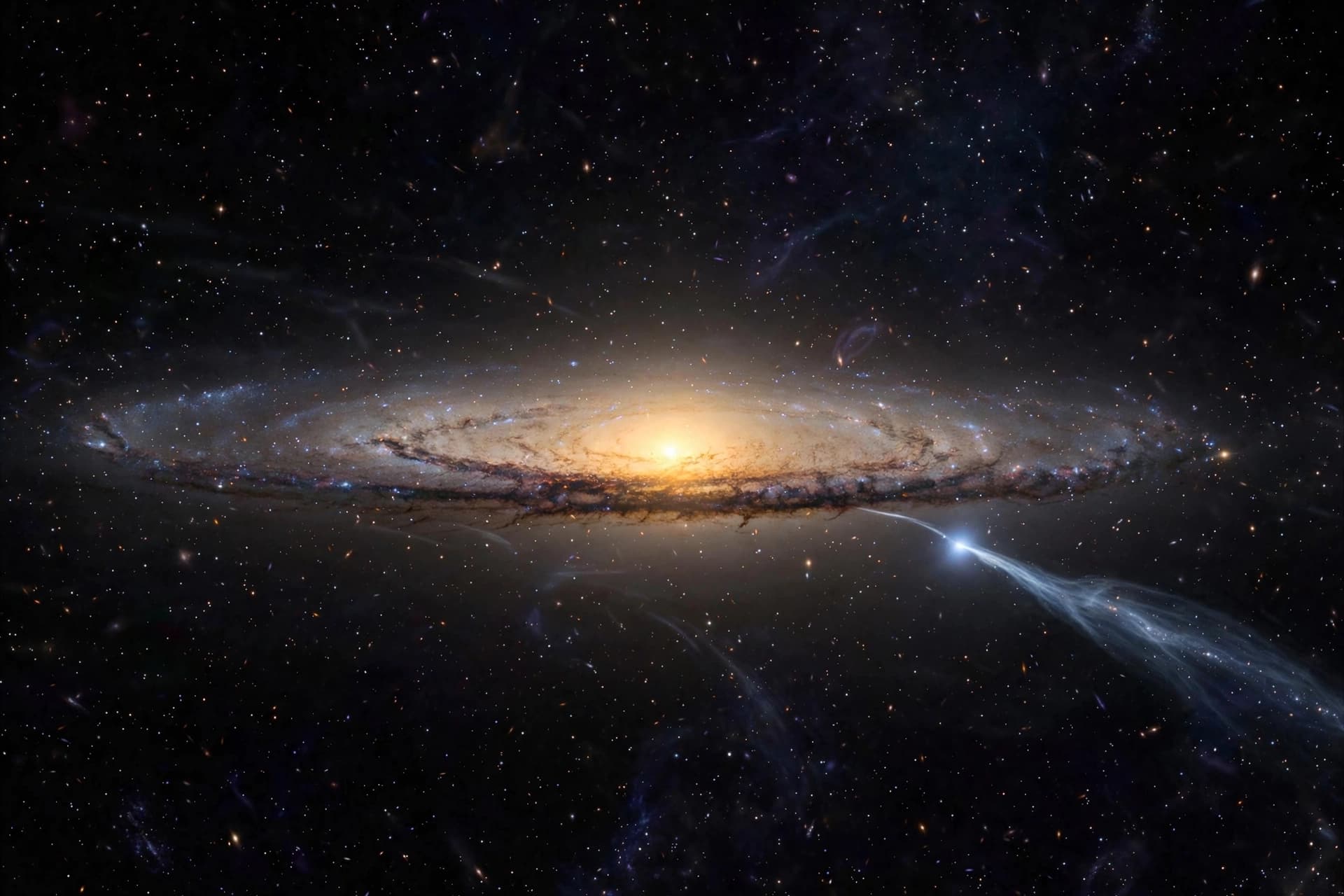
There is a poignancy in the idea of an exile that carries its homeland with it. Astronomers have long known that when galaxies merge, the supermassive black holes at their centers do not always settle peacefully into a new home. Some are flung outward, cast adrift in the cosmos, wandering the darkness for billions of years. New research suggests that these rogue black holes may be more than cosmic curiosities. They may be archivists, carrying within their motion the history of the galaxies they left behind.
A team led by Emma Jane Weller of Yale University used a cosmological simulation called ASTRID to trace the evolution of black holes and galaxies over 12.6 billion years, modeling systems with masses between 10 million and 1 billion times that of the sun . Unlike most simulations that pin black holes to galactic centers, ASTRID allows them to roam—and roam they do, particularly in smaller galaxies where gravitational forces are weaker and the journey back to the center can take eons .
The findings, published in The Astrophysical Journal Letters, reveal a striking pattern. Low-mass galaxies are more likely to host wandering black holes than central ones. And galaxies that have stopped forming stars tend to have their black holes at the center, while those still actively forming stars are more likely to host wanderers . This correlation hints at a deeper connection between black hole mobility and galactic evolution.
"What is exciting about our findings is that black holes seem to remember more than the circumstances of their birth," said Priyamvada Natarajan, a Yale astrophysicist and co-author. "Their present-day locations carry the imprint of everything that has happened to their host galaxies. By separating black holes at galactic centers from those that are wandering, we can begin to disentangle these two histories" .
The research touches on a fundamental question in astrophysics: how did the first supermassive black holes form? One theory suggests they grew from "light seeds"—the collapsed remnants of early massive stars. Another proposes "heavy seeds"—direct collapses of dense gas clouds in the infant universe . If wandering black holes preserve information about their origins, they could help settle that debate.
Observational evidence is beginning to catch up with theory. In July 2026, astronomers announced the discovery of TDE 2025abcr, a tidal disruption event—the flare produced when a star is torn apart by a black hole—located approximately 30,000 light-years from the center of a massive galaxy . This was the farthest offset ever observed for such an event, and it pointed to a black hole of about one million solar masses, likely the remnant of a smaller galaxy that merged with a larger one and lost its home .
"Almost every tidal disruption event we've ever observed has occurred at the center of a galaxy," said Jonathan Carney, a co-author of the discovery paper. "The one we discovered happened tens of thousands of light-years away, revealing a massive black hole in a place we would not normally expect to find one" .
The wandering black holes are difficult to see. They emit no light of their own, and without the dense gas and stars of a galactic core, they rarely produce detectable radiation. Astronomers must rely on rare events like tidal disruptions, or on subtle gravitational effects, to find them. But the new research suggests that when we do find them, they may tell us stories about the universe's violent, ongoing construction.
"Some of the universe's most revealing black holes may be the ones that have wandered away," Natarajan said. "Black holes are remarkable cosmic archivists. Their abundance tells us something about how they were born, while their locations preserve a record of how their galaxies were assembled" .
AI Image Disclaimer: The images accompanying this article were produced using artificial intelligence and are illustrative only.
Sources: Yahoo Tech, The Astrophysical Journal Letters, Science, EurekAlert!, University of North Carolina at Chapel Hill
Published by Banx Network. This article is part of the Banx decentralized media programme, powered by the BXE token on the XRP Ledger.