
Key Highlights
- Discovery:A 98-million-year-old mantis fossil named Folimantis hyalinala mimics leaves.
- Significance:This find is the earliest evidence of mantis plant mimicry, predating modern examples.
- Context:The fossil was preserved in amber, providing insights into ancient ecosystems.
In a remarkable discovery, scientists have unveiled a 98-million-year-old mantis fossil that showcases an extraordinary example of mimicry. Named Folimantis hyalinala, this ancient insect was found preserved in amber, revealing its striking resemblance to the leaves of the Selaginella plant. This finding, published in the journal New Phytologist, not only highlights the mantis's evolutionary adaptations but also pushes back the timeline for plant mimicry in mantises by tens of millions of years.
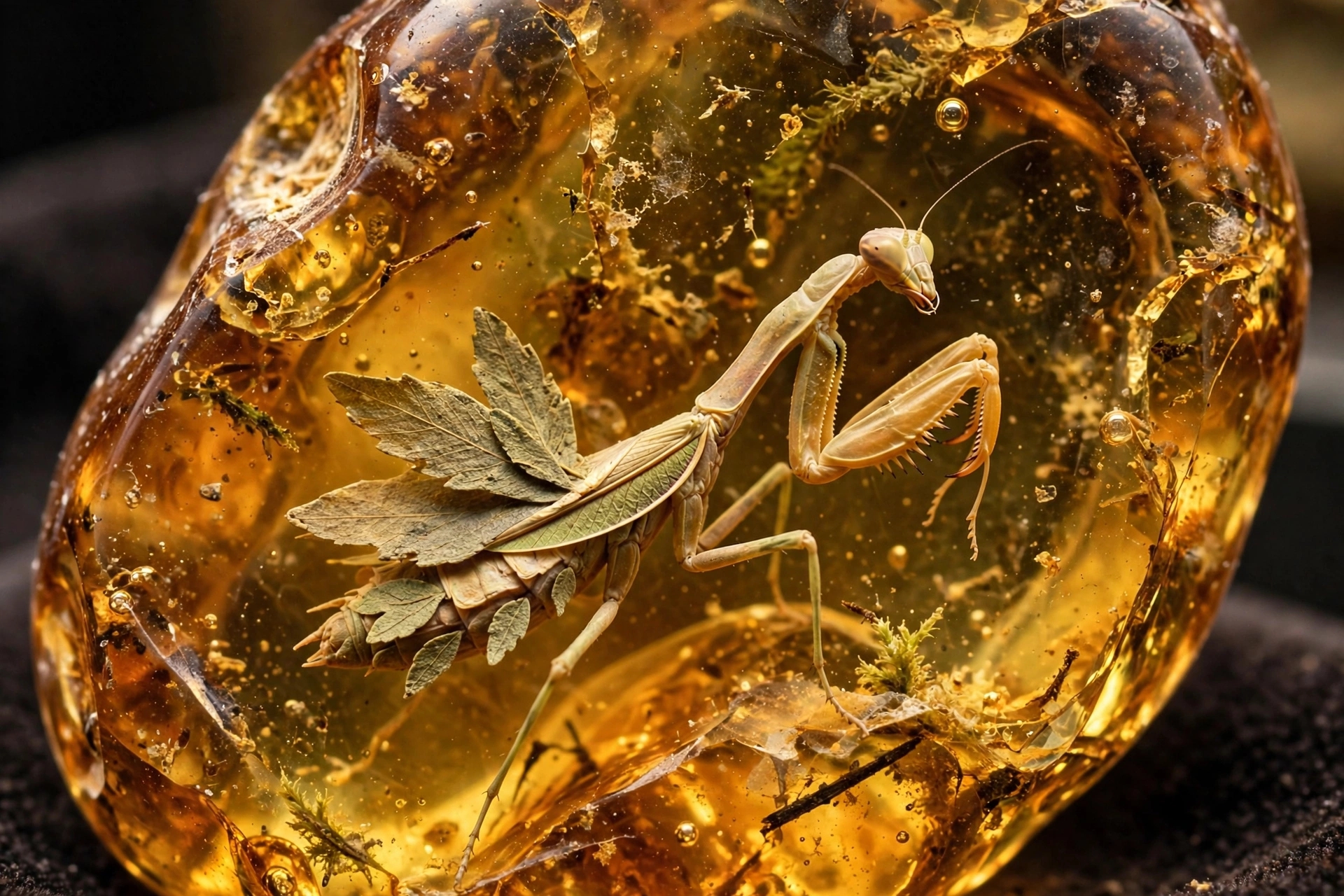
The genus name, Folimantis, translates to "leaf mantis," while the species name refers to the glass-like transparency of its wings. What sets this mantis apart is its abdomen, which features leaf-shaped extensions that closely match the leaves of Selaginella, a group of spore-bearing plants that thrived during the mid-Cretaceous period. The precise imitation of these extensions suggests a sophisticated level of mimicry that has no modern equivalent among mantises.
This discovery is significant as it provides the earliest clear evidence of a mantis mimicking plant leaves. The authors of the study noted, "The mimicry style of F. hyalinala with Selaginella has never been reported before, and there are no species that mimic Selaginella among modern Mantodea." This revelation indicates that the evolutionary strategy of mimicry was already well-developed in the early branches of the mantis family tree, suggesting a long history of adaptation to avoid predation.
The implications of this find extend beyond mere mimicry. The unique characteristics of Folimantis hyalinala, particularly its abdominal adaptations, may offer insights into how mimicry evolved in insects. Unlike many modern mantises that exhibit leaf-like features across their bodies, this ancient mantis displays these adaptations solely on its abdomen. This detail could imply that plant mimicry began with modifications to the abdomen before evolving to include other body parts, reflecting the gradual nature of evolutionary change.
The fossil's preservation is also noteworthy. Acquired by collector Fangyuan Xia in 2015, it was later donated to the insect evolution lab at Capital Normal University in Beijing. While Myanmar has since banned the export of fossils, the legal status of amber specimens remains ambiguous. The Society of Vertebrate Paleontology has called for a moratorium on publishing specimens obtained after January 2021, but this particular fossil predates that call, raising ongoing ethical discussions in the field of amber research.
For entomologists and paleontologists, Folimantis hyalinala serves as a window into a prehistoric world. During the mid-Cretaceous, flowering plants were just beginning to diversify, and the forests of Myanmar were dominated by ferns, conifers, and early angiosperms. The presence of Selaginella in this ecosystem suggests that the mantis evolved its leaf-like appearance as a survival strategy, making it less visible to predators. This adaptation allowed it to thrive long enough to be preserved in amber, where it has remained for nearly a hundred million years.
Ironically, the very camouflage that once protected the mantis has now made it a subject of scientific fascination. The leaf-like extensions that aided in its survival are now the focus of research, illustrating the unpredictable nature of evolution. This discovery not only enriches our understanding of insect evolution but also highlights the intricate relationships between organisms and their environments throughout history.
The accompanying images in this article are AI-generated illustrations and do not depict the actual amber specimen.
Published by Banx Network. This article is part of the Banx decentralized media programme, powered by the BXE token on the XRP Ledger.