Autumn is a season that asks us to look up and outward, to notice the turning of leaves and the shifting quality of light. But there is another way to see it, one that requires leaving the ground entirely. From orbit, the changing colors of a continent become a kind of slow-moving painting, a wash of red and gold spreading across latitudes in a pattern that no single pair of eyes could ever take in at once. NASA's satellites have been watching this annual transformation for years, and the view they offer is both familiar and strange.
The most recent observations come from the PACE satellite, launched to study the oceans but equipped with an instrument capable of seeing vegetation in remarkable detail. The Ocean Color Instrument measures reflected light across hundreds of spectral bands, and among them are wavelengths that reveal the specific pigments in leaves: the reds of anthocyanins, the yellows and oranges of carotenoids, and the green of chlorophyll . By tracking the ratio of red to green over time, scientists can watch the wave of color as it moves across the Northern Hemisphere.
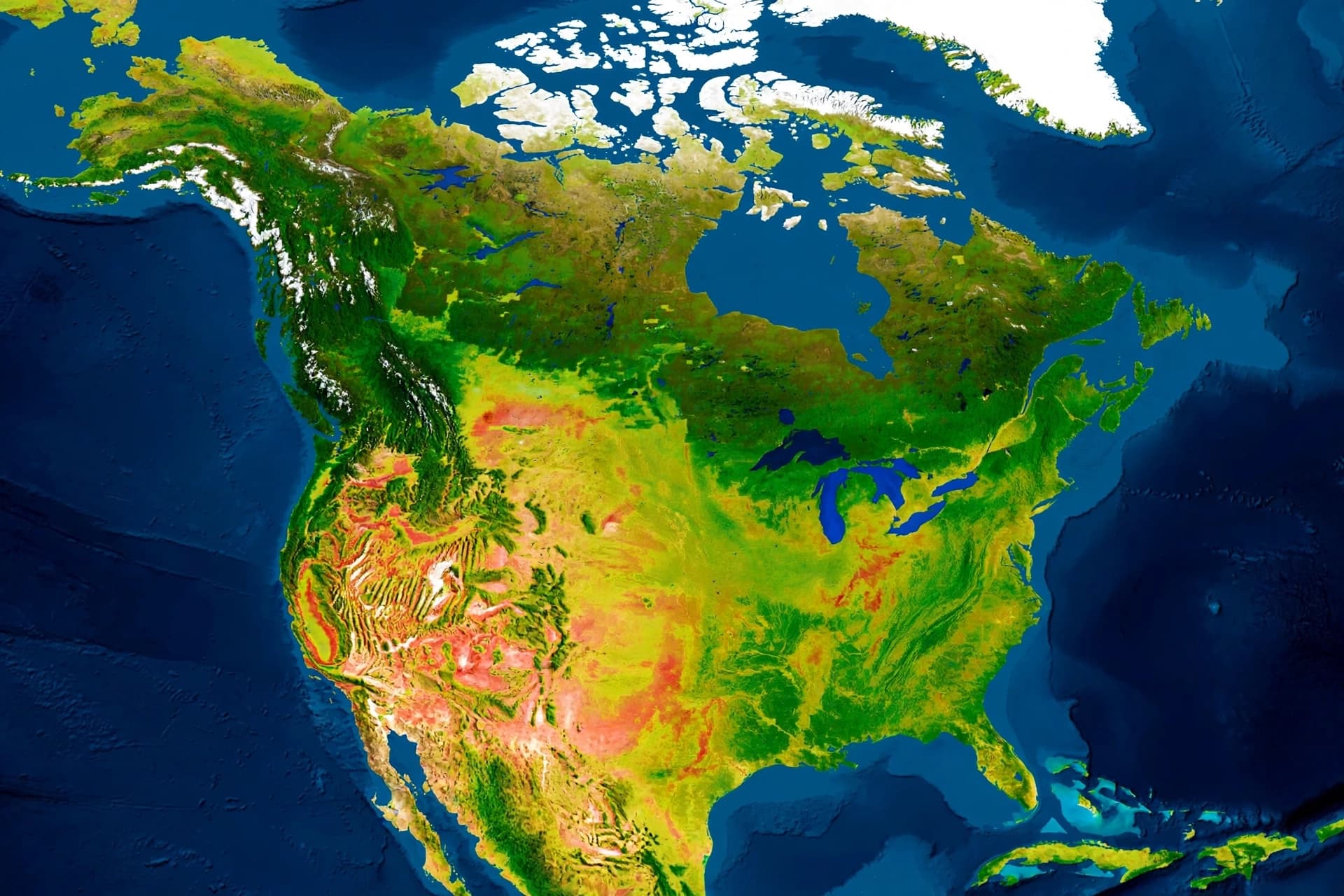
In late September and early October, the satellite detected high levels of redness in northern and eastern Russia, northern Alaska, and northern Canada. By the following week, the red had begun to fade in New England even as it spread southward into the Mid-Atlantic and the Midwest . The maps produced from this data are not photographs in any conventional sense; they are visualizations of a chemical transition, a signal of chlorophyll retreating and other pigments stepping forward to take its place.
The science behind the colors is well understood. As days shorten and temperatures drop, plants stop producing chlorophyll, the molecule that captures sunlight and gives leaves their green. Chlorophyll is not stable, and plants must constantly remake it; when the conditions for that work disappear, the green fades. What remains are the pigments that were always there, hidden beneath the chlorophyll—carotenoids that absorb blue light and reflect yellow, anthocyanins that absorb blue and green and reflect red . The brilliance of autumn is not an addition but a revelation.
What makes the satellite view valuable is not just its beauty but its completeness. A single ground observer can watch one hillside turn, one maple lose its leaves. A satellite can see the entire hemisphere, every day, and record the timing of each transition. Karl Huemmrich, a vegetation scientist involved with the PACE team, described the capacity to collect time-series data of these pigments everywhere on Earth repeatedly as "game-changing" . The phrase is not an exaggeration; it marks a shift from spot checks to continuous observation.
NASA has also released more localized views, including images from the Landsat 9 satellite showing the first flush of color in the Adirondacks and the rapid turn of tundra vegetation in Nunavut . In the far north, the season is compressed—peak color may last only a week—while lower latitudes stretch the display over a month or more. These variations are not incidental. They are data, and they help scientists understand how different ecosystems respond to the same seasonal cues.
There is a public dimension to this work as well. The GLOBE program's North American Phenology Campaign invites citizen scientists to submit photographs of fall foliage, which researchers use to ground-truth the satellite observations . The collaboration is a small but meaningful one: people looking at trees, and machines looking at continents, each contributing something the other cannot. The satellites provide scale; the people provide the texture of lived experience.
Autumn, from space, is not a postcard. It is a measurement, a record of pigments and timing, of warmth and light. But it is also, still, beautiful. The satellites do not strip the season of its poetry; they add a perspective that deepens it. The leaves turn whether or not anyone is watching, but from orbit, we can finally see the shape of the turning.
Image note: The visuals in this article were created by artificial intelligence and do not represent actual satellite imagery.
Sources: NASA Earth Observatory, NASA Science, MODIS Web
Published by Banx Network. This article is part of the Banx decentralized media programme, powered by the BXE token on the XRP Ledger.