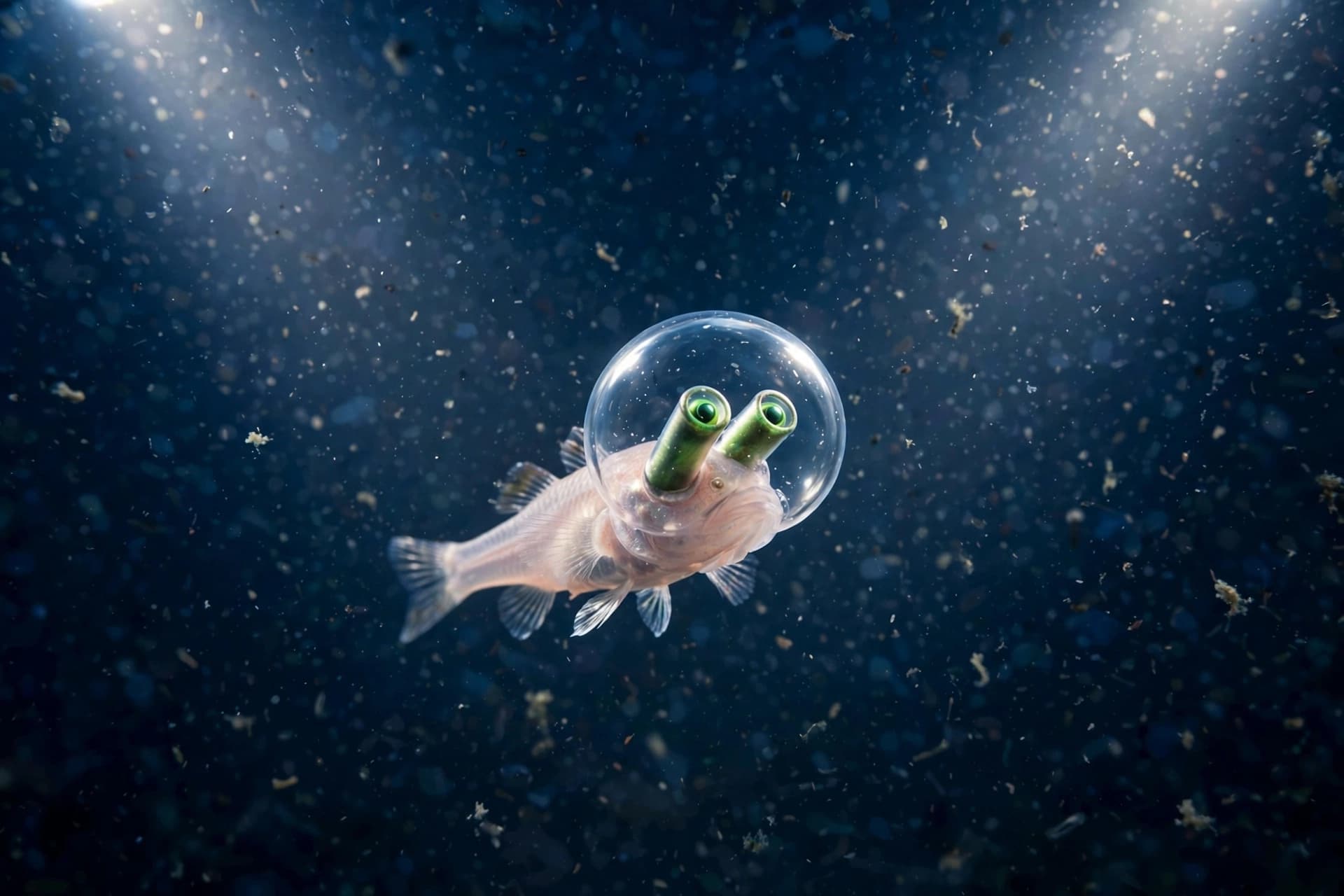
Six hundred meters below the surface, in a region of the ocean where sunlight is little more than a rumor, there exists a creature whose head is a window. The barreleye fish, Macropinna microstoma, carries its eyes not on the sides of its face but within a transparent dome, like two green-tinted pearls suspended in glass. For decades, scientists knew this fish almost entirely from dead specimens hauled up in nets, their delicate head shields collapsed by the violence of decompression. To see one alive, to film it moving through its own dim world, is to encounter something closer to truth than the fragments we had before.
That encounter happened recently, during an expedition aboard the research vessel David Packard. Researchers from the Monterey Bay Aquarium Research Institute were exploring waters roughly fifty-five miles offshore when a barreleye appeared at approximately 1,970 feet below the surface . It was MBARI's eleventh observation of the species in nearly forty years of exploration—a statistic that speaks to both the rarity of the fish and the vastness of the territory it inhabits.
The team had already finished their science operations for the day and were bringing the remotely operated vehicle back to the surface when Research Specialist Shannon Johnson spotted the fish and called for the pilots to stop. What followed was roughly twenty minutes of observation, captured with the ROV's high-resolution 4K camera—the first time this species has been filmed in such detail . The footage shows the barreleye drifting almost motionless, its large fins providing stability, its tubular eyes fixed upward toward the faint silhouettes of prey against the diminishing light.
The barreleye's anatomy is a study in quiet ingenuity. Its eyes are not the two dark spots visible on the front of its face—those are olfactory organs, similar to nostrils. The actual eyes are the green, barrel-shaped structures within the transparent dome, and they can rotate. When the fish spots something edible above it, it tilts its eyes forward to track the prey, then plucks it from the water . The gelatinous shield that houses these eyes appears to serve a protective function as well, guarding them from the stinging cells of siphonophores—colonial jellyfish-like creatures whose tentacles the barreleye raids for trapped crustaceans.
MBARI's researchers did not collect this specimen. The footage itself is the prize, a record of behavior and anatomy that no preserved specimen could provide. Close examination of the eyes will help scientists better understand vision in the ocean's twilight zone, where the ability to detect the faintest trace of light can mean the difference between feeding and starving .
There is something fitting about the fact that this fish was found on the way home. After a long and productive expedition, with instruments stowed and minds already turning toward shore, the ocean offered one more surprise. It is a reminder that discovery rarely arrives on schedule. Sometimes it appears in the final moments, when no one is looking for it, in a place where the light barely reaches.
Image note: The images in this article are AI-generated illustrations, not actual photographs from the expedition.
Sources: Monterey Bay Aquarium Research Institute (MBARI), Environment Coastal & Offshore
Published by Banx Network. This article is part of the Banx decentralized media programme, powered by the BXE token on the XRP Ledger.