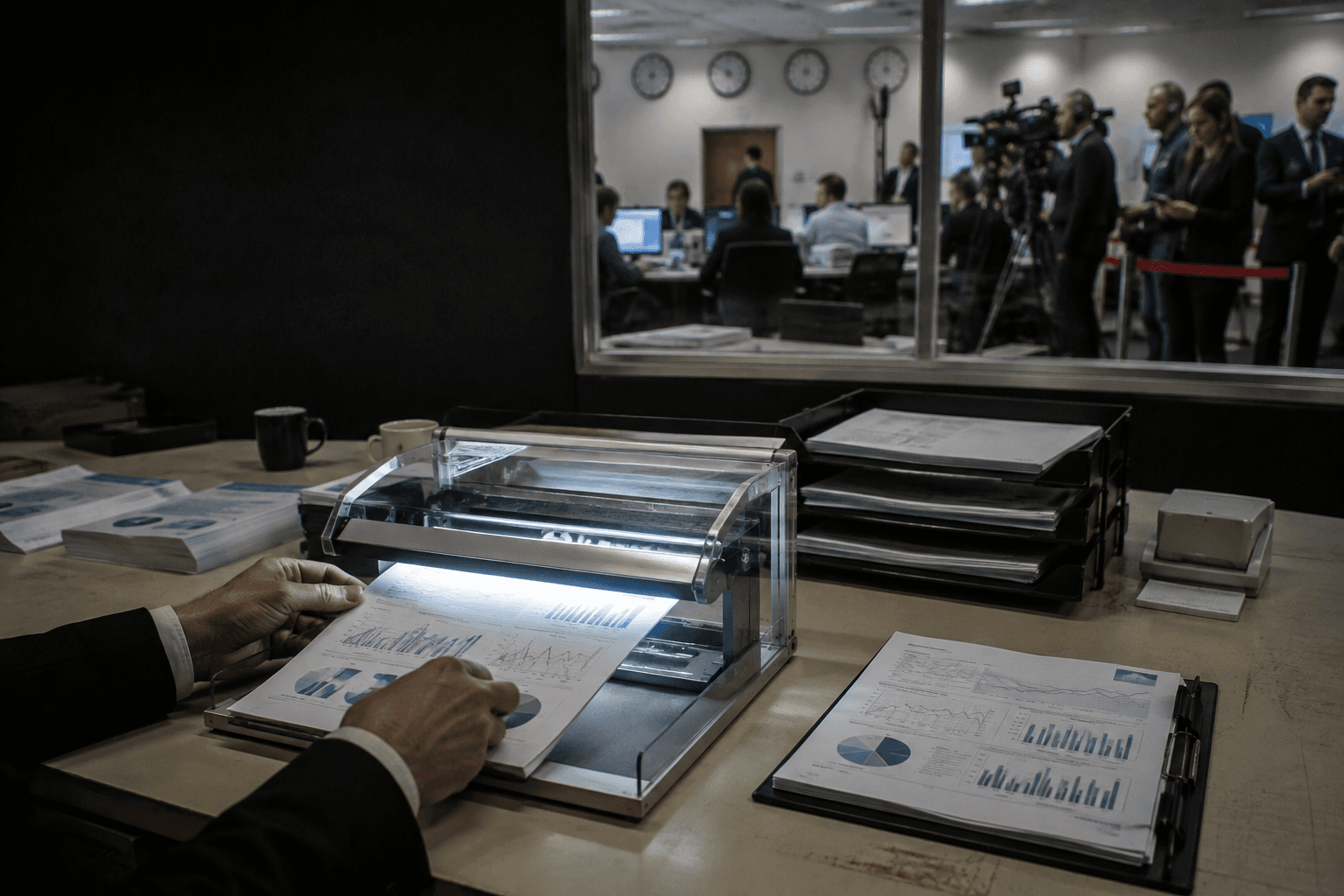
Imagine Someone Changes an Inflation Number
Not XRP's price.
Not a crypto transaction.
An official economic statistic.
Inflation. Employment. Banking data. GDP.
These numbers influence interest rates, government policy and trillions of dollars across global markets.
But once official data leaves the institution that published it and gets copied across websites, databases—and increasingly AI systems—how do you independently prove that nobody changed it?
Researchers have now tested an answer.
And they used the XRP Ledger.
On September 2, the Bank for International Settlements published Working Paper No. 1374, “Verifiable official statistics: a blockchain-based approach.”
The paper presents a working proof of concept that uses XRPL to cryptographically anchor official statistical datasets, allowing users to verify both where the data came from and whether it has been altered.
That sentence deserves another read.
Researchers associated with the institution often called the central bank for central banks built and tested an official-data verification prototype on XRP Ledger.
But the details—and the limitations—make this story even more interesting.
The Problem: Can You Trust the Number on Your Screen?
International institutions distribute enormous quantities of official economic and financial data.
The BIS paper focuses on SDMX, the international standard used to exchange official statistics.
There's a weakness in the conventional process.
After a dataset has been distributed, users need a reliable way to independently verify two things:
Did this data genuinely come from the institution claiming to publish it?
And:
Has anybody changed it since publication?
The researchers' proposed solution doesn't put the entire dataset onto a blockchain.
That would be inefficient.
Instead, they create something much smaller.
A cryptographic fingerprint.
Think of It Like a Digital Tamper Seal
Imagine BANX receives an official economic report.
Before distributing it, the publisher creates a unique mathematical fingerprint representing that exact data.
That fingerprint gets anchored to XRPL.
Someone later changes even part of the underlying dataset.
The fingerprint changes.
Now the copy no longer matches what was originally anchored.
The system can detect that something is wrong.
And crucially, the actual sensitive dataset doesn't have to be stored publicly on XRPL.
According to the BIS paper:
only cryptographic fingerprints—not the underlying data—are placed on the ledger.
That preserves confidentiality while providing a publicly verifiable integrity record.
Why XRP Ledger?
This is probably the question every XRP holder will ask.
Why XRPL?
The researchers cite characteristics including its low nominal transaction fees, fast consensus finality, developer resources and existing technical analysis of its consensus protocol.
But they also make something very clear:
The broader architecture is designed to be blockchain-agnostic.
In other words, the research doesn't claim XRPL is the only blockchain capable of doing this.
XRPL was the blockchain selected for the actual proof-of-concept implementation.
That's an important distinction.
Still, being selected for a working institutional research prototype is considerably more concrete than simply appearing in a blockchain presentation.
They actually built it.
And Then They Measured It
Here's where the story gets particularly interesting.
The prototype wasn't just theoretical.
The researchers measured its performance.
According to the BIS:
Publication: 3–5 seconds Verification: 1–2 seconds
The researchers concluded those speeds were sufficient for interactive use and potentially automated systems consuming information in real time.
Think about what that means.
A financial-data system could receive an official dataset.
Check its cryptographic fingerprint against XRPL.
Verify the publisher.
Verify that the information hasn't changed.
And potentially make that verification in roughly one or two seconds under the prototype's test conditions.
Now Add AI
This is where this stops being just another blockchain story.
The BIS paper explicitly discusses a future in which automated systems and AI agents could benefit from independently verifiable information.
That's a serious problem in the emerging AI economy.
AI systems increasingly consume information from multiple sources.
But an AI model reading a number doesn't automatically know whether:
the source genuinely published it, someone modified it, an intermediary corrupted it, or the dataset is authentic.
Blockchain-based verification introduces another possibility.
Instead of telling an AI:
“Trust this number.”
The system could effectively say:
“Verify this number.”
And XRPL served as the public ledger in the researchers' prototype.
One XRPL Entry Could Cover Thousands of Datasets
There's another clever element.
The researchers don't necessarily need a separate blockchain transaction for every individual dataset.
They aggregate cryptographic fingerprints together.
A single summary value can then represent a batch containing potentially thousands of datasets.
That value is anchored on XRPL.
The BIS says this batching approach makes on-chain fees negligible at modest scale, leaving ordinary processing and storage as the larger costs.
So rather than:
1,000 datasets = 1,000 expensive blockchain records
the architecture can effectively compress proof for many datasets into a much smaller blockchain footprint.
That's important if this type of infrastructure ever has to operate at institutional scale.
But Here's the Part XRP Twitter Will Probably Skip
This was not XRPL mainnet deployment of official BIS statistics.
The implementation is a proof of concept.
The performance numbers describe the prototype—not a hardened production system.
And there is an even more important disclaimer.
BIS Working Papers represent research by their authors.
The BIS explicitly states that views expressed in its working papers do not necessarily represent the views of the BIS or its member central banks.
Therefore:
BIS DID NOT “ADOPT XRP.”
BIS DID NOT ANNOUNCE XRP AS A GLOBAL SETTLEMENT ASSET.
CENTRAL BANKS DID NOT MOVE THEIR DATA TO XRPL MAINNET.
And the paper certainly isn't an endorsement of XRP as an investment.
Those headlines would dramatically overstate what happened.
What Actually Happened Is Still Big
Strip away the exaggeration and the real story remains noteworthy.
Researchers needed a public blockchain for a prototype dealing with something extremely sensitive:
the authenticity of official statistics.
They implemented it using XRP Ledger.
They built the architecture.
They tested it.
They measured its latency.
They modeled its economics.
And they published the results through the BIS.
That's fundamentally different from someone saying:
“XRPL could theoretically be useful for institutions.”
Here, researchers actually demonstrated a use case.
This Isn't Really About Payments
That's another reason this story matters.
For years, the public XRP narrative has largely revolved around:
cross-border payments.
But XRPL's emerging institutional use cases are becoming considerably broader.
Ripple has been developing and promoting infrastructure around tokenization, stablecoins, lending, compliance and institutional DeFi. Its roadmap has highlighted credentials, permissioned markets, tokenized assets and credit infrastructure as areas of development.
Now this BIS research introduces another possible category:
data integrity.
XRPL isn't transferring the economic statistic.
It is providing cryptographic evidence that the statistic hasn't been altered.
That's a very different job for a blockchain.
And It Could Go Beyond Economic Statistics
The researchers say the approach can extend beyond SDMX.
They specifically note that the same architecture could potentially work with other structured reporting formats, including XBRL, which is widely associated with financial and business reporting.
That opens a much larger conceptual possibility.
Imagine cryptographically verifying:
corporate filings,
regulatory reports,
financial statements,
economic releases,
banking statistics,
or machine-readable data consumed automatically by AI systems.
Again, that doesn't mean these applications are coming to XRPL tomorrow.
But it explains why the experiment matters.
The underlying use case is much larger than simply putting government statistics “on blockchain.”
Does This Increase XRP Demand?
This is where we need to be precise.
Not necessarily in any meaningful immediate way.
XRPL transactions use XRP for network fees, but those fees are deliberately tiny.
The entire attraction of this architecture is that verification can be inexpensive.
Therefore, claiming this research will suddenly create enormous XRP demand would contradict one of the advantages the researchers are highlighting.
The significance is instead infrastructure credibility.
If institutions eventually choose XRPL for high-volume verification, settlement, tokenization or other financial applications, the ecosystem surrounding XRP becomes larger.
But one research prototype does not establish that future.
The Bigger Question
This experiment creates a fascinating question for XRPL.
For years, blockchain advocates have argued that public ledgers can provide an immutable source of truth.
But the AI era introduces a slightly different problem:
How does a machine know whether the information it's consuming is authentic?
The BIS researchers' answer is essentially:
Don't put the entire information set onchain.
Put its proof there.
Then let humans—or machines—verify it.
And in their prototype, that proof lived on the XRP Ledger.
Final Take
Forget the exaggerated headline:
“BIS ADOPTS XRP.”
That's not what happened.
The real story is better.
A BIS-published research project built a working system using XRP Ledger to make official economic statistics independently verifiable.
The prototype reported:
3–5 second publication.
1–2 second verification.
Cryptographic tamper detection.
No underlying confidential dataset stored onchain.
An open-source reference implementation.
It remains research.
It remains a proof of concept.
And it does not represent BIS or central-bank adoption of XRP.
But for XRPL, this is exactly the kind of development worth watching.
Because the most interesting blockchain use case may eventually be something most people never see:
proving that the financial data feeding humans, markets and AI is actually real.
Published by Banx Network. This article is part of the Banx decentralized media programme, powered by the BXE token on the XRP Ledger.