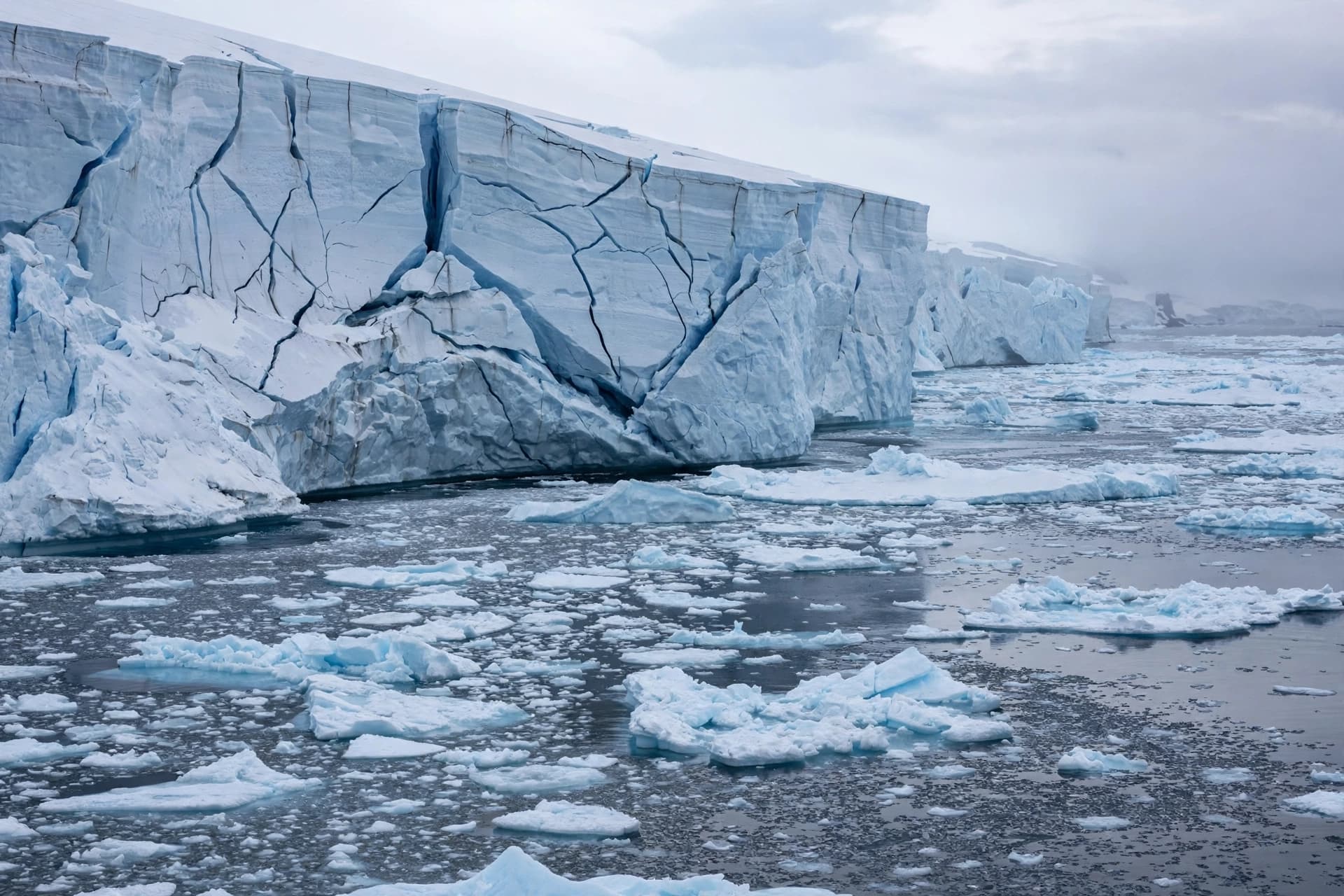
Antarctica can seem almost motionless from a distance, a vast white landscape where time appears to move differently. Yet beneath that stillness, the ice sheet is constantly responding to changes in the atmosphere and ocean. A new study published in Nature Geoscience finds that Antarctic ice loss is very likely to continue through the 21st century, even under aggressive emissions-reduction scenarios.
The study, published September 30, was led by researchers including Yucheng Lin and Xuebin Zhang, with collaborators from several institutions. The researchers used a machine-learning framework combined with ice-sheet modeling and satellite observations to examine how different assumptions affect projections of Antarctic ice loss and its contribution to sea-level rise.
One of the central findings is that the Antarctic Ice Sheet has at least a 92% modeled probability of continued mass loss through 2100 under the study’s lowest-emissions scenario, known as SSP1-1.9. Under a very high-emissions scenario, that probability rises to at least 95%. The researchers emphasize that emissions still matter greatly because higher warming produces substantially greater projected ice loss.
The distinction between continued loss and the amount of loss is important. The paper does not suggest that future emissions are irrelevant. Instead, its projections indicate that cutting greenhouse-gas emissions can reduce the scale of future Antarctic losses even if it cannot completely prevent mass loss during this century.
The researchers also examined the relationship between snowfall and melting. A warmer atmosphere can hold more moisture, potentially increasing snowfall over Antarctica and temporarily adding mass to parts of the ice sheet. But the study finds that this increased snowfall is very unlikely to compensate for ice losses driven by warming oceans.
That ocean connection matters because much of Antarctica’s vulnerability is not simply about warmer air melting snow from above. Ocean water can reach the undersides of floating ice shelves, contributing to melting and thinning. As ice shelves weaken, the glaciers behind them can become more exposed to processes that allow ice to flow toward the ocean.
The study also highlights why Antarctic projections have historically carried significant uncertainty. Researchers found that choices in climate and ice-sheet models can produce different outcomes, with the choice of atmosphere-ocean model playing a particularly important role in how strongly future emissions affect Antarctic mass loss. Their machine-learning approach was designed to examine those uncertainties while calibrating projections against satellite observations.
At the higher end of the study’s projections, the researchers estimate that Antarctic processes could contribute as much as 25.4 centimeters of global mean sea-level rise by 2100 under a very high-emissions scenario, at the 95th percentile, with a median estimate of 15.7 centimeters. These figures are projections rather than fixed predictions, and the authors stress that uncertainty remains an important part of the assessment.
The message from the research is therefore less about a single number than about a long process already underway. Antarctica will continue to respond to the climate conditions created over the coming decades, and the amount of future ice loss will depend partly on how those conditions evolve. The new study adds another layer of evidence to the understanding that emissions reductions can limit future risks, even when they cannot immediately reverse every change already set in motion.
AI Image Disclaimer: Any accompanying image is AI-generated and serves only as a visual interpretation of the scientific subject, not as satellite evidence or an actual future scene.
Sources: Nature Geoscience Nature The Guardian The Conversation The Daily Targum
Published by Banx Network. This article is part of the Banx decentralized media programme, powered by the BXE token on the XRP Ledger.