There is a creature in the slow waters of the Amazon that seems assembled from the discarded sketches of evolution—a flattened body like a submerged leaf, tiny lidless eyes perched on top of its head, and fingers that end in star-shaped lobes capable of sensing what the eyes cannot see. It is the Surinam toad, and it belongs to a category of life that reminds us how little we truly understand about the inventiveness of nature.
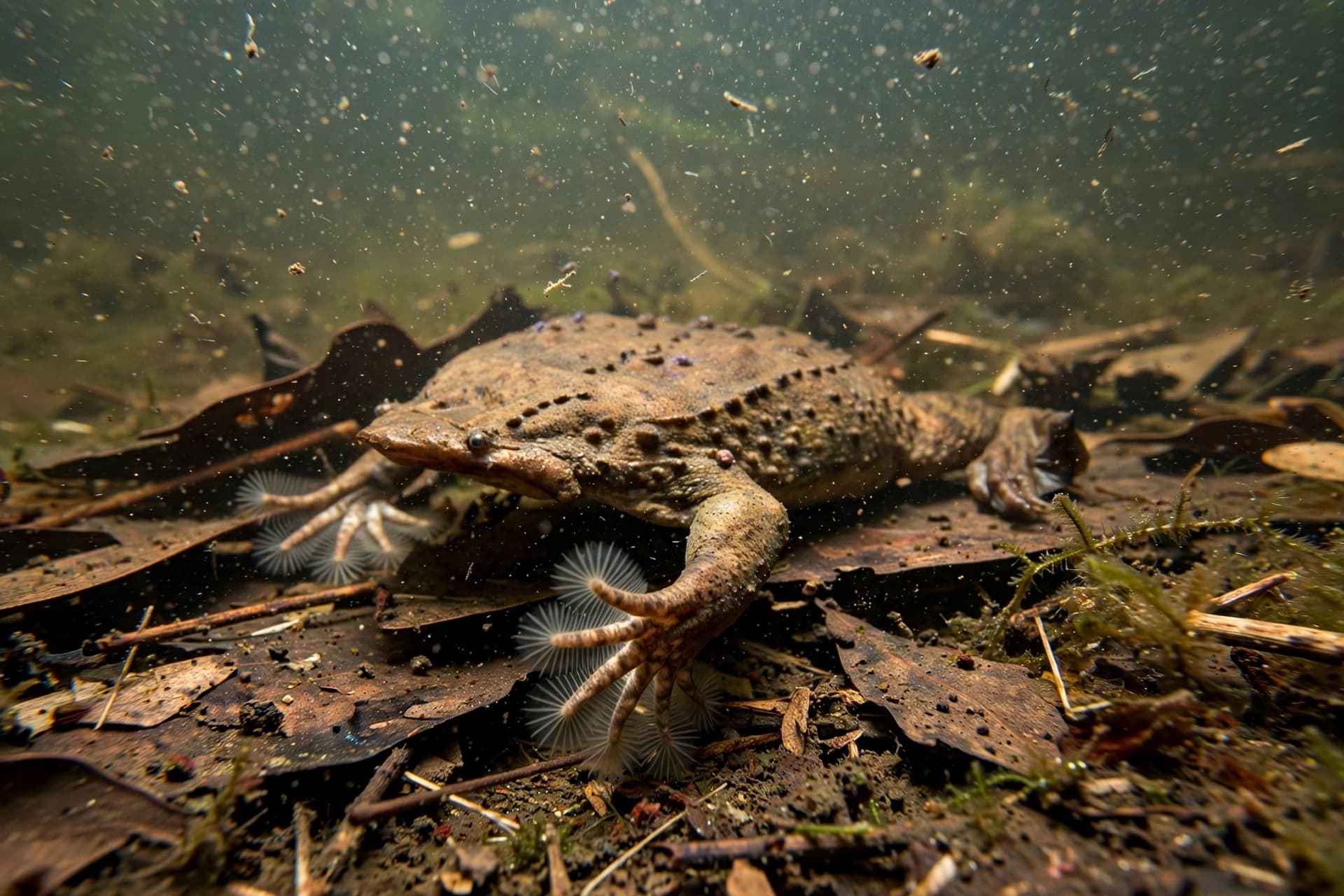
The Surinam toad, Pipa pipa, is a fully aquatic frog native to the slow-moving pools and flooded forests of the Amazon Basin, as well as parts of eastern Trinidad and Tobago. It is not a toad in the conventional sense, nor does it resemble most frogs. Its body is a soft, flattened rectangle of flesh, brown or olive in color, with a texture that blends seamlessly into submerged leaf litter. The head is a shallow triangle, all mouth and snout, with eyes so small and barely used that they offer little help in the dark, murky waters it inhabits.
What the Surinam toad lacks in sight, it compensates for through touch. Its front toes are divided at the tips into elaborate star-shaped sensory organs—structures so distinctive that the species is also known as the star-fingered toad. These lobes detect pressure changes and vibrations in the water, allowing the frog to sense prey without seeing it. Along its body, lateral lines similar to those found in fish further enhance this ability, creating a creature that navigates its world primarily through feeling rather than sight.
The feeding mechanism is equally remarkable. When a small fish, crustacean, or worm comes within range, the Surinam toad opens its toothless, tongueless mouth and expands its mouth cavity with explosive force. Its internal organs shift backward to accommodate the expansion, increasing its body volume by one and a half times in less than twenty-four milliseconds. The resulting suction pulls in water and prey alike. The frog's front feet then scoop stray limbs toward its mouth, acting as strainers to expel excess water while retaining the meal.
But it is the reproductive process that has earned the Surinam toad its reputation as one of the animal kingdom's strangest parents. During mating, the male grasps the female and the pair performs acrobatic somersaults underwater, sometimes for hours, as the female releases between sixty and one hundred eggs. The male fertilizes them and spreads them across the female's back with gentle strokes of his hind legs. Within twenty-four hours, the eggs sink into the spongy skin of her back, and a layer of tissue grows over them, sealing each egg into its own pocket.
The eggs do not develop into free-swimming tadpoles. Instead, they complete their entire metamorphosis within the mother's back, emerging three to four months later as fully formed miniature toads, each about 1.2 centimeters long. When they are ready, the mother's skin ruptures, and the young burst out through the openings—a birth process unlike almost anything else in the animal kingdom. The mother's skin then regenerates, ready for the next mating season.
The Surinam toad is a reminder that evolution does not always follow the paths we expect. It has no need for keen eyesight or a tongue to catch prey. It does not lay eggs in water to be left to chance. It carries its young within its own body and releases them when they are ready to face the world. In the quiet, leaf-strewn waters of the Amazon, it has found a way of being that works—strange, yes, but perfectly suited to the life it leads.
AI Image Disclaimer: The accompanying images in this report were created with artificial intelligence and are intended for conceptual representation only.
Sources: Nautilus, National Geographic, BBC Wildlife Magazine, Hong Kong Biodiversity Museum, Discover Wildlife
Published by Banx Network. This article is part of the Banx decentralized media programme, powered by the BXE token on the XRP Ledger.