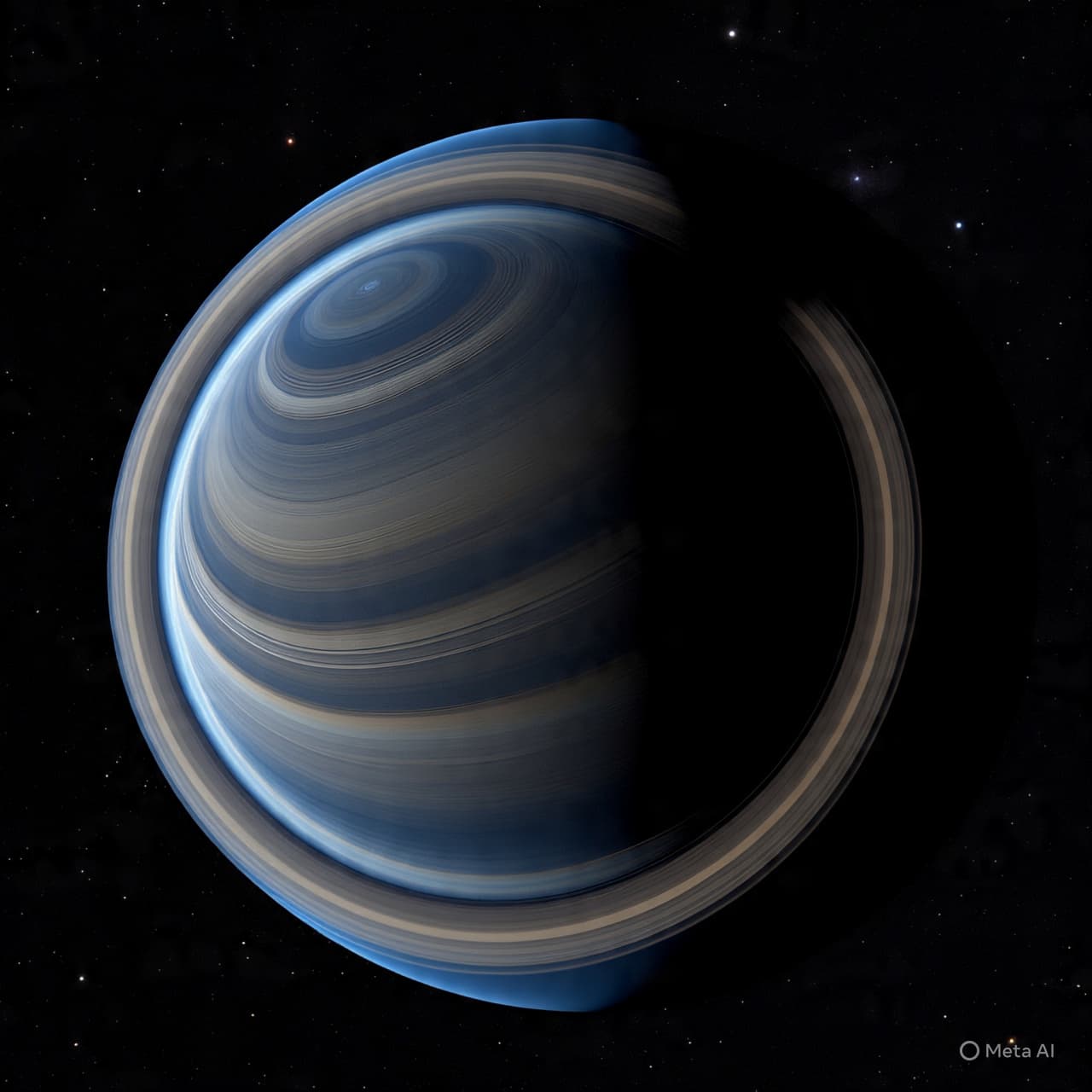
A new scientific study is offering a fresh perspective on one of the solar system’s enduring mysteries: the origins of Saturn’s largest moon, Titan, and the planet’s iconic ring system.
Researchers have proposed that an ancient merger between two precursor moons could have given rise to Titan, while the debris generated by the collision may have later formed Saturn’s rings. The theory builds on ongoing efforts to better understand the complex gravitational and geological history of Saturn’s satellite system.
Titan, larger than the planet Mercury, stands apart from Saturn’s other moons due to its dense atmosphere and active chemistry. Meanwhile, Saturn’s rings—composed primarily of ice and rock particles—have long intrigued astronomers seeking to determine whether they are primordial remnants from the planet’s formation or the result of more recent cosmic events.
The merger hypothesis suggests that early in Saturn’s history, two substantial icy moons may have collided and combined. The impact would have released a significant amount of material into orbit around the planet. Over time, some of that debris could have coalesced into Titan, while lighter fragments may have spread out and flattened into the ring system observed today.
This idea aligns with computer simulations that show how gravitational interactions among moons can destabilize orbits over millions of years. In crowded planetary systems, close encounters and collisions are not uncommon during early formation stages. Similar processes are believed to have shaped other bodies in the solar system, including Earth’s own Moon.
The age of Saturn’s rings has been a topic of debate in recent years. Data collected by NASA’s Cassini spacecraft before its mission ended provided detailed insights into the rings’ mass and composition, prompting new questions about whether they are relatively young on cosmic timescales. If formed from debris generated by a moon-scale collision, the rings may not be as ancient as Saturn itself.
While the merger theory remains under study, scientists emphasize that additional modeling and observational data will be needed to confirm the scenario. Planetary formation is influenced by numerous variables, including gravitational forces, tidal interactions, and the composition of early solar system materials.
Understanding Titan’s origins carries broader scientific importance. The moon’s thick nitrogen-rich atmosphere and methane lakes make it one of the most intriguing environments beyond Earth, and it is the focus of future exploratory missions.
For now, the proposed ancient merger adds another piece to the puzzle of how Saturn’s remarkable system evolved. As researchers continue to analyze existing data and refine models, the story of Titan and Saturn’s rings remains an unfolding chapter in planetary science.
Published by Banx Network. This article is part of the Banx decentralized media programme, powered by the BXE token on the XRP Ledger.