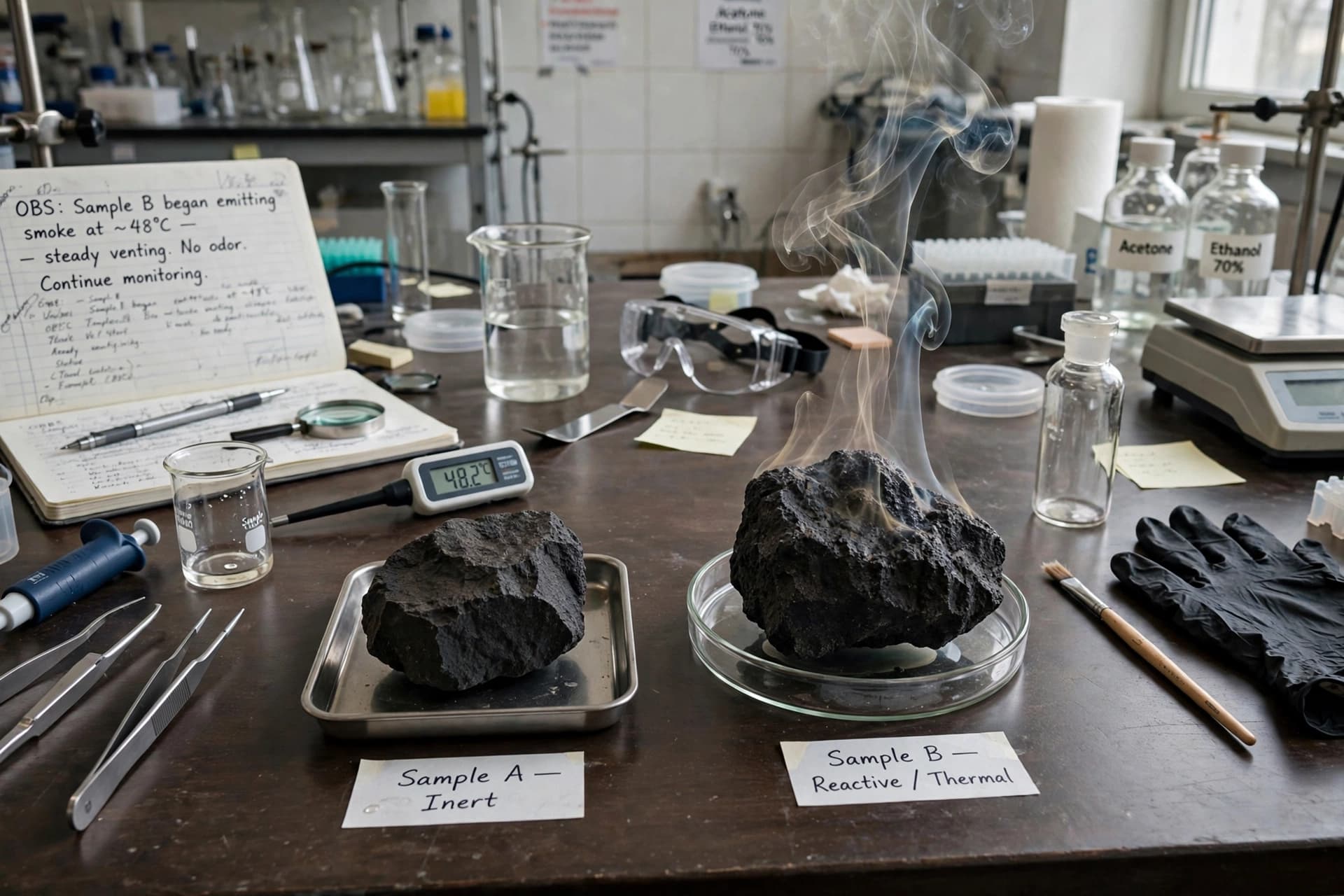
There is a particular kind of surprise that arrives when the familiar rules of the physical world seem to bend—when something as inert as a rock, pulled from the cold darkness of the ocean floor, suddenly behaves like a living thing. In a laboratory at the U.S. Geological Survey, two samples of metal-sulfide rock did exactly that. They began to smoke, then to heat, then to burn. The rocks had caught fire.
The samples were collected in 2022 from the Escanaba Trough, a volcanically active region of the seafloor off the Oregon-California border where tectonic plates are slowly pulling apart. Using a remotely operated vehicle, researchers gathered 57 hydrothermal rock samples from four areas of the trough. Many contained metal sulfides—minerals rich in copper, zinc, and iron, and of considerable interest to an emerging deep-sea mining industry .
The trouble began when scientists freeze-dried and crushed the samples for study. As they broke the rocks apart by hand, exposing fresh surfaces to air, two of the samples began to heat up and smoke. Temperatures exceeded 100 degrees Celsius—212 degrees Fahrenheit—and by the end, the original rock had been completely oxidized .
The culprit, researchers found, was a fragile form of iron sulfide called nanocrystalline marcasite. The marcasite crystals were only 5 to 16 nanometers across, thousands of times thinner than a human hair, which gave oxygen an enormous surface area to react with. The reaction releases heat, and when that heat builds faster than it can escape, the rock can keep warming itself until it burns .
On the seafloor, these rocks sat in water of roughly 2 degrees Celsius with relatively little oxygen—conditions that slow the reaction and help the unstable mineral survive. But pull the rock into warm, oxygen-rich air, add the mechanical energy of crushing and grinding, and the reaction can take off .
The discovery matters beyond the laboratory. Seafloor massive sulfide deposits are being explored as a source of valuable metals, with the International Seabed Authority having granted exploration contracts for parts of the Mid-Atlantic Ridge and the Indian Ocean. No engineering controls currently exist for mining these deposits, and the authors of the study, published in Scientific Reports, warn that the chemistry could cause rapid-onset fires aboard ships .
“The production of heat through exothermic reactions has not been investigated in seafloor massive sulfide deposits but has the potential to cause rapid onset fires on ships,” the researchers wrote . For an industry still in its infancy, the finding offers a quiet warning: the ocean floor holds not only treasure, but surprises that may require a different kind of care.
AI Image Disclaimer: The accompanying visual is AI-generated and does not depict the actual rock samples or laboratory experiments.
Sources: ScienceAlert, Techlicious, Vice, Nautilus, Scientific Reports
Published by Banx Network. This article is part of the Banx decentralized media programme, powered by the BXE token on the XRP Ledger.