In the silent dance of the cosmos, galaxies collide not with a crash, but with a slow, gravitational embrace. These mergers, spanning millions of years, reshape the structure of the universe, birthing new stars and altering cosmic landscapes. The Gemini North Telescope has recently captured a stunning portrait of two spiral galaxies in the midst of such a union. This image invites reflection on the dynamic nature of the universe, where destruction and creation are intertwined in a celestial ballet.
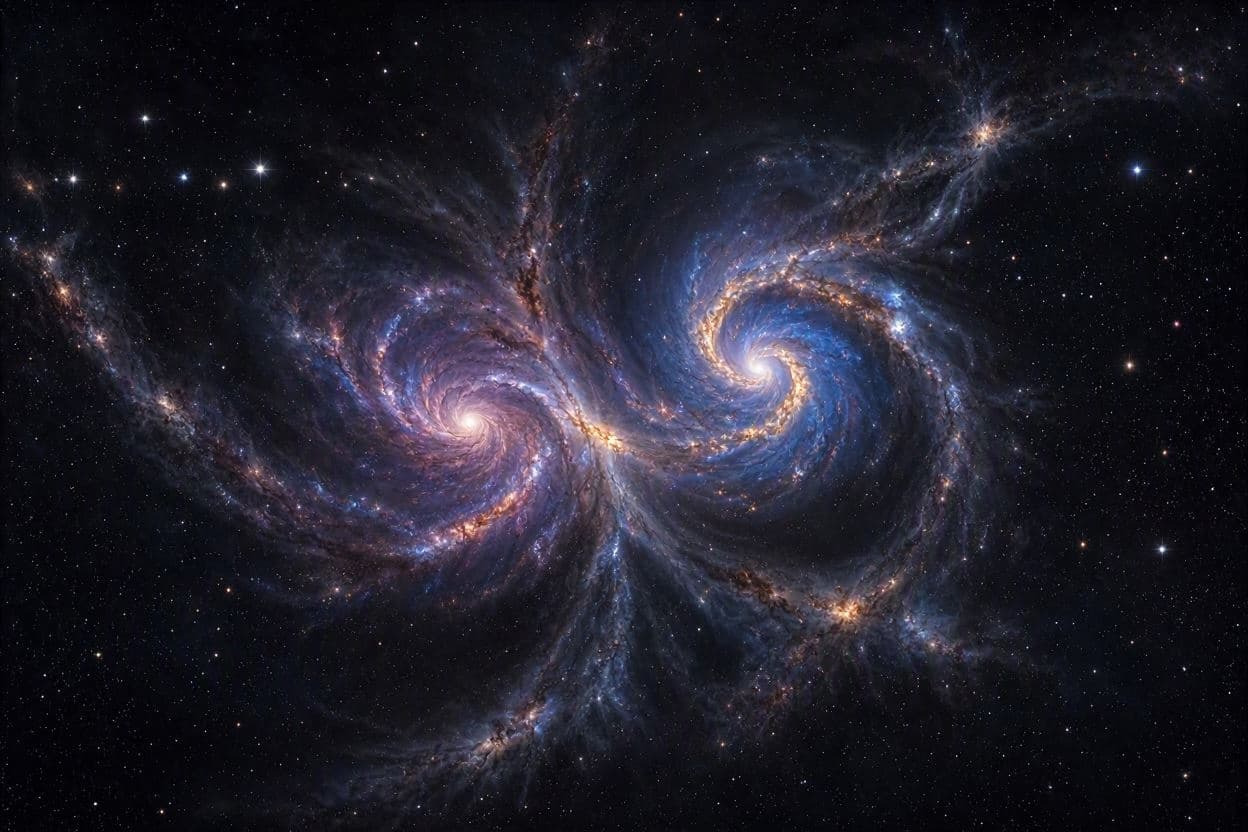
The image reveals two spiral galaxies, their arms distorted and intertwined by mutual gravity. Streams of stars and gas stretch between them, forming bridges of light that connect the two bodies. These tidal tails are characteristic of galactic interactions, showcasing the powerful forces at play. The clarity of the image, achieved through advanced adaptive optics, allows viewers to see details that were previously blurred by atmospheric interference.
Gemini North, located on Mauna Kea in Hawaii, uses a laser guide star system to correct for atmospheric turbulence. This technology enables ground-based telescopes to achieve resolution comparable to space-based observatories. The resulting images are not only scientifically valuable but also aesthetically profound, capturing the beauty of cosmic violence.
Merging galaxies are crucial for understanding galaxy evolution. Most large galaxies, including our own Milky Way, are believed to have formed through such collisions. By studying these events, astronomers can trace the history of stellar formation and the growth of supermassive black holes at galactic centers. Each merger provides a snapshot of a process that shapes the universe over billions of years.
The star formation triggered by these collisions is intense. As gas clouds compress, they ignite new generations of stars, often appearing as bright blue knots in the images. This burst of activity contrasts with the older, redder stars in the galactic cores, highlighting the cyclical nature of stellar life. It is a reminder that even in chaos, there is creation.
For the public, such images serve as a window into the deep past. The light from these galaxies has traveled for millions of years to reach us, offering a glimpse into a time long before human existence. It connects us to the cosmic timeline, fostering a sense of humility and wonder.
The scientific community will analyze the data to measure the masses of the galaxies, the rate of star formation, and the dynamics of the merger. These measurements help refine models of galaxy interaction and predict the future of our own galaxy, which is destined to merge with Andromeda in billions of years.
As technology improves, telescopes like Gemini North will continue to reveal the intricate details of the universe. Each image adds to our collective knowledge, painting a richer picture of the cosmos. It is a testament to human curiosity and the drive to understand our place in the vastness of space.
The Gemini North Telescope has captured a detailed image of two merging spiral galaxies, highlighting the gravitational interactions and star formation involved in galactic collisions. This observation contributes to our understanding of galaxy evolution and the dynamic history of the universe.
AI Image Disclaimer: The images associated with this article are AI-generated visualizations intended to depict galactic mergers and astronomical observation, using respectful and descriptive imagery.
Sources: Gemini Observatory Astrophysical Journal Space.com
Published by Banx Network. This article is part of the Banx decentralized media programme, powered by the BXE token on the XRP Ledger.