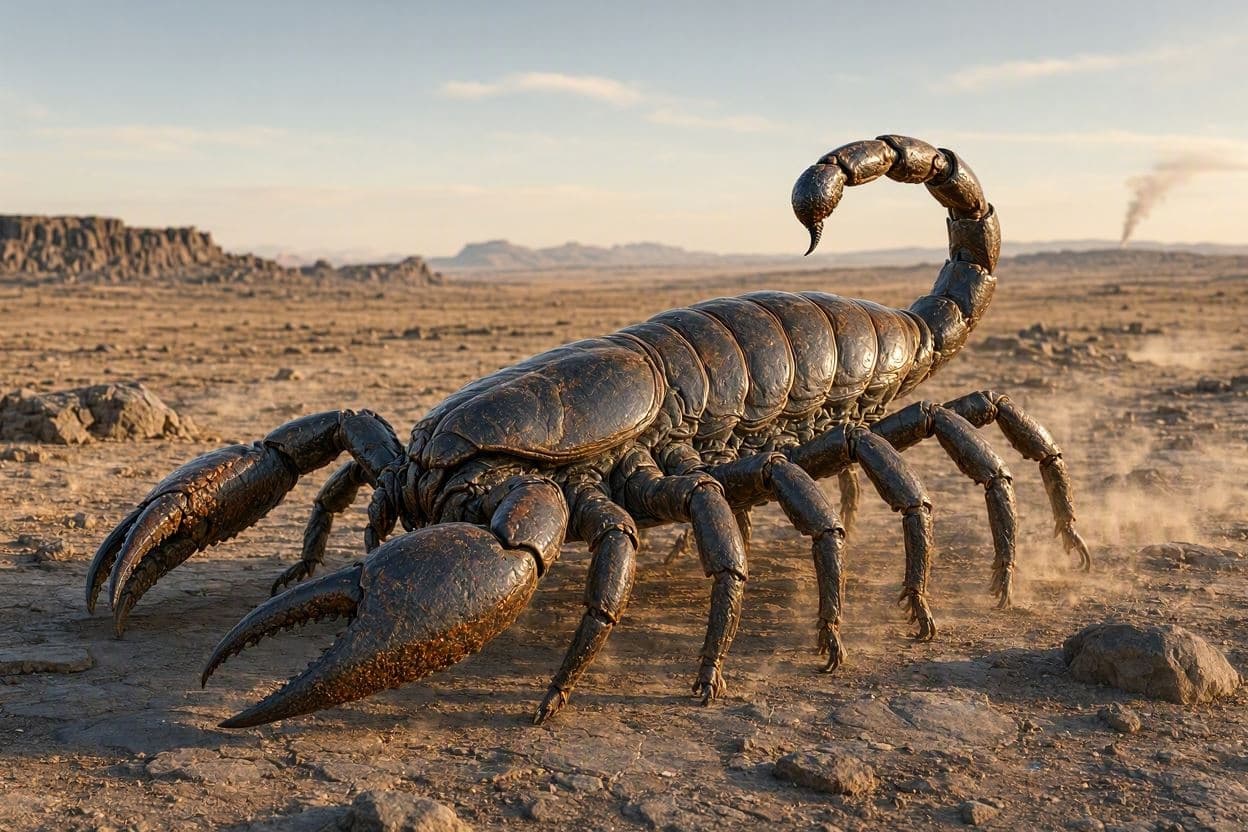
Long before the first tree cast a shadow on the Earth, the landscape was a stark, rocky expanse dominated by ancient seas and barren land. In this primordial world, creatures of immense scale and strange form ruled the terrain. Among them was a scorpion-like arthropod, large enough to rest on a coffee table, roaming a planet that had yet to develop forests. This image invites reflection on the deep history of life, reminding us that the natural world has undergone dramatic transformations, hosting giants in eras we can barely imagine.
The creature in question belongs to the group Eurypterida, commonly known as sea scorpions, though some relatives ventured onto land. Fossils reveal that these arthropods could reach lengths of over two feet, dwarfing modern scorpions. Their existence predates the Devonian period, when the first true forests began to emerge, placing them in a time when terrestrial ecosystems were still in their infancy.
These ancient arachnids were apex predators of their time, equipped with powerful pincers and armored exoskeletons. Without the competition of vertebrates or the cover of dense vegetation, they thrived in shallow waters and muddy shores. Their size was likely supported by higher oxygen levels in the atmosphere, which allowed arthropods to grow larger than is possible today.
The discovery of such fossils provides a window into the evolutionary pressures of the Paleozoic era. It shows how life adapted to fill ecological niches in the absence of complex plant life. The lack of forests meant fewer hiding places, favoring creatures with strong defenses and predatory capabilities. This dynamic shaped the early evolution of terrestrial animals.
Paleontologists study these fossils to understand the timeline of life on land. The presence of large scorpions before forests suggests that animal life colonized land earlier and more aggressively than previously thought. It challenges the traditional narrative that plants paved the way for animals, indicating a more complex interplay between flora and fauna.
The comparison to a coffee table helps modern audiences grasp the scale of these ancient beings. It brings the distant past into familiar terms, making the abstract concept of deep time more tangible. Such analogies help bridge the gap between scientific data and public imagination, fostering a deeper appreciation for natural history.
These creatures eventually went extinct, replaced by smaller arthropods and rising vertebrate groups. Their legacy remains in the fossil record, a testament to the transient nature of dominance in the natural world. Every era has its giants, and every giant eventually yields to change.
Studying these ancient scorpions reminds us of the resilience and adaptability of life. It highlights the Earth’s capacity to support diverse forms under different conditions. As we look at the small scorpions of today, we see the echoes of their colossal ancestors, linking the present to a distant, wild past.
Fossils reveal that a coffee-table-sized scorpion-like creature roamed Earth before the existence of forests, highlighting the unique evolutionary conditions of the Paleozoic era. This discovery offers insight into early terrestrial ecosystems and the impressive scale of ancient arthropods.
AI Image Disclaimer: The images associated with this article are AI-generated visualizations intended to depict prehistoric life and ancient landscapes, using respectful and descriptive imagery.
Sources: Paleontological Society Journals Nature Ecology & Evolution Smithsonian Magazine
Published by Banx Network. This article is part of the Banx decentralized media programme, powered by the BXE token on the XRP Ledger.