The center of our galaxy is often depicted as a place of violent energy, dominated by a supermassive black hole and swirling stars. Yet, amidst this cosmic turbulence, there exists a quiet complexity that speaks to the chemical richness of the universe. In a giant molecular cloud near the Milky Way’s core, astronomers have identified more than 120 distinct molecular species. This discovery invites us to look beyond the glare of stellar light and appreciate the intricate chemistry that serves as the foundation for potential life, reminding us that the universe is not just a physical expanse but a vast laboratory of creation.
The cloud, known as G+0.693-0.027, lies within the Central Molecular Zone, a region dense with gas and dust. Using advanced radio telescopes, researchers detected the unique spectral signatures of various molecules, ranging from simple compounds like carbon monoxide to complex organic structures. Each molecule acts as a fingerprint, revealing the temperature, density, and history of the environment in which it formed. The sheer diversity found in this single cloud is unprecedented, offering a detailed map of interstellar chemistry.
These molecules are the building blocks of more complex structures, including amino acids and sugars, which are essential for life as we know it. Finding them in such abundance near the galactic center suggests that the ingredients for life are widespread and resilient, capable of forming even in harsh radiation environments. It challenges the notion that life’s precursors can only arise in calm, peripheral regions of a galaxy.
The detection process relies on identifying specific frequencies of light emitted or absorbed by molecules as they rotate and vibrate. With over 120 species identified, the spectral data is incredibly crowded, requiring sophisticated algorithms to disentangle the signals. This technical achievement highlights the progress in observational astronomy, allowing scientists to see the invisible chemical web that permeates space.
For astrobiologists, this finding is significant because it provides clues about how organic matter evolves in space. By studying these clouds, researchers can better understand the chemical pathways that lead from simple atoms to complex prebiotic molecules. It bridges the gap between astrophysics and biology, suggesting that the story of life may begin long before a planet even forms.
The environment of the Central Molecular Zone is extreme, with strong magnetic fields and high levels of cosmic rays. That such delicate molecular structures can survive and thrive here indicates a robustness in chemical evolution. It suggests that the universe is far more chemically active and diverse than previously imagined, with hidden pockets of complexity waiting to be discovered.
This discovery also underscores the importance of continued exploration. As telescope technology improves, we may find even more complex molecules, perhaps leading to the detection of definitive biosignatures in other star systems. Each new finding adds a piece to the puzzle of our cosmic origins, deepening our connection to the stars.
As we gaze toward the galactic center, we are no longer just looking at gravity and light, but at a rich tapestry of chemistry. The 120 molecular species are silent witnesses to the processes that shape our universe, inviting us to wonder about the possibilities that lie within the dust and gas.
Astronomers have identified over 120 molecular species in a giant cloud near the Milky Way’s center, highlighting the chemical complexity of interstellar space. This discovery enhances our understanding of the origins of organic matter and suggests that the building blocks of life are abundant even in extreme cosmic environments.
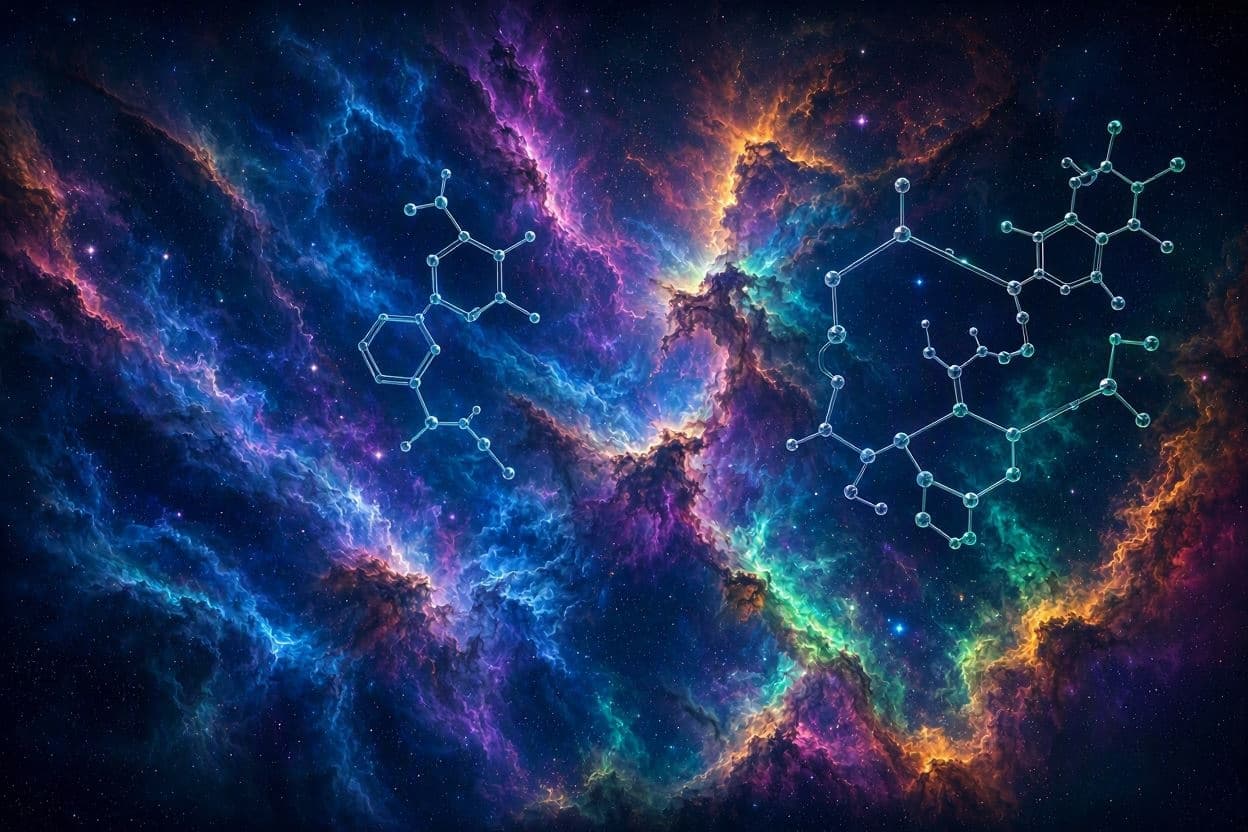
AI Image Disclaimer: The visual representations accompanying this article are AI-generated interpretations designed to symbolize the chemical diversity of the cosmos, using abstract imagery of molecular structures and nebulae.
Sources: Nature Astronomy National Radio Astronomy Observatory Scientific American
Published by Banx Network. This article is part of the Banx decentralized media programme, powered by the BXE token on the XRP Ledger.