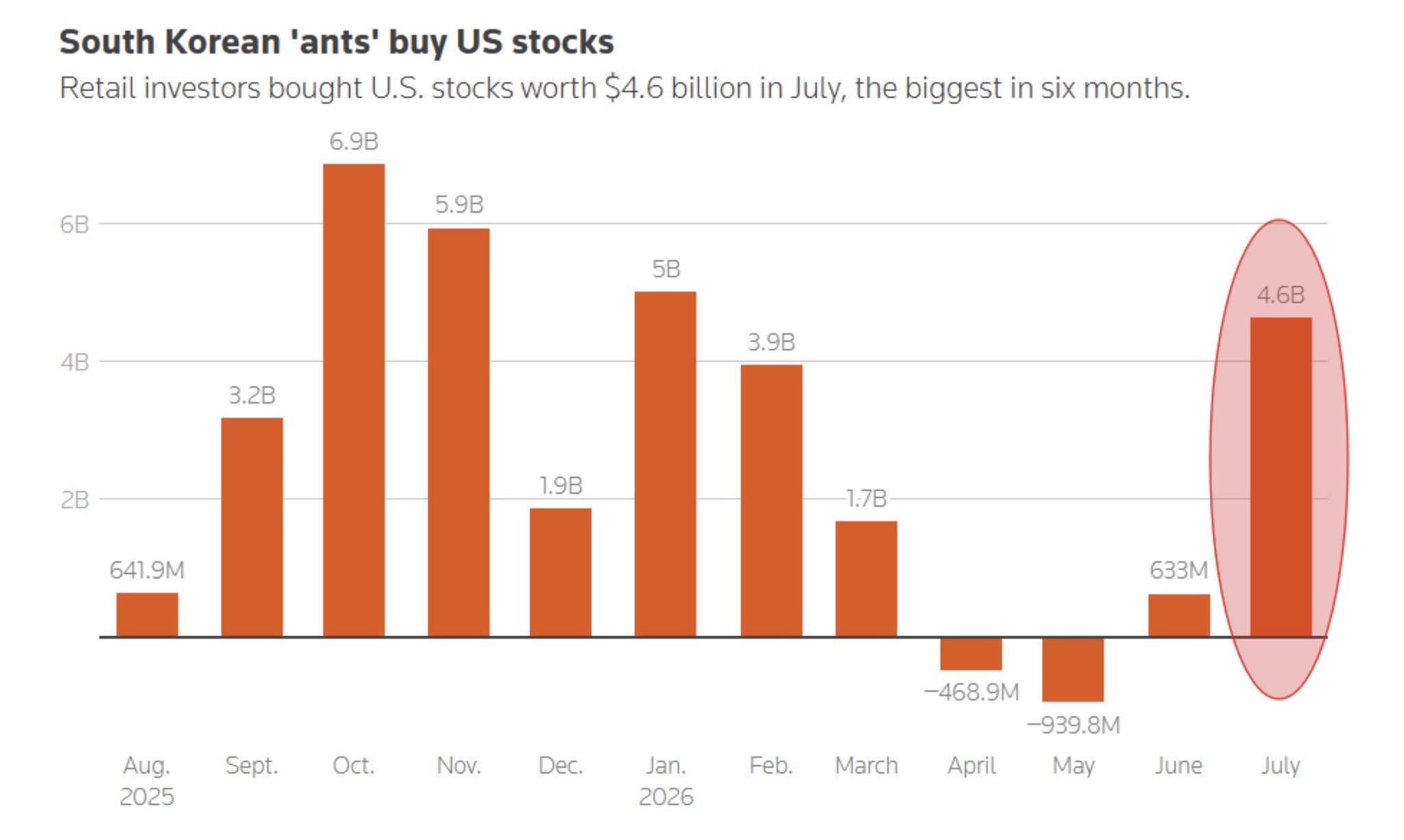
South Korean investors dramatically increased their purchases of U.S. stocks in July, committing approximately $4.6 billion during the month. The figure, highlighted by crypto.news, represents the largest monthly allocation shown on the accompanying chart since January and demonstrates the continuing appetite among South Korean retail investors for American equities. The July figure stands out because it follows several months of significant changes in investor flows. The chart shows South Korean retail investors purchasing billions of dollars in U.S. equities during several months, followed by weaker or negative flows during April and May. June then saw buying recover to approximately $633 million before July's much larger $4.6 billion allocation. The pattern suggests that investor sentiment toward U.S. markets can change rapidly. Rather than maintaining a constant level of exposure, retail investors appear to be responding to market conditions, expectations surrounding individual companies and the broader performance of U.S. technology and growth stocks. American equities remain particularly attractive to international investors because the U.S. market contains some of the world's largest technology companies. Businesses involved in artificial intelligence, cloud computing, semiconductors, software and digital infrastructure have become major components of global investment portfolios. South Korean investors are especially familiar with technology-driven industries because South Korea itself is home to major semiconductor and electronics companies. The renewed buying therefore comes at a time when artificial intelligence continues to influence global investment decisions. Companies connected to AI infrastructure and services have attracted enormous amounts of capital, while investors have increasingly looked beyond domestic markets for opportunities. U.S. exchanges offer exposure to companies operating at a scale that can be difficult to replicate in smaller national markets. The $4.6 billion figure is also important from a market-flow perspective. When large numbers of international retail investors purchase U.S. stocks, they contribute to demand for American equities. The impact of one month's purchases is not necessarily enough to move the entire U.S. market, but sustained international flows can become meaningful over longer periods. Currency considerations are another major factor. South Korean investors purchasing U.S. shares are exposed not only to changes in the stock prices themselves but also to movements in the Korean won against the U.S. dollar. A profitable investment in a U.S. company can produce a different return once converted back into Korean currency. The chart also shows how quickly sentiment can reverse. South Korean investors were net sellers during April and May, with the chart displaying negative flows of approximately $469 million and $940 million respectively. Those numbers contrast sharply with the $4.6 billion purchased in July. Such fluctuations can occur when investors react to market corrections. Retail investors may reduce positions during periods of uncertainty and then return when they believe valuations have become more attractive. The July surge could therefore reflect renewed confidence in U.S. equities after earlier concerns. Another important feature is the concentration of international retail investment. Investors frequently favor recognizable technology companies, meaning that capital flows can become concentrated in a relatively small number of popular stocks. This can amplify both gains and losses because highly valued technology companies can experience significant price movements when expectations change. The growing international appetite for U.S. stocks also reinforces America's position at the center of global capital markets. Foreign investors can access U.S. companies through exchanges, brokerage platforms and increasingly accessible investment applications. The result is a market in which domestic and international investors are constantly interacting. For South Korean households, investing abroad also provides diversification. Exposure to U.S. companies can reduce dependence on the performance of the domestic Korean market. However, diversification does not remove risk. Investors remain exposed to equity-market volatility, currency movements, valuations and changing interest-rate expectations. The July surge is therefore an important indicator of investor confidence, but it should not automatically be interpreted as evidence that U.S. stocks will continue rising. Capital flows can change quickly when economic data, corporate earnings or geopolitical developments alter expectations. Nevertheless, $4.6 billion in monthly purchases represents a powerful demonstration of global demand for American equities. South Korean investors are once again directing substantial capital toward U.S. markets, reinforcing the international reach of Wall Street and showing how strongly global retail investors remain connected to the performance of American companies.
Published by Banx Network. This article is part of the Banx decentralized media programme, powered by the BXE token on the XRP Ledger.