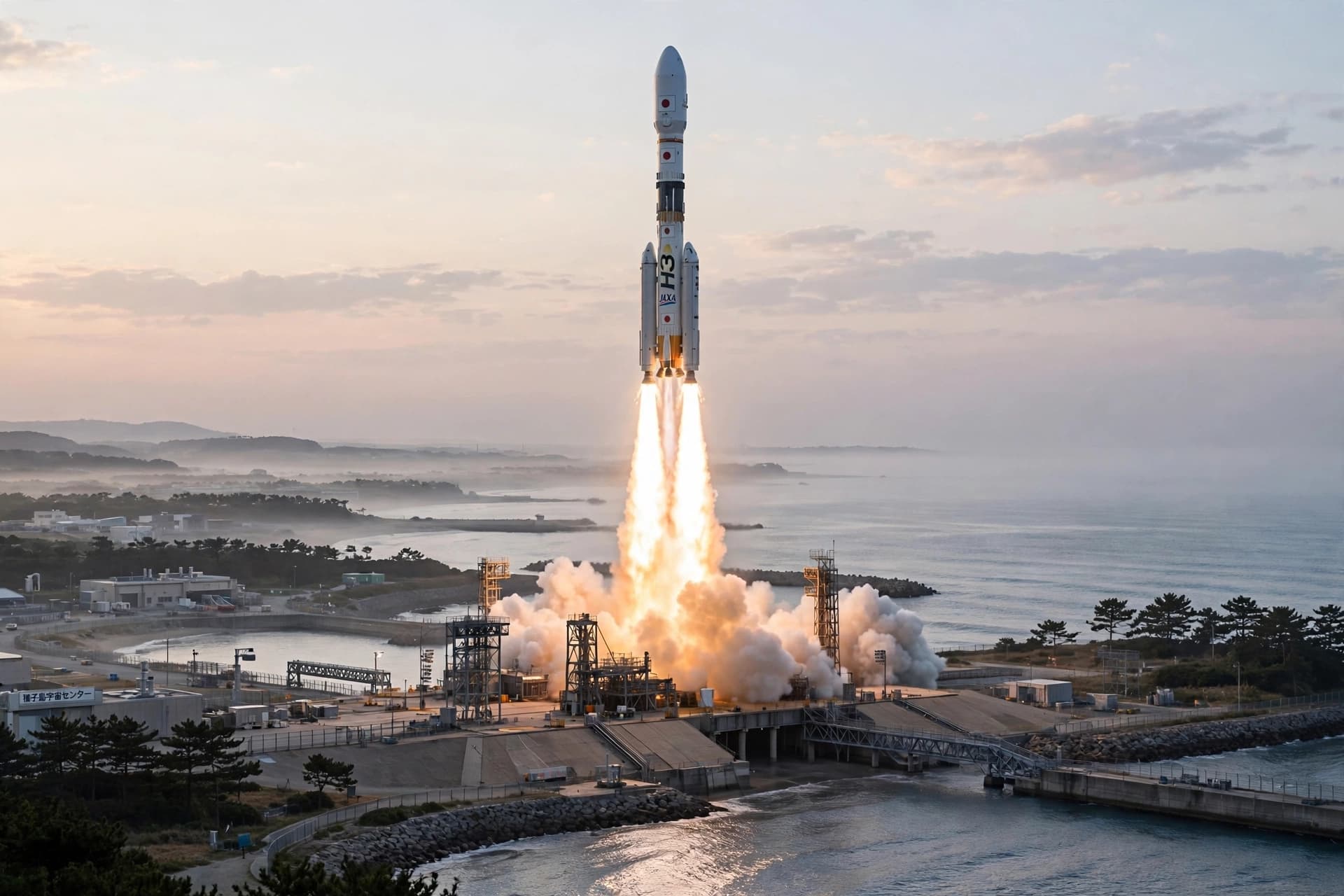
There is a particular kind of patience required to reach across the solar system and bring a piece of it home. On a clear October morning at the Tanegashima Space Center, Japan took the first step in that long conversation with the red planet's smallest companion. An H3 rocket lifted off carrying the Martian Moons eXploration spacecraft, known as MMX, beginning a journey that planners hope will culminate in the first-ever return of samples from the surface of Phobos . The launch itself lasted only moments, but the mission it inaugurated stretches across years and carries the quiet weight of scientific ambition.
The MMX spacecraft, developed by the Japan Aerospace Exploration Agency at a cost of roughly 350 million dollars, is not a simple round trip . It will travel for about a year to reach the Martian vicinity, arriving around August 2027, and then spend three years conducting observations . The centerpiece of the mission is Phobos, a small, irregularly shaped moon orbiting some six thousand kilometers above Mars. The plan calls for the spacecraft to attempt soft landings and deploy a rover to collect at least ten grams of material from the moon's surface layer, at a depth of about two centimeters or more . The samples would be sealed and returned to Earth in a capsule expected to land in Woomera, South Australia, in the early 2030s .
The challenge of touching down on Phobos is not trivial. Its gravity is roughly one two-thousandth that of Earth, so the spacecraft cannot rely on weight to hold it steady . The landing legs have been designed with special features to ensure stability, addressing concerns that the probe might tip over in the feeble gravitational field . This engineering problem is part of why the mission matters. JAXA hopes the technologies developed for MMX will contribute to future exploration of the Martian sphere, including potential human missions . The moon itself, described by some as potato-shaped, has not undergone the same geological evolution as planets, so it may preserve a record of the early development of Mars and its neighborhood .
The scientific questions MMX carries are layered. There are competing theories about how Phobos and its sibling Deimos came to be. One holds that a massive collision with Mars created them from debris; another suggests they were asteroids captured by the planet's gravity . The samples collected from Phobos could help distinguish between these possibilities and, in doing so, shed light on the formation of the solar system and the movement of material through it. There is also the matter of water and organic compounds. Mars today is a cold desert with a thin atmosphere, but evidence suggests it once had a more hospitable environment. The question of where the water and organic matter necessary for life originated may find partial answers hidden within the Phobos samples .
The mission is not Japan's alone. A rover jointly developed by French and German teams will land on Phobos as part of the operation, and Australia will play an essential role in the final stage by retrieving the re-entry capsule . Prime Minister Sanae Takaichi welcomed the launch, expressing hope that the historic endeavor would succeed in collecting samples and returning them safely . The international character of MMX reflects a broader reality of planetary science: the questions are too large, and the distances too great, for any single nation to answer alone.
For now, the spacecraft is in its planned orbit, having separated from the rocket with what project managers described as exceptional precision . It will spend the coming year coasting toward Mars, a silent traveler carrying the hopes of researchers who have waited years for this moment. The samples, when and if they arrive, will be small in mass but heavy with possibility.
---
Image Disclaimer: The visual materials in this article are AI-generated and do not depict actual mission hardware or events.
Sources: NHK World-Japan, AZERTAC, Australian Broadcasting Corporation
Published by Banx Network. This article is part of the Banx decentralized media programme, powered by the BXE token on the XRP Ledger.