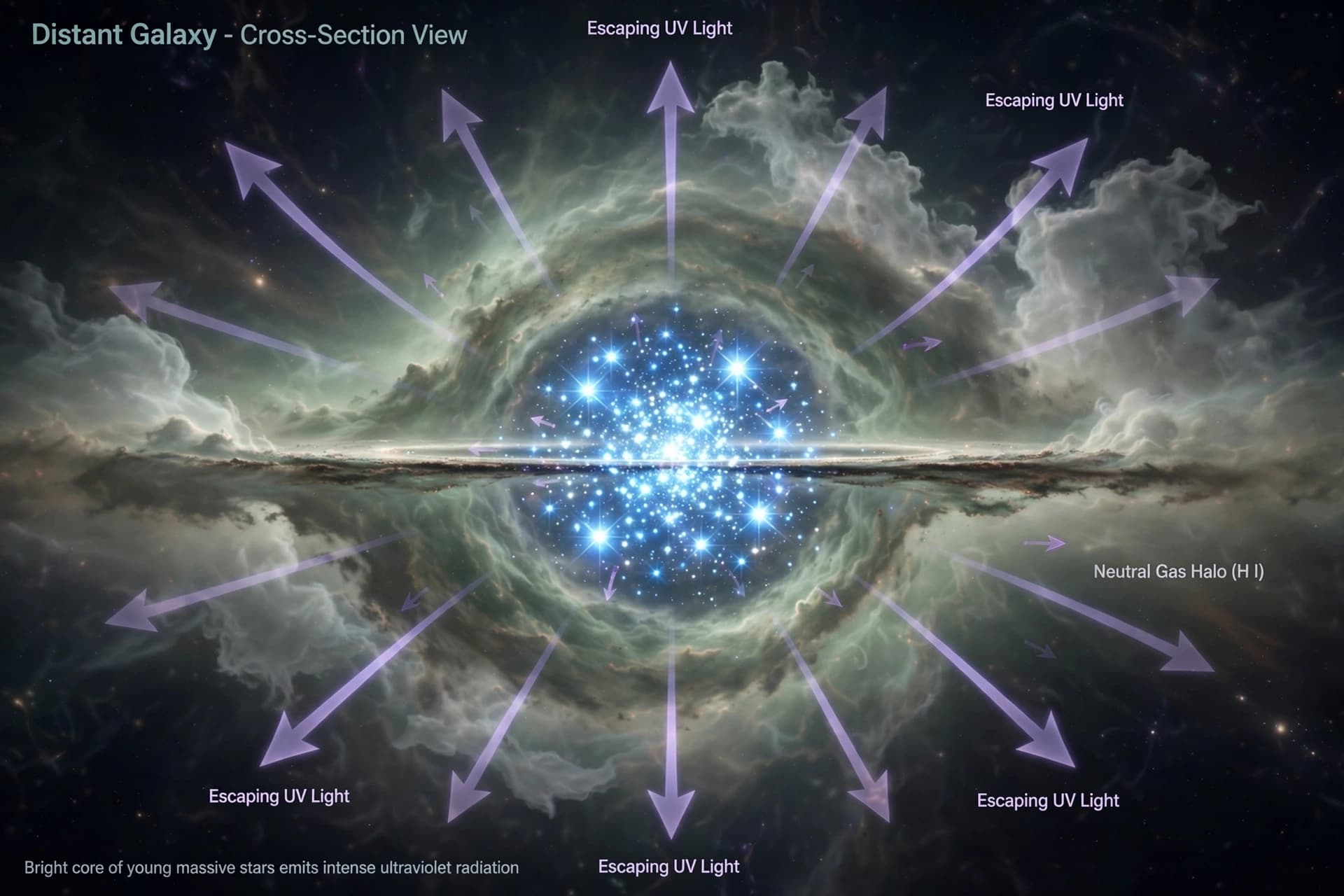
For a long while, the story of how the universe cleared its earliest fog seemed settled. Imagine a vast, dark room filled with neutral hydrogen, opaque to light, and the first galaxies as small lamps struggling to shine through. The favored explanation held that exploding stars, supernovae, swept the room clean with powerful winds, carving pathways for ultraviolet radiation to escape and ionize the surrounding gas. It was a tidy narrative of destruction enabling illumination. New observations from the Hubble Space Telescope, however, suggest the story may have unfolded in a different order, with the light finding its way out before the explosions had their say .
The study, led by researchers at Zhejiang University and the University of Michigan and published in Nature Astronomy, examined six nearby galaxies undergoing intense bursts of star formation . These local analogs serve as stand-ins for the distant galaxies that might have driven reionization, the last major phase transition of the universe. By analyzing the spectra of these galaxies, the team could measure the speed of galactic winds and the fraction of ionizing radiation escaping into space. The expectation was straightforward: faster winds should correspond to clearer pathways and more escaping light.
The results inverted that expectation. Galaxies with the fastest winds allowed the least ionizing radiation to escape . Rather than clearing a path, the energy from supernovae appears to have stirred up neutral gas and dust, spreading a wider curtain that absorbed the very radiation it was thought to liberate. Stephan McCandliss of Johns Hopkins University, a senior author, noted that the energy input increased rather than decreased the coverage of obscuring material . The winds, in other words, were not opening doors but drawing blinds.
What emerged instead was a narrow window of opportunity. The researchers found that the peak escape of ionizing radiation occurs in the first three million years after a burst of star formation begins . This is the brief interval when massive, young stars are shining fiercely, but before the first supernovae have detonated and whipped up the winds that would later choke the exits. Radiation from these young stars, perhaps aided by smaller-scale stellar winds in their immediate vicinity, slips through the surrounding gas before the neighborhood becomes too turbulent . Cody Carr, the study's lead author, put it simply: the photons are escaping before galactic winds form .
This revised timeline carries weight for how astronomers model the early universe. Cosmological simulations have long placed supernovae at the center of the reionization story, assuming their winds were essential for clearing the way . The new findings suggest a need to revisit those assumptions and to examine how the radiation and winds of young stars shape their surroundings in the crucial moments before the first explosions. Renyue Cen of Zhejiang University, a senior author, emphasized the importance of understanding this pre-supernova phase .
The study does not dismiss supernovae entirely. Weaker winds near young stars may still play a supporting role in helping radiation escape, and the team is seeking additional Hubble time to study a larger sample of galaxies . The work is a reminder that cosmic history is not always a story of dramatic forces clearing the stage. Sometimes the quietest moment, before the explosions begin, is when the light gets through.
---
Image Disclaimer: The illustrations accompanying this article are generated by artificial intelligence and are intended for illustrative purposes only.
Sources: Universe Space Tech, EurekAlert, Nature Astronomy
Published by Banx Network. This article is part of the Banx decentralized media programme, powered by the BXE token on the XRP Ledger.