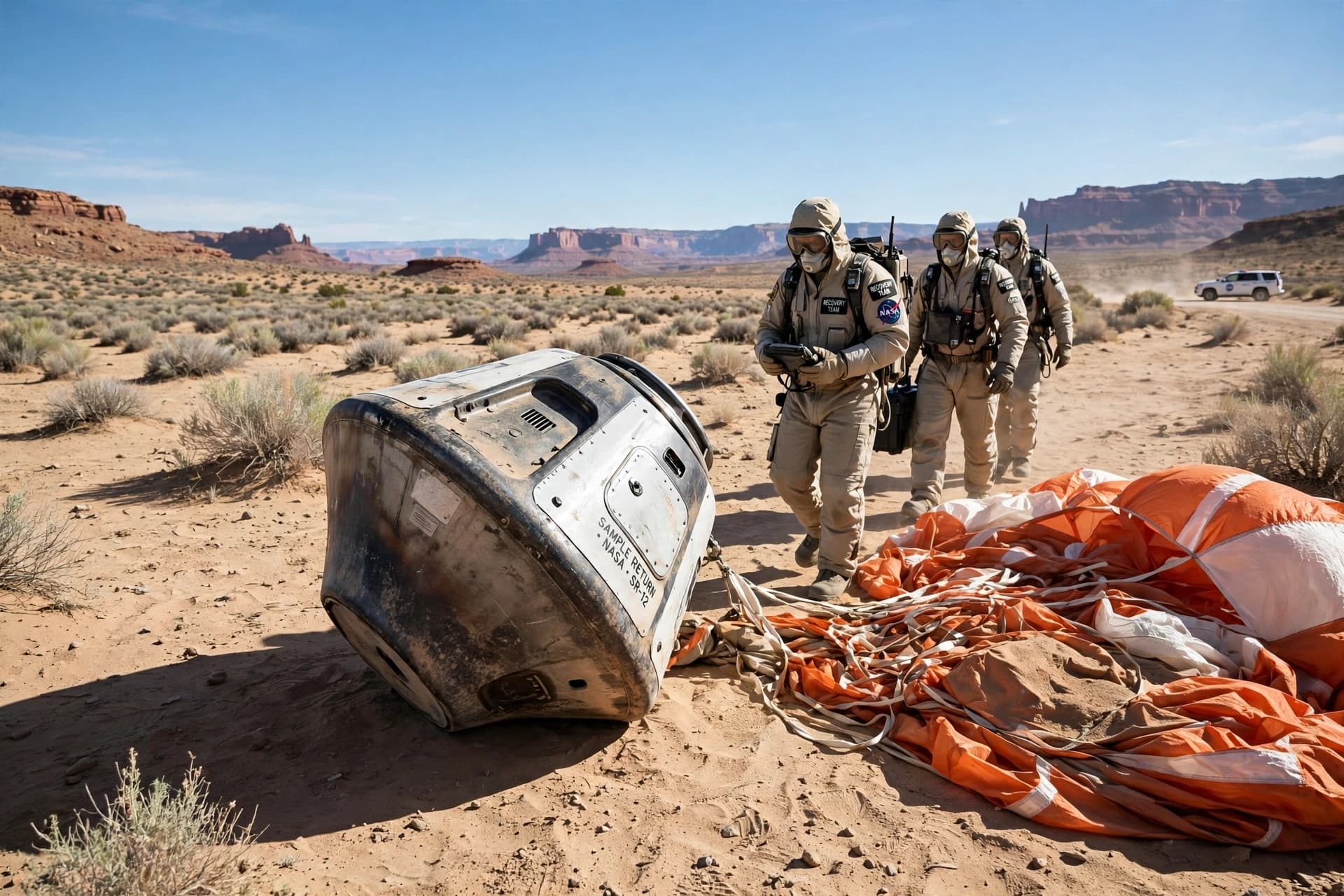
There is a particular poignancy in the formal end of a mission that has already succeeded, a closing of the book on a journey whose most important chapters have already been written. On September 30, NASA officially concluded the OSIRIS-REx mission, the first American spacecraft to collect a sample from an asteroid and return it to Earth. The spacecraft itself is still flying, renamed OSIRIS-APEX and bound for a different asteroid. But the mission that began in 2016 and delivered 121.6 grams of Bennu to the Utah desert in 2023 is now, formally, complete.
The numbers tell a story of achievement. The sample was more than twice the mission's requirement, the largest asteroid sample ever returned to Earth . More than 200 scientific papers have already been published from its analysis. Researchers found amino acids and sugars—molecules essential to life—along with evidence of past liquid water on Bennu, a 490-meter asteroid that carries material from the earliest days of the solar system . Much of the sample remains archived for future generations, awaiting instruments and questions that have not yet been imagined.
But the mission was not a smooth execution of a predetermined plan. When OSIRIS-REx arrived at Bennu in 2018, the team expected a relatively smooth, sandy surface. They found instead a loosely aggregated pile of sharp boulders, with no obvious place to land . The navigation team had to improvise, mapping the asteroid in finer detail than planned and selecting a site in the Nightingale crater that was barely large enough for the spacecraft. When the sample was collected in October 2020, the surface responded more like a fluid than a solid; the collection head sank 51 centimeters before the thrusters fired to pull the spacecraft away . The sample container then failed to seal properly because of excess material, forcing the team to stow it early. On return, a parachute anomaly required quick thinking before the capsule landed safely in Utah .
Dante Lauretta, the mission's principal investigator, spoke of the end with a mixture of pride and sadness. "I have known this day was coming for a long time, but it is still hard to see it arrive," he said. "I feel immense pride in what we accomplished together, and real sadness that this journey has ended" . He described the mission's success not as the avoidance of surprises but as the result of a team designed to adapt to them. "A successful exploration mission is not one that avoids surprises; it is one that is intentionally designed to adapt to them" .
The spacecraft, meanwhile, has a second life. Renamed OSIRIS-APEX (APophis EXplorer), it is using its remaining fuel to travel toward asteroid Apophis, which will pass within 32,000 kilometers of Earth in April 2029. The spacecraft is expected to arrive in orbit around Apophis later that month and study how Earth's gravity alters the asteroid during its close passage . The mission to Bennu is over. The journey of the spacecraft that made it is not.
For the scientists who built the instruments and analyzed the data, the formal closure is a bureaucratic marker, not an intellectual one. The sample is still here. The papers are still being written. The questions Bennu raised are still open. What ended on September 30 was a mission. What continues is the work it made possible.
---
AI Image Disclaimer: The visuals in this article are generated by artificial intelligence and are for illustrative purposes only.
Sources: NASA, University of Arizona, Media Indonesia, CNES,
Published by Banx Network. This article is part of the Banx decentralized media programme, powered by the BXE token on the XRP Ledger.