There is a particular kind of humility that comes when science discovers it has been telling a story slightly wrong for a very long time. For a century and a half, the giant crane of prehistoric Europe existed in the comfortable certainty of extinction—a creature of ice-age caves and museum drawers, gone before anyone thought to notice. But sometimes the past is not as distant as the labels suggest, and the line between what has vanished and what has merely transformed is thinner than we imagine.
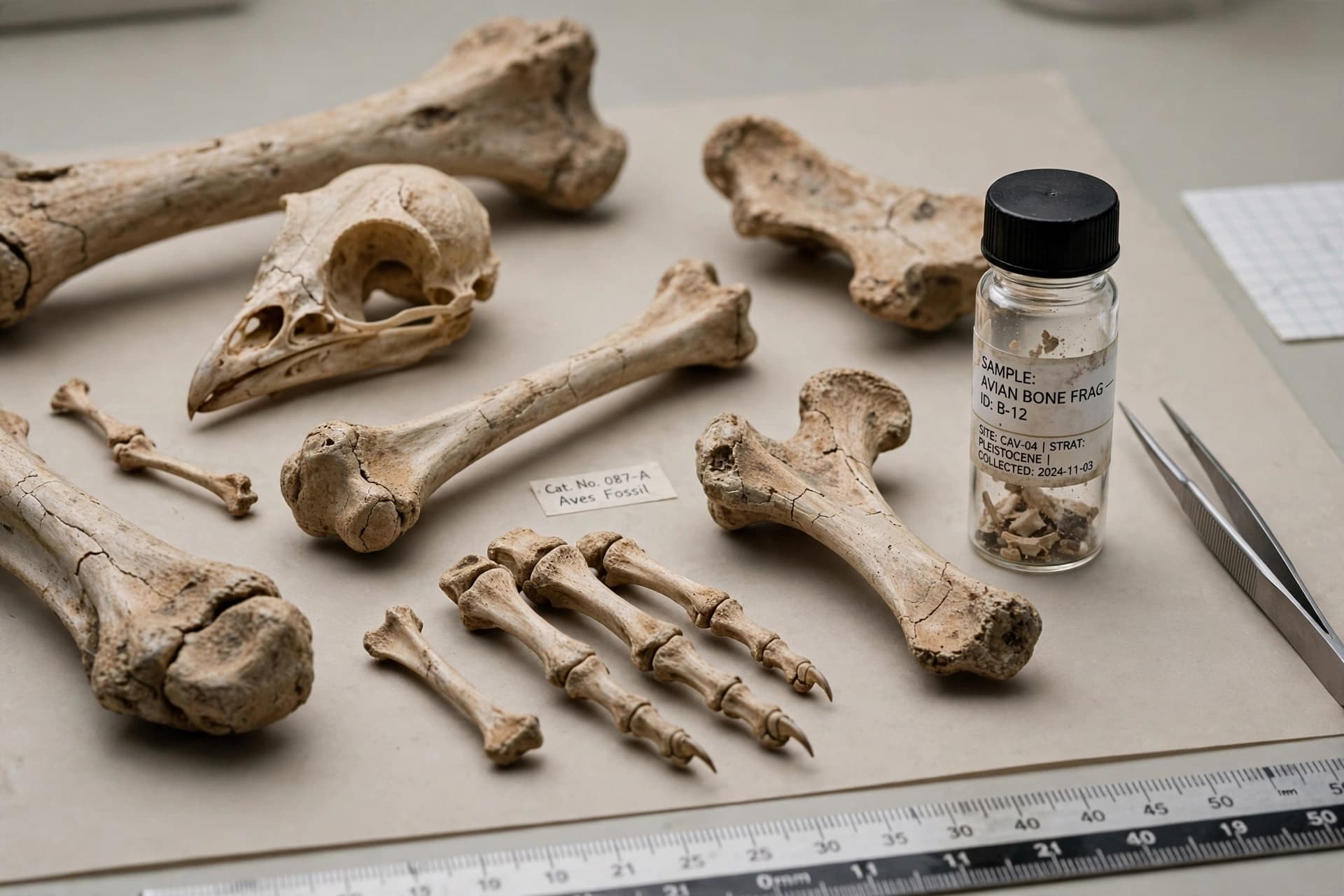
The mystery began in the nineteenth century, when French biologist Alphonse Milne-Edwards examined unusually large bird bones unearthed from caves in southern France. Dating back more than twenty thousand years, the remains were classified as a distinct species: Grus primigenia, a giant crane that had roamed Europe alongside other prehistoric animals before disappearing . For generations, this classification stood largely unchallenged, accepted as one more entry in the long ledger of losses.
But researchers at Bournemouth University suspected something was amiss. Dr. John Stewart, a professor of evolutionary palaeoecology who led the new study, noted a simple clue that earlier scientists may have overlooked: cranes exhibit significant size differences between males and females. What appeared to be two separate species—one giant, one familiar—might instead have been a single species with pronounced sexual dimorphism .
To test this, the team partnered with the Centre for Palaeogenetics in Stockholm and extracted ancient DNA from eighteen crane bones found across England, Wales, France, Germany, and the Balearic Islands. Rather than relying on shape and size alone, they let the genetic material speak. The results were unambiguous. The ancient giants were not a lost species at all; they were larger versions of the common crane, Grus grus, a bird that still migrates across European skies today .
The finding raises a question that is both scientific and quietly philosophical: why were these ancient cranes so much larger than their modern descendants? Researchers suspect that changes to their environment—the draining of wetlands, the spread of human land use—may have favored smaller body sizes over millennia . The birds did not vanish; they adapted, shrinking as their world shrank around them.
Stewart has been careful to note that further research is needed to understand the precise mechanisms behind this size shift. But the implications extend beyond cranes. Other prehistoric birds classified as extinct based on bone size alone might similarly represent oversized versions of living species. "It may be that we have overestimated the number of extinctions in the past," Stewart observed . This is not a call to complacency about modern biodiversity loss, but a gentle correction to the historical record—a reminder that the past is not always as foreign as it seems.
The common crane, it turns out, has been carrying its own ancient history all along, hidden in plain sight. The giant of the caves never truly left. It simply became smaller, quieter, and more familiar.
Image note: The visuals accompanying this article were created with artificial intelligence and are illustrative rather than documentary.
Sources: Bournemouth University, People.com
Published by Banx Network. This article is part of the Banx decentralized media programme, powered by the BXE token on the XRP Ledger.