History often speaks in quiet fragments rather than complete stories. A weathered stone, a carefully carved inscription, or a single ceremonial object can carry echoes of beliefs that shaped entire civilizations. In Egypt, archaeologists have uncovered ancient tombs containing human remains fitted with delicate gold tongues, offering another glimpse into funerary traditions that have fascinated researchers for generations.
The discovery was made during archaeological excavations at an ancient burial site dating to Egypt's Greco-Roman period. Researchers reported that several burials included thin gold tongue-shaped amulets placed inside or near the mouths of the deceased. Similar findings have been documented at a limited number of Egyptian archaeological sites in recent years, making the latest discovery an important addition to ongoing research into ancient burial customs.
According to archaeologists, these gold tongue amulets were likely symbolic rather than decorative. One widely accepted interpretation suggests they were intended to enable the deceased to communicate with deities in the afterlife, particularly in the presence of Osiris, the ancient Egyptian god associated with the underworld and resurrection. However, researchers continue to study the practice, acknowledging that its precise meaning may have varied across regions and historical periods.
Beyond the gold artifacts, the excavation also revealed stone sarcophagi, pottery vessels, funerary offerings, amulets, and human skeletal remains. Each object provides valuable evidence about burial practices, religious beliefs, craftsmanship, and everyday life during the period in which the tombs were constructed. Careful documentation and conservation work are continuing to preserve these materials for future study.
Archaeologists emphasize that discoveries such as these contribute to a broader understanding of ancient Egyptian society rather than fundamentally changing existing historical knowledge. Every newly excavated tomb offers additional context that helps scholars compare regional customs, artistic traditions, and religious practices across different centuries of Egyptian civilization.
Modern archaeological techniques have played an important role in examining the site. Researchers are using digital mapping, photographic documentation, laboratory analysis, and conservation methods to study fragile artifacts while minimizing damage. Human remains and associated objects may also undergo scientific testing to provide information about age, health, diet, and burial chronology.
Egypt continues to produce significant archaeological discoveries due to its exceptionally rich cultural heritage and ongoing excavation projects led by Egyptian and international research teams. Many previously unexplored burial complexes remain beneath the desert landscape, ensuring that careful scientific investigation will continue expanding historical understanding for years to come.
The newly unearthed tombs and their distinctive gold tongue amulets offer another carefully preserved chapter in the story of ancient Egypt. As archaeologists continue analyzing the site, the findings are expected to enrich scholarly understanding of funerary traditions while providing the public with a deeper appreciation of one of history's most enduring civilizations.
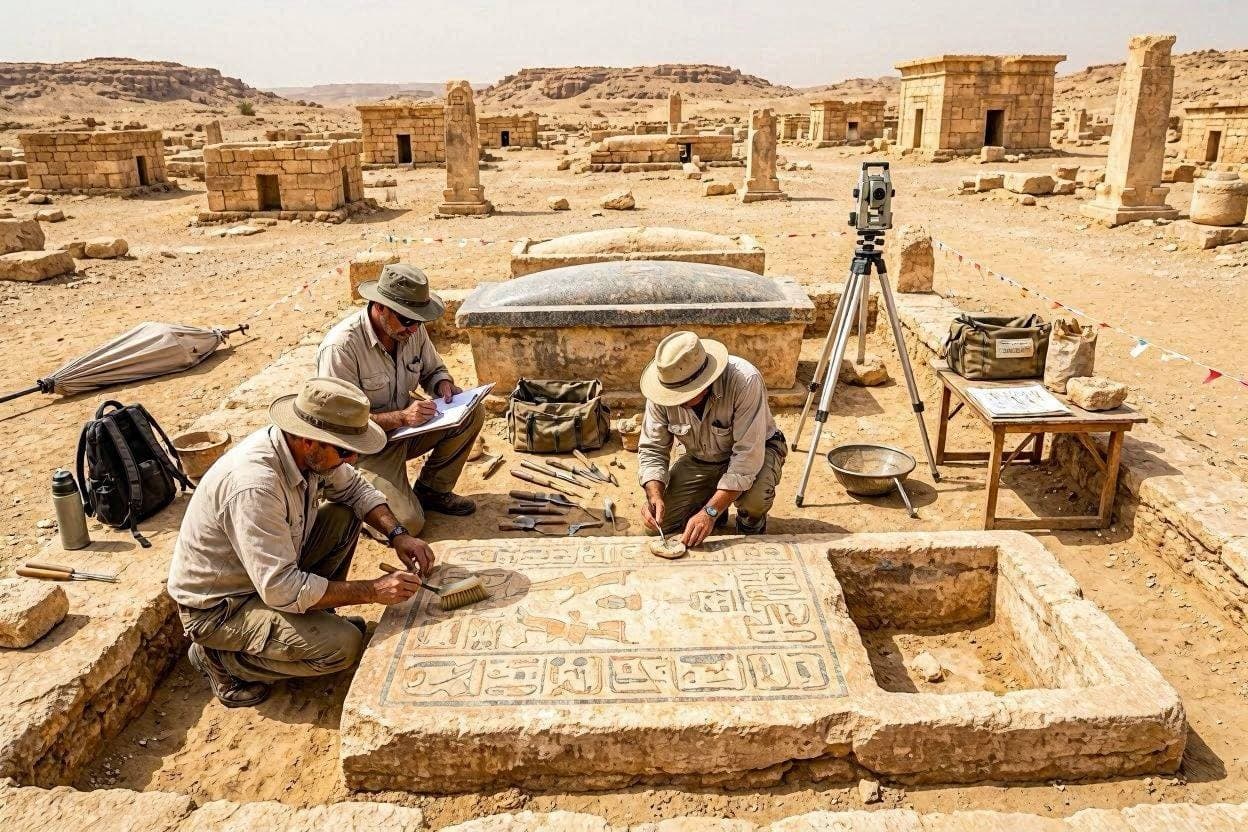
AI Image Disclaimer: The accompanying illustrations are AI-generated artistic reconstructions based on archaeological descriptions and should not be interpreted as authentic excavation photographs.
Source Verification Check: Strong credible sources found.
Sources:
Egypt Ministry of Tourism and Antiquities Live Science Archaeology Magazine Smithsonian Magazine Reuters
Published by Banx Network. This article is part of the Banx decentralized media programme, powered by the BXE token on the XRP Ledger.