There is a particular kind of vision that sees possibility where others see only ice—the ability to look at a cubic kilometer of Antarctic glacier and imagine a telescope that could capture particles from the most violent events in the cosmos. Francis Halzen possessed that vision. This week, the Royal Swedish Academy of Sciences awarded him the 2026 Nobel Prize in Physics for his decisive contributions to the IceCube Neutrino Observatory and the discovery of high-energy neutrinos of astrophysical origin .
Halzen, an 82-year-old Belgian-American particle physicist at the University of Wisconsin–Madison, first presented his vision for capturing neutrinos at the South Pole in 1988 . Neutrinos are elementary particles that barely interact with matter—65 billion of them pass through a human fingernail every second without leaving a trace . But they are produced in enormous quantities by nuclear reactions, including those in the most powerful cosmic accelerators: active galactic nuclei, supernova remnants, and black hole jets .
Because neutrinos are electrically neutral, they can travel across the universe without being deflected by magnetic fields or absorbed by gas and dust. They arrive at Earth carrying information directly from their sources—information that light, X-rays, or cosmic rays cannot deliver . The challenge is catching them. Most pass through detectors as if they were not there. To observe even a few, Halzen realized, you need an enormous volume of transparent material.
The solution was ice. Beginning with a predecessor experiment called AMANDA in the 1990s, Halzen and his team embedded optical sensors deep in the Antarctic ice sheet. IceCube, completed in 2010, uses 5,160 sensors deployed on 86 strings between 1,450 and 2,450 meters below the surface . When a neutrino collides with an atomic nucleus in the ice, it produces a flash of light—Cherenkov radiation—that the sensors detect. From the timing and intensity of that light, researchers can reconstruct the neutrino's energy and direction .
The payoff came in 2013, when IceCube detected two events—nicknamed Bert and Ernie—with energies exceeding 1 petaelectronvolt, more than a thousand times the energy of the most powerful particle accelerator on Earth . A year later, the collaboration reported 37 high-energy neutrino events, confirming that they came from beyond our solar system . "His tenacity and scientific vision has paved the way for a new kind of astronomy," said Mark Pearce, Chair of the Nobel Committee for Physics .
Halzen told the academy by phone that he was "delighted" and "surprised" by the announcement, which came while he was attending a conference in Italy . The prize, which he shares with no one this year, carries a sum of 12 million Swedish crowns, approximately $1.2 million .
The IceCube observatory is not finished. New sensors with greater sensitivity were installed at the South Pole at the beginning of 2026, and DESY, the German research center that contributed significantly to IceCube's construction, continues to collaborate on its expansion . The ghostly particles that Halzen spent his career chasing have opened a new window on the universe—one that looks not with light, but with the faint, fleeting signals of neutrinos born in the cosmos's most violent corners.
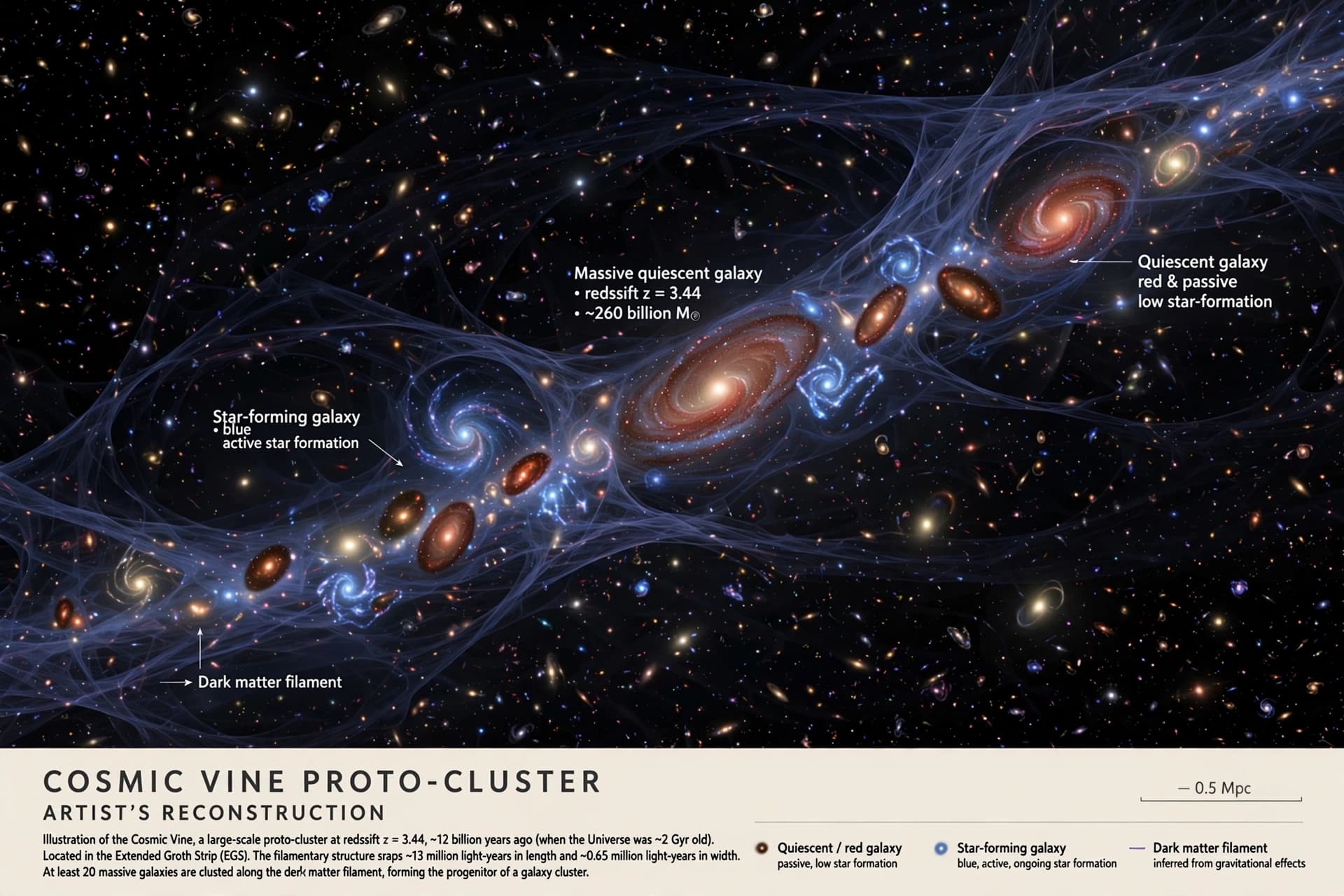
AI Image Disclaimer: The imagery in this article was created using artificial intelligence for illustrative purposes only and does not depict the actual observatory or individuals described.
Sources: Science (AAAS), Reuters, CBC News, American Physical Society, DESY
Published by Banx Network. This article is part of the Banx decentralized media programme, powered by the BXE token on the XRP Ledger.