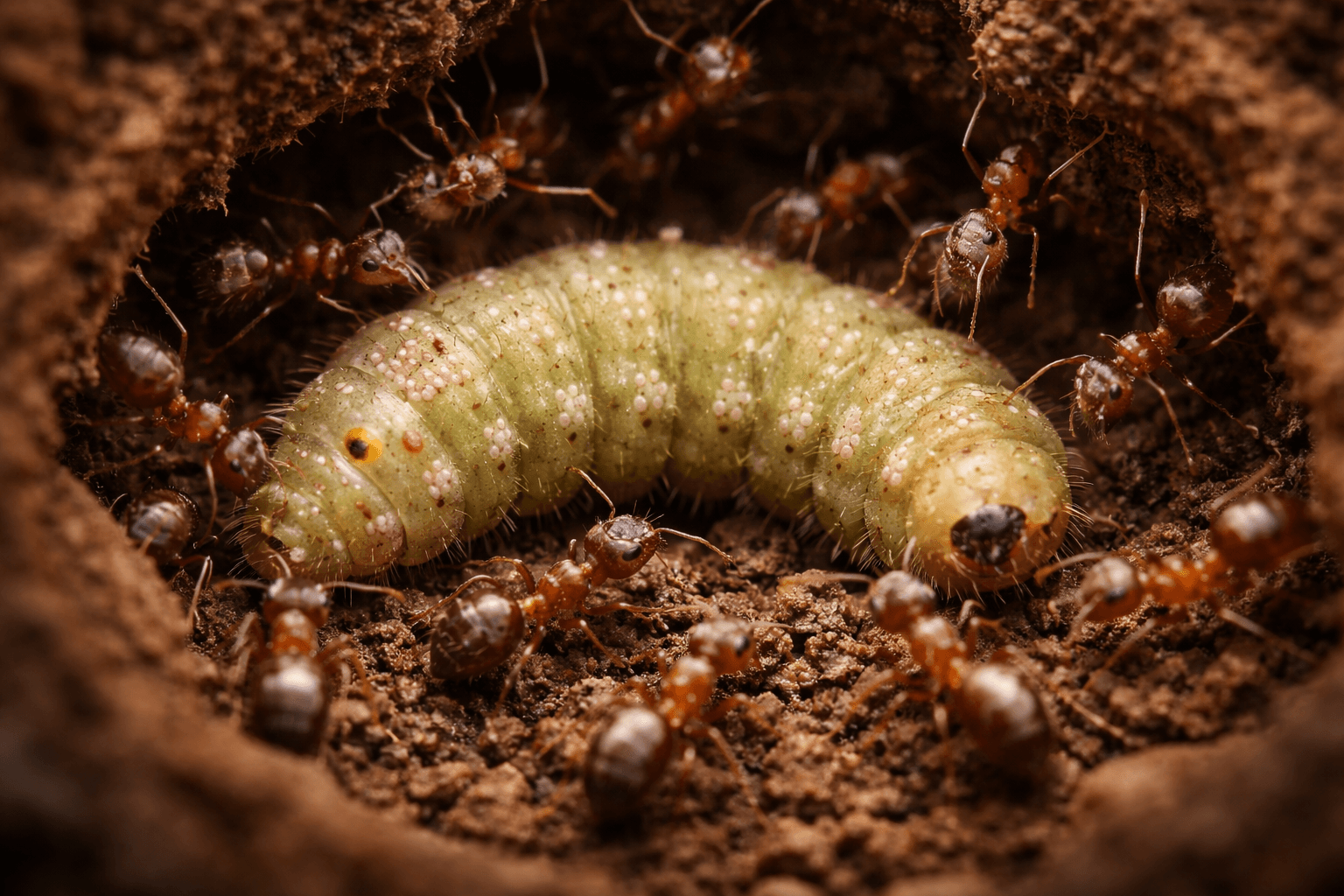
At first glance, an ant nest appears to be a place of certainty. Beneath soil and leaf litter, order reigns, guided not by sight or sound but by an invisible grammar of scent. Each ant belongs because it smells right. Anything that does not is swiftly removed. In such a world, survival seems reserved only for those born inside. Yet nature, patient and inventive, has found a way to bend this certainty. Certain caterpillars, fragile and slow, approach ant colonies not with force, but with familiarity. They carry what might be called a password, though it is neither spoken nor seen. It is chemical, woven into their outer skin, and tuned precisely to the colony they seek to enter. Ants rely on hydrocarbons coating their bodies to recognize kin from intruder. These chemical signatures are constantly checked, antennae brushing against passing forms like silent questions. Some caterpillars, particularly those associated with lycaenid butterflies, have evolved the ability to mimic these signatures with remarkable accuracy. When an ant encounters them, confusion replaces alarm. The scent feels known. The threat dissolves. In some cases, the deception goes further. The caterpillar not only smells like an ant, but also behaves like one that deserves care. It may secrete substances that ants value, encouraging protection rather than aggression. Carried into the nest, it lives among its would-be predators, feeding, resting, and growing under their watch. This relationship is not always gentle. Some caterpillars repay protection by consuming ant larvae, while others coexist more peacefully. What unites them is precision. A slight chemical error would mean death. The success of the intrusion depends on flawless imitation and timing, refined across generations. As researchers continue to study these interactions, the story remains less about trickery than adaptation. Ants follow rules that keep their societies intact. Caterpillars learn those rules and quietly comply, even as they benefit from them. It is a reminder that in nature, access is often granted not to the strongest, but to the most convincingly familiar. In the end, the ant colony does not fall. It continues, unaware that its defenses have been momentarily redefined. And the caterpillar, hidden in plain scent, survives another stage of its transformation.
AI Image Disclaimer Illustrations were produced with AI and serve as conceptual depictions rather than real photographs. Sources Nature Science National Geographic The New York Times BBC
Published by Banx Network. This article is part of the Banx decentralized media programme, powered by the BXE token on the XRP Ledger.