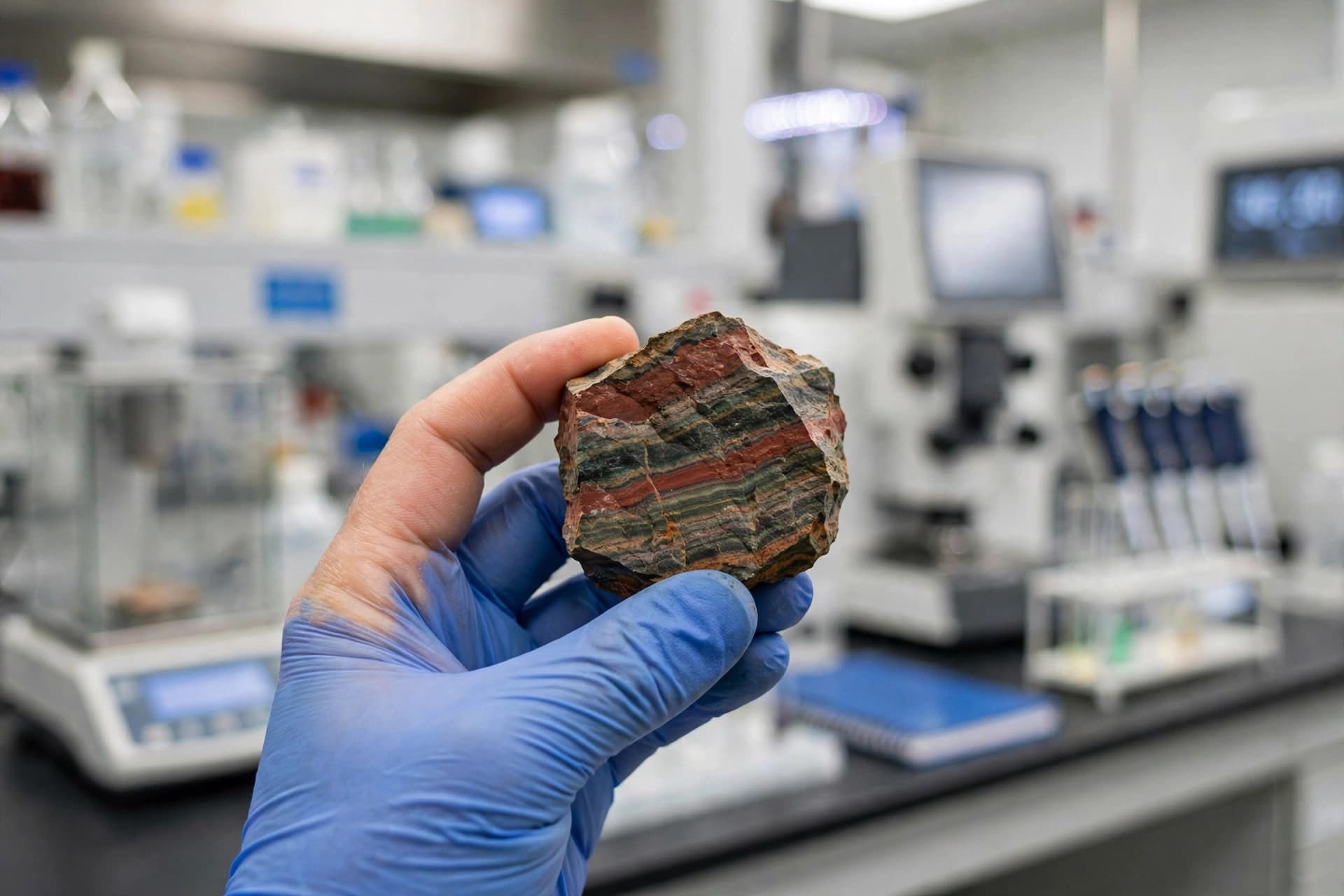
Some stones carry the memory of pressure and heat the way a sailor carries the memory of storms. A rock found on Goodenough Island, off the eastern coast of Papua New Guinea, has traveled farther than most—more than ninety kilometers down into the Earth's mantle, caught in the slow machinery of a subduction zone, before returning to the surface after roughly 4.4 million years .
The sample belongs to a rare class of rock called eclogite, formed under extreme pressure. Inside it, researchers found tiny inclusions of coesite, a mineral that only forms at depths of ninety kilometers or more. Zircon crystals provided a timestamp for when that pressure was applied. What the rock revealed, however, was not a simple story of increasing heat with depth. It was something stranger .
At about forty-five kilometers below the surface, the rock had reached temperatures of roughly 700 degrees Celsius—hotter than models predict for subduction zones at that depth. But when it descended further, past ninety kilometers, the temperature rose by only about 100 degrees more. The rock had entered a relatively cooler environment deeper down, a thermal path that contradicts established assumptions .
"What makes this rock so interesting is that it records two very different thermal conditions at different stages of its time deep inside Earth," said geologist Axel Schmitt of Curtin University in Australia. "At about 45 kilometers depth, the rock was surprisingly hot, but as it traveled deeper it entered an environment that was cooler than we would normally expect at that depth" .
Scientists from the University of Göttingen, Curtin University, and Syracuse University analyzed the sample using techniques that did not exist when it was collected more than two decades ago. The original expedition, funded by the National Science Foundation, retrieved the rock in 2003. Now, with modern analytical methods, the team could reconstruct its pressure-temperature history in fine detail .
Two explanations have been proposed. One involves intense shearing where tectonic plates meet, generating additional heat at relatively shallow depths. The other suggests the subduction zone is young and has not yet cooled to the lower temperatures that models would predict .
"Finding this change from relatively hot conditions at shallower depth to colder conditions deeper down was unexpected," Schmitt said. The findings, published in Nature Geoscience, suggest that the thermal structure of subduction zones may be more complex than previously thought .
Subduction zones are not merely geological curiosities. They are the engines that produce earthquakes, volcanic eruptions, and the long-term cycling of carbon through the Earth. Understanding how heat moves through these zones helps scientists refine models of how the planet has regulated its climate over millions of years. One small rock, carried down and brought back up, offers a piece of that puzzle .
AI Image Disclaimer: The image accompanying this article is AI-generated and not a photograph of the actual rock sample.
Sources: ScienceAlert, EurekAlert, Tech Explorist, Nature Geoscience (journal), University of Göttingen
Published by Banx Network. This article is part of the Banx decentralized media programme, powered by the BXE token on the XRP Ledger.