
In the fertile soils of Egypt's Nile Delta, where farmers have turned the earth for millennia, the past and the present are never far apart. A plow can turn up a sherd of pottery, a child can stumble upon a carved fragment, and sometimes a single stone can open a door to a king who ruled more than three thousand years ago.
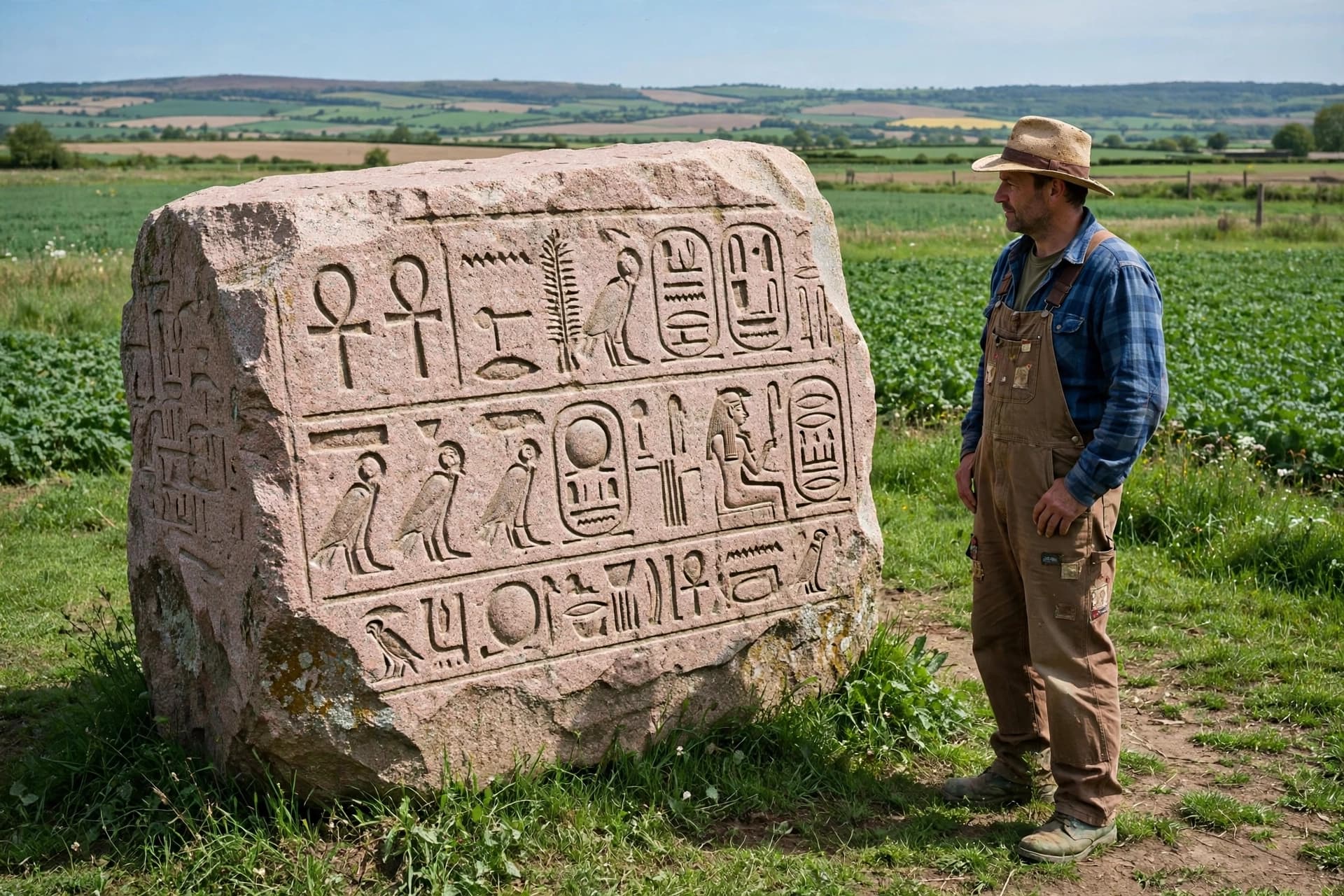
That is what happened in Behbeit el-Hagar, a village in Gharbia province about sixty miles north of Cairo. Khaled al-Shahat was working on his land when he came across something he had not seen before—a pink granite block bearing hieroglyphic inscriptions . Rather than keeping it or moving it, he alerted local antiquities officials. That decision led archaeologists from Egypt's Supreme Council of Antiquities to conduct rescue excavations, and what they found exceeded all expectations .
The excavations uncovered the remains of two colossal royal statues. The first and most striking discovery was a massive head of Ramses II, measuring about 1.6 meters in height, depicting the pharaoh wearing the double crown that symbolizes the unification of Upper and Lower Egypt . Based on the size of the head, archaeologists estimate the complete statue once stood approximately 8.5 meters tall, including its base . A fragment from the statue's back pillar bears part of the king's Horus name, confirming the identification .
Nearby, the team found the larger surviving portion of a second royal statue, measuring about 2.4 meters. It is missing its legs and base, but its face remains clearly visible, with well-preserved features beneath a traditional nemes headdress. Experts believe it also depicts Ramses II, based on the similarity of its facial features to the first statue . A third discovery—a 1.3-meter block of pink granite—carries two royal titles of Ramses II: "Nesw-Bity," meaning King of Upper and Lower Egypt, and "Sa-Ra," meaning Son of Ra .
The site, Behbeit el-Hagar, is already known for the remains of a major temple dedicated to the goddess Isis. The new discoveries add to evidence of the area's importance during the reign of Ramses II, one of ancient Egypt's most celebrated pharaohs, who ruled for approximately 66 years and left monuments across the country .
On Wednesday, Minister of Tourism and Antiquities Sherif Fathy traveled to the village to honor al-Shahat, presenting him and his wife with certificates of appreciation and an Umrah pilgrimage to Mecca in recognition of his honesty and responsible conduct. "The minister insisted that the citizen be honored in his village, on his own land, and among his family and fellow villagers," the ministry said .
Excavations and archaeological studies are continuing on al-Shahat's land, as researchers believe further discoveries may lie beneath the surface. For now, the farmer who found an unusual stone has become part of the story he helped uncover—a story that connects a modern cucumber field to the grandeur of an ancient king.
AI Image Disclaimer: The accompanying visual is AI-generated and does not depict the actual archaeological site or artifacts.
Sources: CBS News, Anadolu Agency, Egyptian Gazette, The New Arab, Gazeta Express, Agenzia Nova, Daily Express
Published by Banx Network. This article is part of the Banx decentralized media programme, powered by the BXE token on the XRP Ledger.



