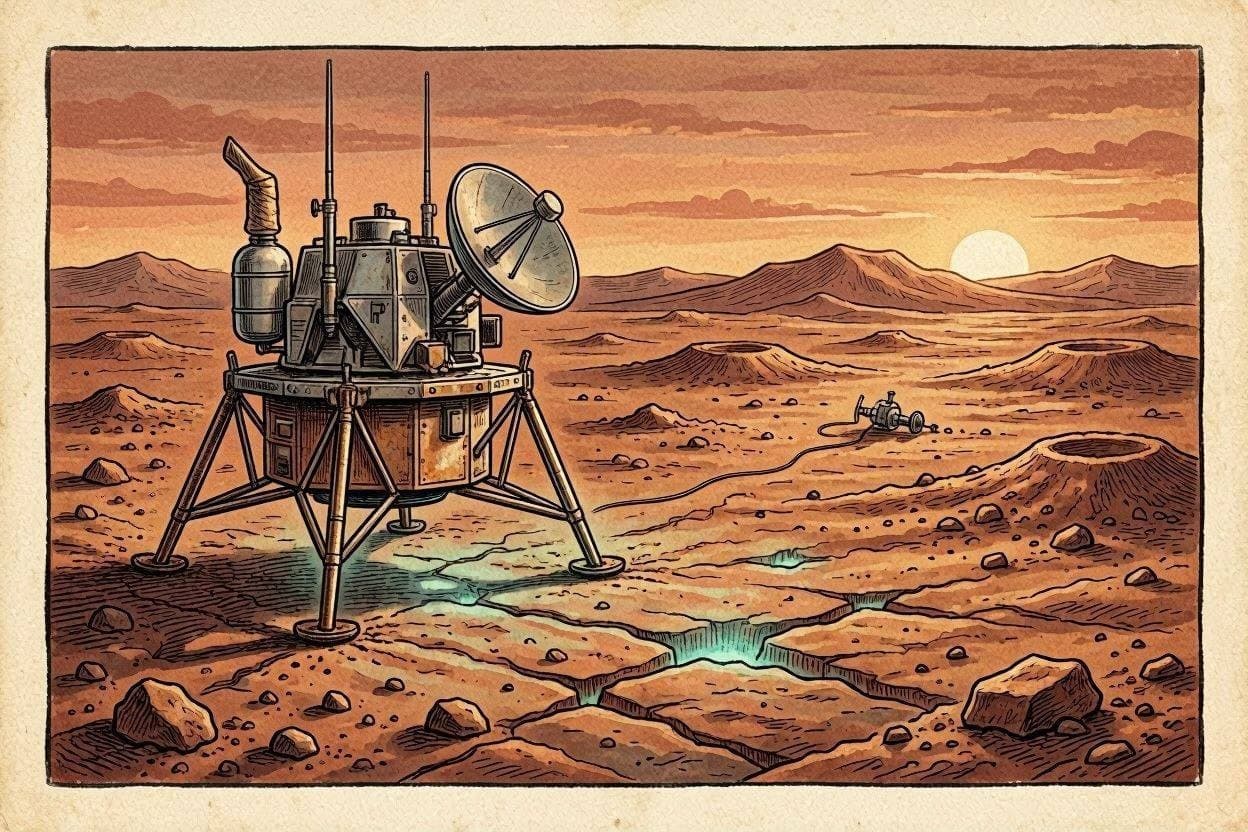
Opening: Half a century ago, the Viking 1 lander touched down on the rusty surface of Mars, carrying with it the hopes and questions of humanity. Among its suite of instruments was the Gas Chromatograph-Mass Spectrometer (GCMS) and the Labeled Release (LR) experiment, designed to detect signs of microbial life. While the official conclusion was negative, a persistent debate has simmered in the scientific community, fueled by ambiguous data and new interpretations. This enduring mystery invites reflection on how we define life and the challenges of searching for it in the vast silence of space.
Body: The core of the controversy lies in the results of the LR experiment, which detected the release of gas when Martian soil was mixed with nutrient solution. Initially interpreted as a chemical reaction rather than biological activity, recent studies have suggested that the pattern of gas release mirrors that of terrestrial microbes. Proponents of the biological hypothesis argue that the data is consistent with metabolic processes, challenging the long-held assumption that Mars is sterile.
However, the GCMS instrument failed to detect organic molecules in the soil, a finding that strongly supported the non-biological interpretation. Critics of the life hypothesis point out that without organic building blocks, the presence of metabolism is highly unlikely. They argue that reactive chemicals in the soil, such as perchlorates, could have produced the observed gas release through abiotic means. This contradiction between the two instruments remains the central puzzle of the Viking mission.
Advancements in our understanding of Martian chemistry have added complexity to the debate. Discoveries of perchlorates by later missions, such as Phoenix and Curiosity, revealed that these compounds can break down organics when heated, potentially explaining the GCMS’s null result. If perchlorates destroyed organic evidence during the Viking analysis, it is possible that life-related molecules were present but undetected. This retrospective insight has reignited interest in the original data.
The scientific method thrives on skepticism and reevaluation, and the Viking data is no exception. Researchers continue to analyze the archived results using new models and comparative biology techniques. Some experiments simulate Martian conditions on Earth, testing how local microbes respond to similar nutrients. These analog studies provide context, helping scientists distinguish between biological and chemical signatures in extreme environments.
Public interest in the possibility of past or present life on Mars remains high, driven by the profound implications of such a discovery. The idea that we may have missed evidence of neighbors in our solar system captures the imagination, fueling support for future missions. Each new rover and orbiter sent to Mars carries more sophisticated tools, aiming to resolve the questions left unanswered by Viking.
The debate also highlights the importance of instrument design and mission planning. Future missions, such as those under the Artemis program and international collaborations, prioritize the detection of biosignatures with greater precision. Lessons learned from Viking inform these efforts, ensuring that ambiguity is minimized and data is robust. The legacy of Viking is not just in its findings but in how it shapes our approach to exploration.
As we look back fifty years later, the Viking mission stands as a testament to human curiosity. Whether or not it found life, it sparked a conversation that continues to drive scientific inquiry. The red planet remains a frontier of mystery, inviting us to look closer and question deeper.
Closing: The question of whether Viking 1 found life on Mars remains open, sustained by conflicting data and evolving scientific understanding. While no consensus has been reached, the debate enriches our search for extraterrestrial life. As new missions explore the Red Planet, the spirit of Viking lives on, guiding us toward clearer answers.
AI Image Disclaimer: Visuals in this piece are artificially generated and should be viewed as artistic interpretations rather than factual documentation.
Sources: NASA Scientific American Space.com Journal of Geophysical Research
Published by Banx Network. This article is part of the Banx decentralized media programme, powered by the BXE token on the XRP Ledger.