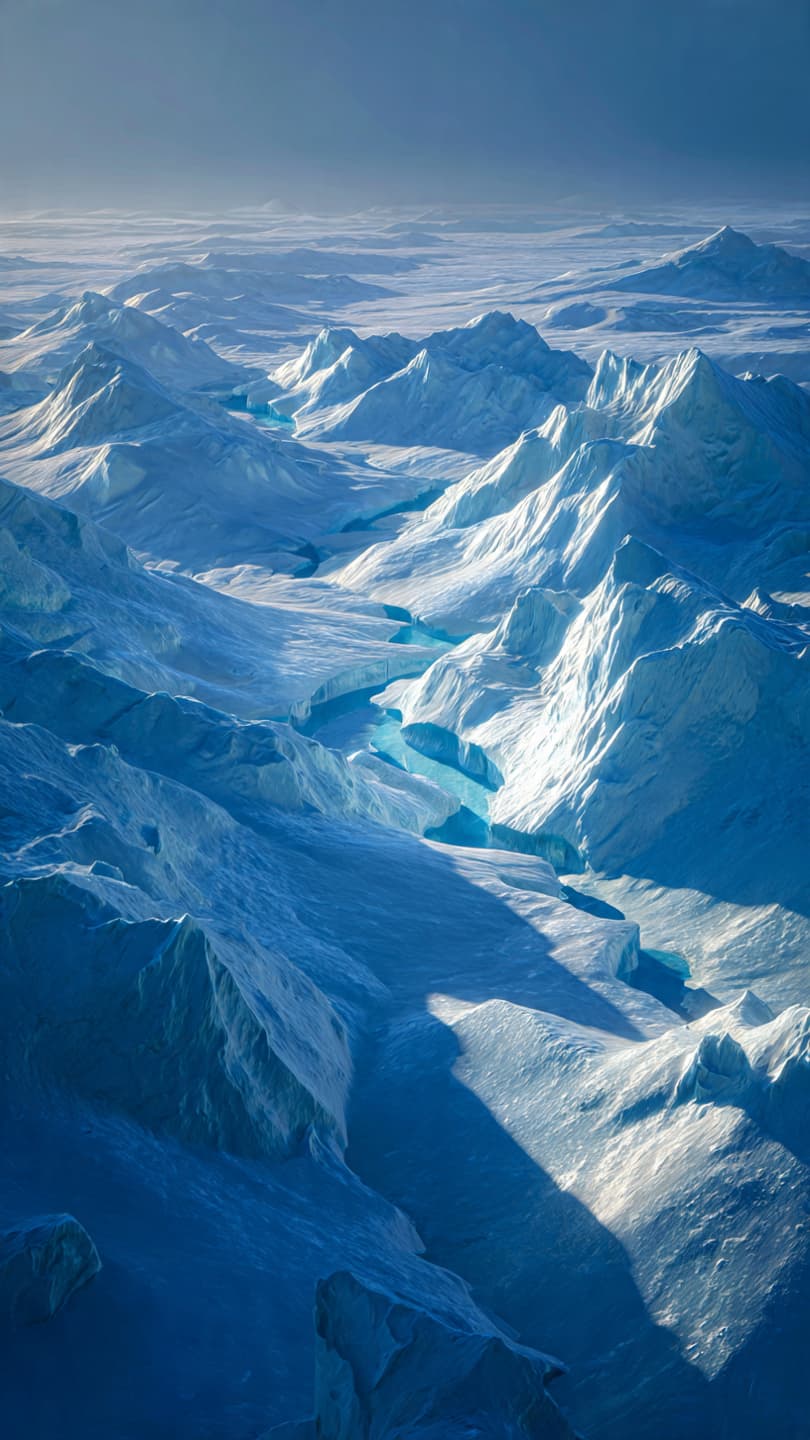
From above, Antarctica appears almost timeless.
A white expanse stretches toward the horizon, concealing a landscape that few humans have ever seen. Beneath ice that reaches more than three kilometers in thickness in some places lies a hidden world of mountains, valleys, lakes, and ancient geological scars.
Now, researchers have uncovered evidence that some of Antarctica's largest buried features are not isolated formations at all.
Instead, they are part of a vast continent-scale structure hidden beneath the East Antarctic Ice Sheet.
What Did Scientists Find? The discovery centers on a giant network of subglacial basins buried beneath East Antarctica.
Researchers found that several major features—including:
The Wilkes Basin The Aurora Basin The basin containing Lake Vostok are all connected within a single fan-shaped geological province. Scientists have named it the East Antarctic Fan-shaped Basin Province (EAFBP).
While these basins have been studied individually for years, this is the first time they have been recognized as parts of one enormous geological system.
How Big Is It? The structure exists on a continental scale.
Scientists describe it as a giant fan-shaped pattern extending beneath vast portions of East Antarctica, hidden under ice nearly two miles thick in some areas.
Its size makes it one of the largest examples of this type of geological formation ever identified within continental crust.
How Did It Form? Researchers believe the structure developed through a process known as rotational extension.
In simple terms:
Earth's crust gradually stretched apart Large basins formed as the land expanded Multiple tectonic events shaped the region The process may be linked to the formation and breakup of the ancient supercontinent Gondwana Scientists think the structure could even be related to the eventual separation of Antarctica and Australia millions of years ago.
Why Does It Matter Today? The discovery is not just about ancient geology.
The landscape beneath Antarctica's ice continues to influence how the ice sheet behaves today.
Subglacial basins can affect:
Ice movement Water flow beneath glaciers The formation of hidden lakes Ice-sheet stability Responses to climate change Understanding the shape of the bedrock below the ice helps scientists build more accurate models of how Antarctica may change in the future.
How Was It Found? Because the structure is buried beneath kilometers of ice, researchers relied on multiple scientific tools, including:
Ice-penetrating radar Gravity measurements Magnetic field data Seismic observations Geological modeling Combining these datasets allowed scientists to reconstruct what East Antarctica's landscape would look like if the ice sheet were removed.
A Wider Reflection Antarctica often appears to be a frozen continent suspended outside of time.
Yet beneath its ice lies a landscape shaped by ancient tectonic forces, vanished rivers, and geological events that occurred long before humans existed.
The newly identified basin province is a reminder that even the most familiar places on Earth can still hold profound surprises.
For decades, scientists studied these buried basins as separate pieces of a puzzle.
Now, those pieces appear to fit together into a single picture—one that stretches across a continent and reaches back hundreds of millions of years into Earth's history.
AI Image Disclaimer Images are AI-generated illustrations and are intended for visual representation only, not real-world documentation.
Source Check Scientists have identified a massive hidden geological structure beneath the ice of East Antarctica, revealing that several previously known subglacial basins are actually part of one enormous interconnected system. The newly recognized formation, called the East Antarctic Fan-shaped Basin Province, stretches across a large portion of the continent and may reshape scientists' understanding of Antarctica's geological history and ice-sheet behavior.
Published by Banx Network. This article is part of the Banx decentralized media programme, powered by the BXE token on the XRP Ledger.