In the grand tapestry of physics, few threads are as enduring as Isaac Newton’s law of universal gravitation. For three centuries, this elegant principle has described how apples fall from trees and how planets orbit stars, serving as the foundation for our understanding of motion and force. Yet, in the vastness of the cosmos, where gravity shapes the structure of the universe itself, even the most trusted laws must be continually tested. Recently, scientists have conducted the largest-scale examination of gravity to date, probing the behavior of galaxy clusters separated by hundreds of millions of light-years. The result? Newton’s law, along with Einstein’s refinements, holds firm, offering new insights into the mysterious nature of dark matter.
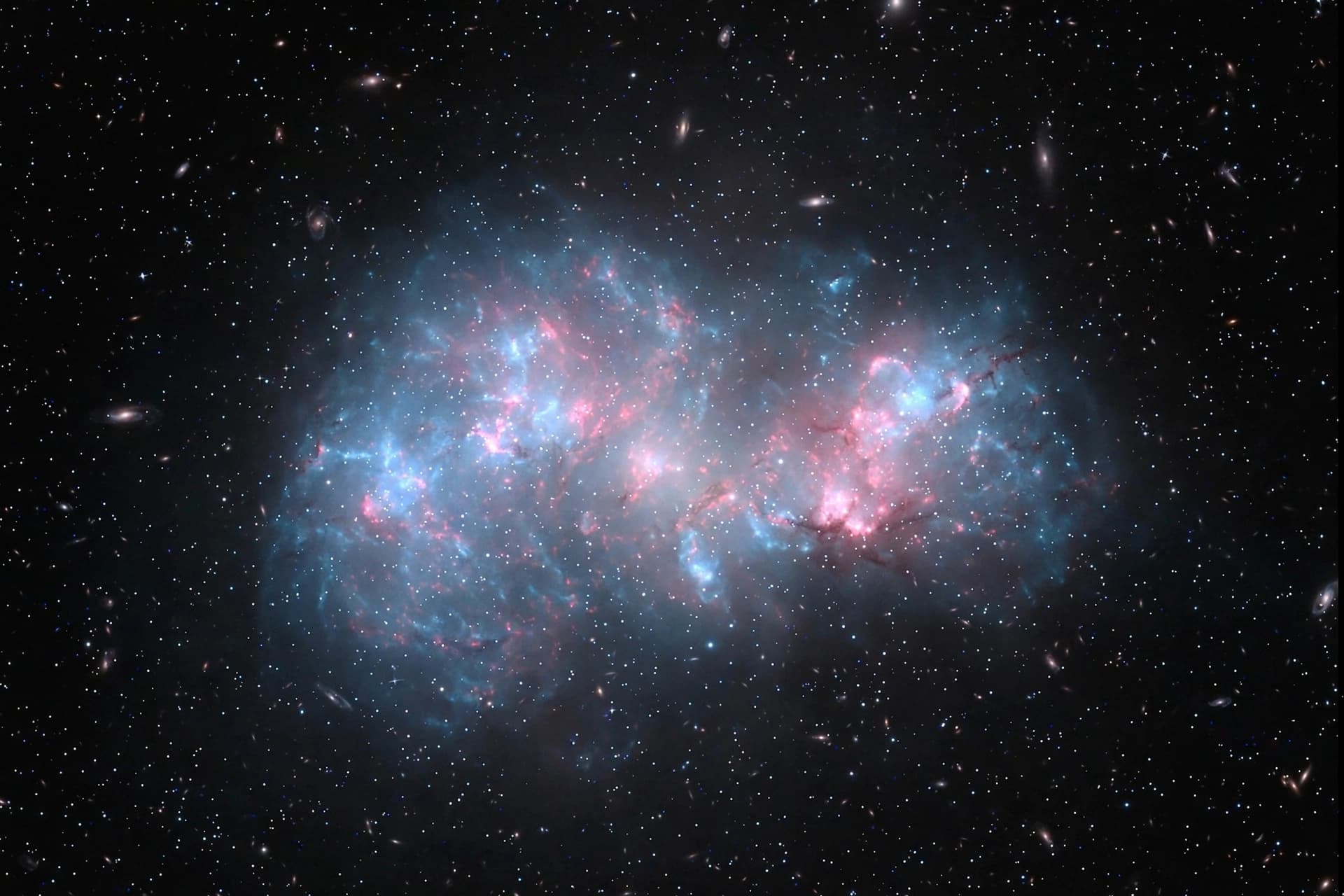
The study, led by researchers at the University of Pennsylvania, utilized data from the Atacama Cosmology Telescope to analyze the movement of massive galaxy clusters. These clusters, among the largest structures in the universe, are bound together by gravity, making them ideal laboratories for testing gravitational theories on a cosmic scale. By observing how these clusters interact and move relative to one another, scientists could determine if gravity behaves differently over vast distances than it does within our solar system.
For decades, some physicists have proposed that gravity might weaken or change its behavior at large scales, potentially eliminating the need for dark matter—an invisible substance thought to make up most of the universe’s mass. If Newton’s law failed at these distances, it could suggest that what we attribute to dark matter is actually a modification of gravity itself. However, the new findings show no such deviation. The observed motions of the galaxy clusters align perfectly with predictions based on standard gravitational laws.
This confirmation strengthens the case for the existence of dark matter. Since visible matter alone cannot account for the gravitational pull holding these clusters together, the presence of an unseen mass remains the most plausible explanation. The study provides robust evidence that dark matter is not just a theoretical construct but a real component of the cosmic web, influencing the evolution of galaxies and the large-scale structure of the universe.
The precision of modern telescopes has made such tests possible. The Atacama Cosmology Telescope, located in the high desert of Chile, offers unparalleled clarity in observing the cosmic microwave background and distant galaxy clusters. Its data allows astronomers to map the distribution of mass in the universe with unprecedented detail, revealing the subtle fingerprints of gravity at work across billions of years.
For the scientific community, this result is both a relief and a challenge. It confirms that our current models of physics are robust, but it also means that the mystery of dark matter remains unsolved. Researchers must now focus on detecting dark matter particles directly or understanding their properties through other indirect methods. The quest to identify this elusive substance continues to drive innovation in particle physics and astronomy.
The implications extend beyond academic interest. Understanding gravity and dark matter is crucial for cosmology, helping us trace the history of the universe from the Big Bang to the present day. It informs our knowledge of how galaxies form, how stars are born, and ultimately, how life-friendly environments like our own solar system come to be.
As we look deeper into space, we are also looking back in time. Each observation of distant clusters is a glimpse into the past, allowing us to see how the universe has evolved. The fact that Newton’s law holds true across such vast epochs is a testament to the universality of physical laws, connecting us to the earliest moments of creation.
Newton’s 300-year-old law has once again proven its resilience, passing its most rigorous test yet on a cosmic scale. While the mystery of dark matter persists, the stability of gravitational theory provides a solid foundation for future discoveries, guiding us as we continue to unravel the secrets of the universe.
AI Image Disclaimer: Please note that any accompanying visuals for this report are AI-generated representations intended to illustrate the context of the event.
Sources: Science Daily SciTechDaily ScienceAlert University of Pennsylvania
Published by Banx Network. This article is part of the Banx decentralized media programme, powered by the BXE token on the XRP Ledger.