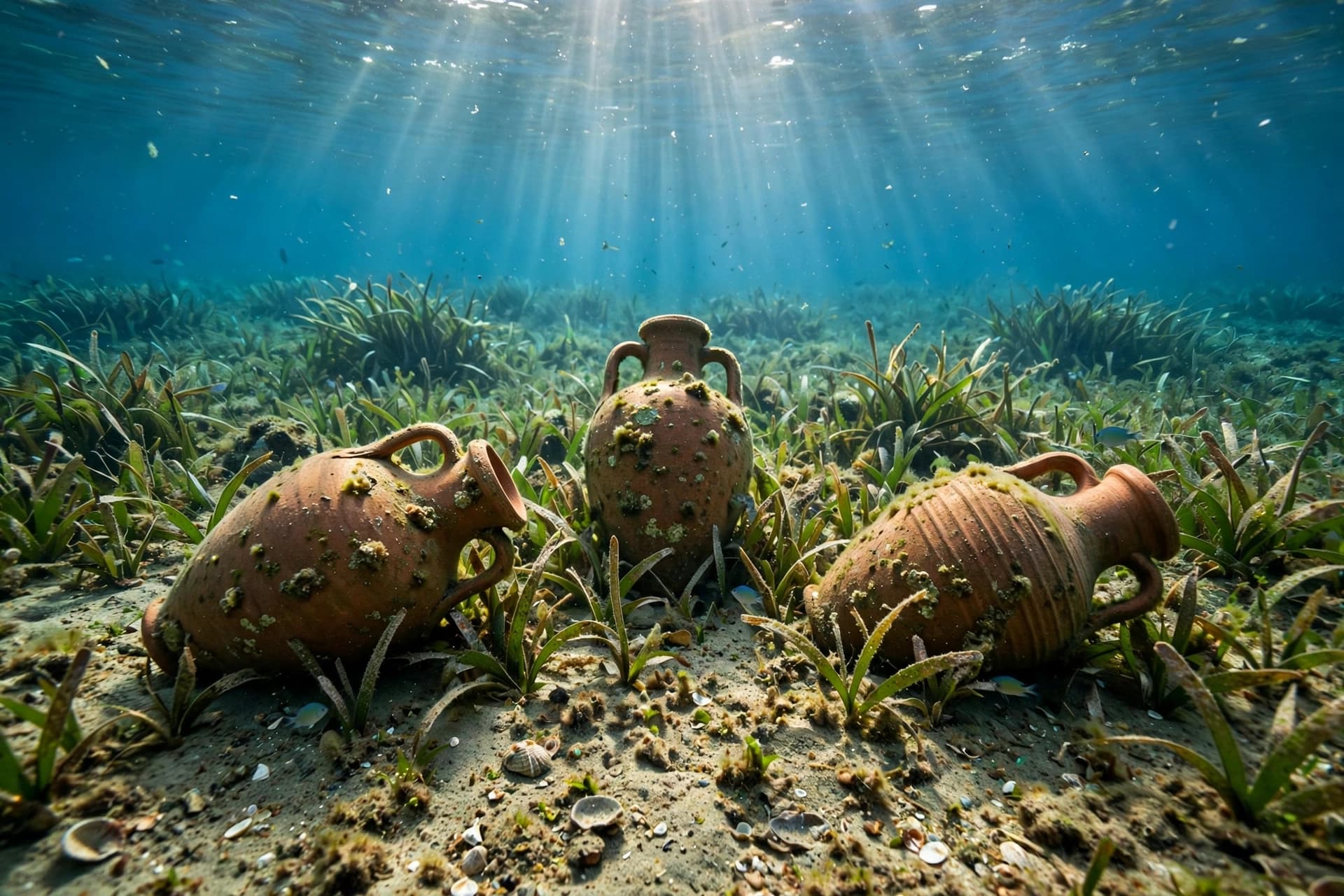
There is a quiet poetry in the way the sea keeps what we have lost—a patience that spans centuries, holding artifacts in trust until the moment someone happens to look down. For police divers conducting a routine safety operation off the coast of Sardinia, that moment arrived when a piece of broken terracotta caught their eye on the seabed. What began as a glint of something out of place led to a discovery that had rested beneath the Mediterranean for two thousand years: three intact Roman amphorae, vessels that once carried wine, olive oil, or grain across an empire .
The officers, based in Olbia, were not searching for history. They were conducting an underwater safety operation near Porto Rotondo, a coastal area on the Italian island of Sardinia, when they first noticed the fragment . That single shard prompted a second dive, and on that return, they found the vessels largely intact, their clay forms nestled among seagrass and sediment . The discovery was announced by the Sassari Police Headquarters in late August, bringing to light an encounter that seems almost accidental—the kind of find that reminds us how much remains hidden beneath the surfaces we pass over.
What makes the amphorae significant is not merely their survival but their story. These were not decorative objects but working vessels, the shipping containers of the ancient world. Amphorae transported the goods that sustained Rome—wine from Campania, olive oil from Iberia, grain from Egypt . Preliminary analysis suggests these particular vessels may date to a period spanning the second half of the 1st century B.C. to the 1st century A.D., a time that encompassed the fall of the Roman Republic and the rise of the Empire. Their origin, officials hypothesize, may lie in Lazio, Campania, or the Iberian Peninsula .
The police divers did not stop with the three amphorae. A more detailed search of the area followed, revealing additional items still awaiting classification. "Careful dredging action allowed the identification and subsequent recovery of three intact terracotta artifacts, specifically a transport basin, along with other minor items," officials said. The artifacts were recorded and made available to the competent Archaeological Superintendent for further examination .
This discovery is not an isolated one in Italian waters. Earlier this year, authorities announced the discovery of a Roman merchant shipwreck in the Ionian Sea, its cargo of amphorae still intact . And off the coast of Sicily, divers found a 2,000-year-old shipwreck piled high with hundreds of well-preserved containers, a discovery Italy's culture minister described as one of the most important underwater archaeological finds of recent years . The Mediterranean seabed, it seems, is a repository of such stories—a submerged archive of trade routes and lost cargo, waiting for the right moment and the right pair of eyes.
For the specialists now examining the Sardinian amphorae, the work ahead involves determining their precise age and origin, and assessing whether the vessels came from a larger archaeological site. If they did, more artifacts may await discovery beneath the sand and seagrass . The officers who found them returned to the surface with more than they had set out to find—not just evidence of their own vigilance, but a fragment of a world that ended long before their own began. The sea had kept its secret. It simply chose this moment to let it go.
AI Image Disclaimer: The images accompanying this article were generated by artificial intelligence and are for illustrative purposes only.
Sources: Fox Bangor, Cover Images, GreekReporter, Sassari Police Headquarters
Published by Banx Network. This article is part of the Banx decentralized media programme, powered by the BXE token on the XRP Ledger.